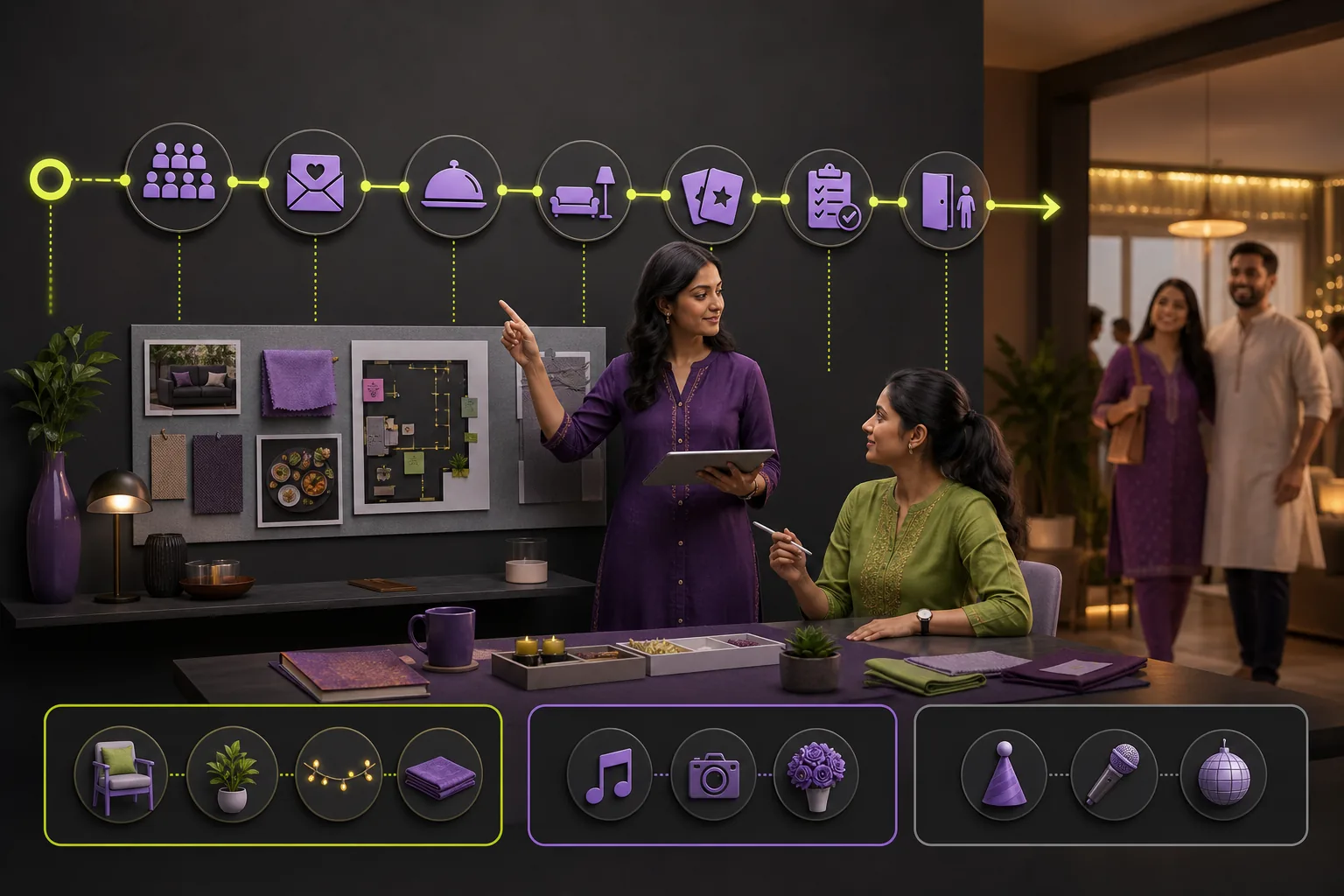
Planning a party in two days is possible when the event is small enough, the host accepts a simple format and essential services are genuinely available. It becomes stressful when the host tries to compress an eight-week plan into 48 hours without removing anything. The goal is not to create a rushed version of a large formal event. It is to create a safe, welcoming gathering with clear expectations.
This action plan works best for a home birthday, family tea, small game night, casual farewell or simple apartment gathering. A wedding-scale function, regulated event or complex public celebration needs more time, permissions and professional coordination. If the proposed guest count or venue cannot be handled safely, postpone, reduce or change the plan.
Make the go-or-no-go decision first
Before inviting anyone, confirm that the event is realistic. Ask whether you have a safe venue, an affordable total, a manageable guest count and at least one reliable helper. Check whether the date conflicts with building rules, work, travel or essential family needs.
Write the party in one sentence: “A relaxed Saturday dinner at home for 12 close friends,” or “A two-hour afternoon birthday for eight children and their parents.” If the sentence contains a large crowd, several vendors, a stage, multiple meals and elaborate decor, the scope is too ambitious for 48 hours.
Set a strict spending limit using the Party Budget Calculator. Do not pay urgent premiums with money you cannot afford. Simplicity is a planning decision, not an embarrassment.
Use the must-do, delegate and skip framework
Every task belongs in one of three columns.
Must-do tasks affect safety, access, food, water, guest communication or the central purpose. The lead host keeps visibility over them even when somebody helps.
Delegate tasks can be owned by a named reliable person. Delegation means clear responsibility, not sending a general message asking everyone to assist.
Skip tasks do not materially improve the experience within the available time. Remove them now rather than hoping for extra hours.
| Must do | Delegate | Skip when time is short |
|---|---|---|
| Confirm safe venue and guest count | Pick up a tested cake or dessert | Multiple decorative zones |
| Send clear invitation and collect replies | Prepare playlist and charge speaker | Printed invitation suites |
| Arrange safe food and drinking water | Set up one simple game | Several untested recipes |
| Prepare seating, washroom and access | Receive a known vendor | Complicated return gifts |
| Check dietary and accessibility needs | Take a short priority photo set | Long speeches and staged photos |
| Set event timing and closing | Pack leftovers and check belongings | Activities added only to fill time |
Review this table whenever the plan starts expanding.
Hour 48 to 44: lock the scope
Decide the purpose, maximum guests, location, date, start and finish time. Use the guest-count guide to ensure the group fits after furniture and food service are included.
Choose home only when it genuinely supports the list. If considering a small hall or community room, confirm the exact space, price, access and cancellation terms before inviting people. Do not pay for a venue based on photographs when no trusted person can inspect it.
Name one co-host. Share the master plan, key contacts and budget limit. If the lead host becomes unavailable, the co-host should know whether to continue or cancel.
Hour 44 to 40: send a clear invitation
Use a simple message or digital card. Include the occasion, date, start and finish, location, who is invited, RSVP deadline and a practical note such as limited parking. Do not spend hours designing animation.
Because notice is short, give guests an easy way to decline. Avoid guilt or repeated calls. Ask for dietary, allergy and accessibility information privately.
Address households clearly so accompanying adults, children or plus-ones are not ambiguous. Never invite beyond capacity because some people may be busy.
Set the reply deadline within several hours, leaving enough time to order food. Mark responses as confirmed, declined or awaiting rather than depending on memory.
Hour 40 to 36: choose the simplest complete menu
Decide whether the event includes tea and snacks, a full meal or cake and light refreshments. Match the menu to the invitation time. Use the party food planning guide to fill essential roles without excessive variety.
For a full meal, choose a focused menu: one or two starters, satisfying main options for key diets, rice or bread, a fresh element, water and one dessert. Select a reliable vendor or recipes the host has already made successfully.
Confirm the final order deadline, delivery window, service equipment, taxes and payment. Ask what happens if the guest count changes. Do not accept unverified allergy claims.
Plan visible drinking water from the start and enough refrigerator or safe holding capacity.
Hour 36 to 32: inspect the space
Walk through the actual venue. Check entrance, seating, food surface, washroom, ventilation, power and exit. At home, store private papers, medicines, valuables and fragile objects securely. Remove floor clutter.
Create only essential zones: welcome, seating, food and water, one activity area and a quieter seat. Our apartment party guide provides compact layout ideas.
Check building rules, visitor entry, lift and quiet hours. Inform immediate neighbours where appropriate. Do not assume a terrace, corridor or shared room is available.
List missing functional items before thinking about decor: chairs, glasses, serving spoons, waste bags, soap, toilet paper, extension equipment approved for the location and food containers.
Hour 32 to 28: assign named responsibilities
Keep the team small. A last-minute event becomes harder when many people make independent decisions. Assign one person each for food coordination, entrance, activity and closing where the group size requires it.
| Role | Exact task | Deadline | Backup |
|---|---|---|---|
| Co-host | Maintain master plan and make decisions | Event end | Lead host |
| Food helper | Confirm delivery, labels, utensils and leftovers | Before service | Co-host |
| Welcome helper | Door, directions, bags and water | Arrival window | Lead host |
| Activity helper | Prepare one tested activity | Two hours before | Skip activity |
| Closing helper | Lost items, waste, rentals and final check | 30 minutes before finish | Co-host |
Ask each person directly and confirm acceptance. Do not assign private guest information beyond what the role requires.
Hour 28 to 24: shop once
Create one list grouped by store section or supplier. Buy essentials and the single chosen decor concept. Reuse suitable household items instead of visiting several shops for matching objects.
Prioritize water, food ingredients or confirmed order, washroom supplies, basic cleaning items, safe serving equipment and any central celebration item. Add tape, scissors, labels and a marker to a small host kit.
Avoid browsing while shopping. Substitute a simple available option instead of travelling across the city for one decorative colour. Keep receipts and check return conditions for unopened items.
Do not purchase electrical or flame-based decor that cannot be installed and supervised safely.
Hour 24 to 20: reset and clean the useful areas
Clean the entrance, guest room, food surface and washroom. You do not need to reorganize the entire home. Close private rooms appropriately and keep emergency routes available.
Remove unnecessary furniture only with safe help. Arrange stable seating in conversational groups and preserve a clear path. Test ventilation at the expected party time.
Prepare one uncluttered focal wall using warm safe lighting, existing plants, a clean fabric or a few paper elements. The low-budget party ideas guide explains how a focused setup can feel premium.
Stop decorating when the room already looks intentional.
Hour 20 to 16: prepare what keeps well
If cooking, prepare only items that can be made, cooled, stored and reheated safely according to the recipe and reliable food-safety guidance. Label containers and clear refrigerator space. Do not leave perishable food at room temperature overnight.
Organize game materials, prizes and return gifts if they are truly part of the plan. Charge phones, power banks and speakers. Download or prepare any needed playlist without exposing personal notifications.
Set out non-food serving items and count plates, cups and cutlery. Keep them covered or protected until setup.
Get adequate sleep. An exhausted host is more likely to forget safety and become unavailable to guests.
Hour 16 to 12: confirm the final count
Follow up once with people who have not replied. Treat vague answers as unconfirmed unless your culture and relationship make a different arrangement clear. Update the food order within the vendor’s deadline.
Review dietary and accessibility notes. Reserve suitable seating and check the guest route. Confirm accompanying adults for children.
Send the location pin and one concise reminder only when useful. Include any building entry or parking instruction. Do not fill the group chat with setup updates.
Review the budget and stop new spending.
Hour 12 to 8: build the timeline
Use a short timeline with anchors: guest arrival, one central activity or celebration, food and closing. The party timeline guide shows how to add buffers without scheduling every minute.
For a three-hour casual gathering, allow arrivals and conversation, offer refreshments, hold the main game or cake, serve the meal and finish with dessert or thanks. Identify what will be skipped if arrivals or food are late.
Tell helpers the anchors and the venue finish time. Guests do not need the full internal run sheet.
Avoid placing a long game immediately before food delivery.
Hour 8 to 5: prepare one reliable activity
Choose a game suited to the space, ages and relationships. Test it. The Spin the Wheel can select players, the Team Generator can form groups and the Tambola Caller can run a no-repeat home game. Use Truth or Dare only with clear boundaries and a normal pass option.
Prepare inputs and rules. Keep the activity optional and short. Select an offline backup such as charades or Antakshari.
Do not order complicated equipment or invent a large tournament. Conversation is a valid activity.
Hour 5 to 3: set functional zones
Place seating, food surface, water, waste bin and welcome area first. Test the route while carrying an empty plate. Keep the washroom and exits clear. Protect children from balconies, hot food and sharp objects.
Set up the simple focal decoration and test lighting. Secure cables along approved safe routes. Keep speakers away from shared walls.
Prepare the washroom with soap, toilet paper, hand-drying supplies and a covered bin. Remove medicines and personal items.
Brief helpers about private rooms, first aid, water and closing responsibilities.
Hour 3 to 1: receive food and complete checks
Confirm delivery contents, condition, labels and utensils before completing payment. Store or hold food safely. Set out only suitable quantities and refill in smaller batches where practical.
Test sound, digital tools and charging. Put the phone used for music or games in a privacy-safe notification mode. Keep a printed or simple offline contact list.
Walk from entrance to washroom and exit one final time. Remove boxes, shopping bags and cleaning equipment from guest areas.
Stop non-essential work at least 30 minutes before arrival.
Final 30 minutes: reset the host
Change, drink water, eat something appropriate and review the first two actions only: welcome guests and make water available. A calm host creates a more premium feeling than another layer of decoration.
Place payment methods and valuables securely. Give the co-host a short update. Turn on suitable lighting and music.
If something essential is still missing, choose the simplest safe replacement. If only decoration is missing, leave it missing.
During the party: protect the anchors
Welcome people, then allow the opening to breathe. Monitor food, ventilation, seating and noise. Do not force the activity if conversation is working well.
Protect the core moment, meal and closing time. Shorten repeated photos, extra game rounds and speeches first. Handle small issues privately. Pause unsafe behaviour immediately.
The complete party host checklist provides the event-day operating process, including payments and leftovers.
Close deliberately
Stop launching long activities about 30 minutes before the finish. Prepare dessert, return gifts if any, transport and belongings. Lower music and begin natural thanks.
Store leftovers using safe guidance and label them. Check washroom, charging points and seating for lost items. Count borrowed or rented items and save receipts.
Do only urgent hygiene and safety cleanup while tired. Schedule the remaining work for the next day.
What to skip without guilt
- Multiple coordinated outfits
- Several decorative walls
- Untested recipes
- Printed menus and signs for a small home event
- Long formal speeches
- More than one main game
- Complicated return gifts
- Photo combinations that delay food
- Shopping trips for a perfect colour match
- Any feature that compromises sleep, budget or safety
Guests were invited to share time, not audit a production checklist.
Frequently asked questions
Can I plan a birthday party in two days?
Yes, when the group and format are manageable. Use a safe familiar venue, simple invitations, a focused menu and one central celebration. Reduce scale rather than rushing complex elements.
What should I book first?
Confirm the venue and guest capacity first, then food and any essential central item. Do not book decor before knowing the space, count and budget.
How do I make a last-minute party look planned?
Keep the room clean, use one coordinated focal point, arrange clear zones, serve a focused menu and communicate timing confidently. Consistency looks intentional even when the setup is simple.
What if a vendor cancels?
Use the backup decided in advance: a simpler local food order, existing home items or removal of the optional feature. Document deposits and follow the contract, but protect the guest experience from public conflict.
Final takeaway
The key to a good 48-hour party is subtraction. Confirm a realistic scope, protect safety and food, assign a few named responsibilities and remove anything that requires uncertain time, money or skill. Use one clean focal point, one reliable activity and a short timeline. When the essentials are ready and the host is calm, guests experience the event as thoughtful—not last-minute.