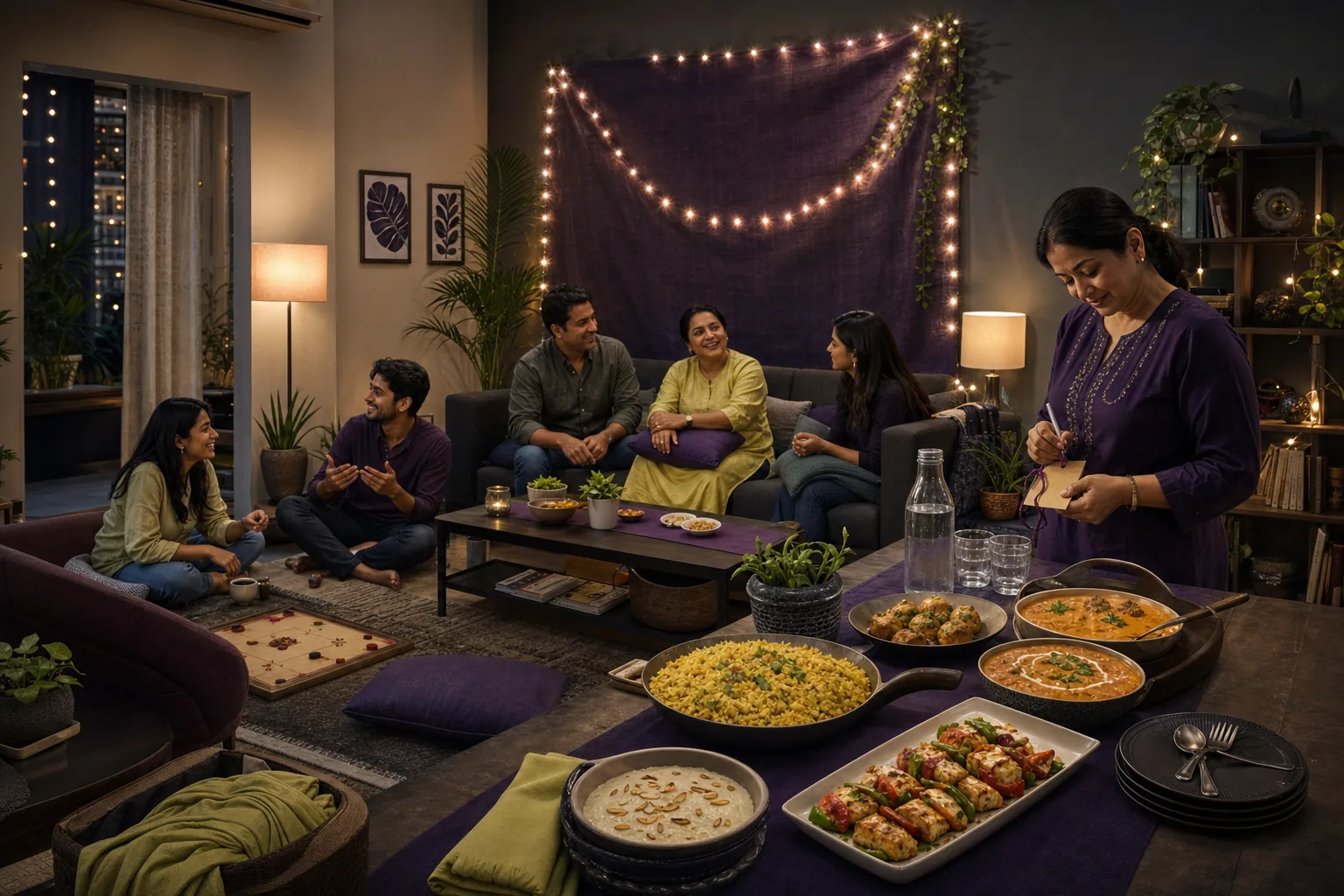
A premium-feeling party is not the same as an expensive party. Guests usually notice whether the space is comfortable, the host is present, food arrives at the right time and small details make sense. They do not know the price of every decoration, and they rarely need ten dishes or a large rented backdrop to feel welcome.
Budget parties become disappointing when the host tries to imitate a high-cost event with cheaper versions of everything. The result can be clutter, rushed food and financial stress. A better approach is to choose a few priorities, execute them well and remove anything that does not improve the guest experience. This guide explains how to do that for birthdays, family gatherings, game nights, kitty parties and casual celebrations.
Set the spending limit before collecting ideas
Decide the maximum amount you can comfortably afford without depending on debt or an uncertain contribution. Then divide it into essential categories: food and water, venue or home setup, guest comfort, activity, decoration and contingency. Use the Party Budget Calculator to test the total and our party budget guide to identify hidden costs.
Do not begin with shopping apps. Attractive low-priced items can become expensive when dozens are added. Write the plan first and purchase only what has a clear purpose.
Keep a modest contingency for unavoidable changes. It is not an extra decoration budget. If the main estimate already reaches the maximum, simplify before inviting people.
Choose three priorities
Ask what guests should remember. A birthday may prioritize a favourite meal, good photos and relaxed conversation. A game night may prioritize comfortable seating, one excellent main game and easy snacks. A family lunch may prioritize accessibility, familiar food and time together.
Choose only three priorities and give them most of the attention. Everything else should be simple. This prevents the budget from being divided across details that nobody experiences properly.
Examples of useful priorities:
- Fresh, well-timed food
- Comfortable seating and ventilation
- One personal decoration or photo area
- A meaningful cake or dessert
- Fun, inclusive games
- Good lighting and a clean background for photos
- Easy transport or parking guidance
The priorities should match the group, not current trends.
Save-versus-spend decision table
| Category | Usually worth protecting | Good place to simplify | Avoid |
|---|---|---|---|
| Food | Safe preparation, enough water and a complete meal | Fewer dishes with better balance | Ordering many similar items for display |
| Venue | Safe capacity, washrooms and accessibility | Host at home when the group genuinely fits | Crowding a small room only to avoid rent |
| Decor | One coordinated focal point and good lighting | Reuse fabric, plants and existing furniture | Buying many single-use themed pieces |
| Entertainment | Clear rules and suitable activities | Use free browser tools and host-led games | Paying for activities the group may not enjoy |
| Photography | Clean light and a short priority photo list | Ask a capable friend with consent | Forcing long photo sessions |
| Invitations | Clear date, time, location and RSVP | Use a simple digital invitation | Expensive printing for a casual event |
| Return gifts | Useful or personal item if genuinely wanted | A handwritten note or no gift | Cheap clutter given only from obligation |
This table does not say professional services lack value. It helps you protect what matters when the budget is limited.
Keep the guest list intentional
Guest count is one of the strongest cost controls. A smaller list reduces food, seating, gifts and venue pressure. Invite people who fit the purpose rather than everyone in your contact list. Use the guest-count capacity guide before sending invitations.
Do not invite extra people because you expect declines. Plan within safe capacity even if everyone accepts. Communicate household and plus-one limits politely and consistently.
A smaller gathering can feel more generous because the host has time for each person and food service remains calm. Intimacy is not a failure of scale.
Host at home only when home truly works
Home can remove venue rent and create a personal atmosphere, but it is not automatically free. Count furniture rental, cleaning, cooling, serving equipment, deliveries and household disruption. Check washrooms, neighbours, parking and usable space.
Our home party vs banquet hall comparison helps calculate the complete trade-off. If the group does not fit safely, reduce the list or choose a modest community room instead of forcing a crowded home setup.
Use existing rooms as zones. One area handles arrival and bags, another conversation, and a separate surface holds food and water. Moving a few pieces of furniture can improve the experience more than buying decor.
Use lighting as the main decoration
Lighting changes a room more effectively than many small objects. Use existing warm lamps, safe string lights and candles only where flames are permitted and supervised. Avoid loose wires across walking routes and never cover hot fixtures.
Turn off harsh unused lights, but keep stairs, entrances, food and washrooms clearly illuminated. A dark room may photograph dramatically but is not comfortable or accessible.
Test the lighting at the event time. Daylight plans can fail after sunset. If using string lights, check every section and power source in advance.
Build one simple focal area
Choose one wall, table or corner for the main visual moment. Use a clean existing curtain, a reusable fabric, a few paper shapes, family photos, flowers from a suitable local source or potted plants already in the home. Repeat two or three colours rather than mixing every decoration available.
Leave negative space. A crowded backdrop often looks cheaper than a simple one. Hide packaging, extra tape and storage boxes before guests arrive.
Do not attach heavy items without correct hardware or venue permission. Keep decorations away from exits, fans, flames and electrical equipment.
Reuse household items deliberately
Trays, glass jars, baskets, table runners, cushions and plants can create a coordinated setup when they share a palette. Reuse should look intentional, not like every available object was placed in the room.
Select items, clean them and assign a function. A basket can hold napkins; matching jars can hold safe LED lights; framed family photos can tell the occasion’s story. Return objects to their normal use afterward.
Avoid buying disposable “reusable” items that have no future purpose. The most sustainable decoration is often something already owned.
Plan a focused menu
Food quality and timing matter more than variety. Use the party food planning guide to create a balanced menu with one or two starters, complete main options, a starch, fresh contrast, water and a modest dessert. Adjust for your group and event.
Choose dishes that share ingredients without tasting identical. This simplifies purchasing and preparation. Use recipes you have cooked successfully rather than experimenting with several unfamiliar items on the event day.
Serve in smaller refill batches where safe and practical. A neat, fresh tray feels more premium than a large container left exposed. Keep drinking water visible from arrival.
Use a signature item instead of a long menu
One memorable homemade drink, family recipe, snack station or dessert can give the event identity. It should be reliable, suitable for the group and easy to serve. Do not call it “signature” on a printed sign unless the label adds value; the experience can speak for itself.
Pair the special item with simple supporting food. If the host is cooking, choose something that can be prepared safely without spending the entire party in the kitchen.
For serious allergies or dietary needs, never rely on a decorative label alone. Confirm ingredients and preparation limitations honestly.
Make water and basic comfort look cared for
Create a clean water station with glasses, napkins and a refill plan. Keep it away from crowded electrical areas. Provide a covered waste container nearby but not directly beside food.
Check soap, toilet paper, hand-drying supplies, room temperature and stable seating. Reserve seats for older guests and anyone who needs one. These basics cost little compared with decorative upgrades and affect every person.
Place a small basket with tissues and simple useful supplies in the washroom. Avoid displaying medicines or personal items.
Use free digital party tools
Entertainment does not need rented equipment. The Spin the Wheel can choose players or activities, while the Team Generator creates quick random groups. Use Truth or Dare with a clear pass rule and age-appropriate mode. For a family Tambola round, the Tambola Caller provides a no-repeat call history.
Test the device, charger, internet connection and screen visibility before guests arrive. Prepare inputs in advance. Keep an offline backup such as charades, Antakshari or a conversation round.
Free tools are useful only when the activity suits the group. Do not add games merely to fill the timeline.
Create personal entertainment
A short memory quiz, photo guessing game or playlist built from guest suggestions can feel more thoughtful than generic paid entertainment. Keep private or embarrassing stories out of public games unless the person has clearly agreed.
Ask guests for one song before the event, then create a focused playlist. Check volume so conversation remains possible. Avoid letting one person control music from an unlocked personal phone containing private notifications.
For milestone occasions, display a small sequence of photos or notes instead of printing dozens of decorative boards.
Make simple invitations useful
A digital invitation needs clarity more than animation. Include the occasion, date, start and finish time where relevant, location, who is invited, RSVP deadline and any practical note such as parking or footwear. Use readable contrast and a familiar font.
Do not send a large video when a simple image or message is easier for guests to access. Avoid publicly sharing the home address or guest phone numbers.
One polite reminder near the RSVP deadline is more useful than repeated promotional-style messages.
Borrow and rent with a checklist
Borrowing chairs, vessels or lights can save money, but record the owner, quantity, condition and return date. Do not assume relatives are comfortable lending valuable items. Clean and return everything promptly.
Rental can be better than buying when the object is large, rarely used or hard to store. Compare delivery, deposit, setup, damage and collection costs. Count items during handover.
Never use borrowed electrical equipment without checking suitability and safe installation.
Avoid false savings
Some cheap choices create more cost later. Too few helpers can lead to overtime. A distant low-rent venue can increase transport. Unreliable food may need last-minute replacement. Flimsy decor can damage walls or become waste.
Evaluate total cost and risk, not sticker price. Spend enough for safety, food handling, capacity and accessibility. Remove optional features instead of compromising essentials.
The cheapest plan is not the one with the smallest initial payment; it is the plan that works without preventable emergency spending.
A sample limited-budget allocation worksheet
Use percentages only as a starting conversation. Enter actual local prices and adjust for your priorities.
| Category | Planned amount | Why it matters | Simplification if over budget |
|---|---|---|---|
| Food and water | ___ | Core guest comfort | Reduce variety, not safe quantity |
| Venue or home setup | ___ | Capacity and basic infrastructure | Reduce list or use existing furniture |
| Decor and lighting | ___ | Atmosphere and focal point | Use one reusable setup |
| Activities | ___ | Participation and energy | Use free tools and host-led games |
| Cake or special item | ___ | Occasion moment | Choose smaller size and serve another simple dessert |
| Transport or service | ___ | Smooth operation | Consolidate deliveries |
| Contingency | ___ | Real unexpected needs | Protect; do not spend early |
Review the final number before invitations. Do not hope later gifts will repay party spending.
Add one meaningful handmade detail
A handwritten place note, a small photo for each close guest, a family recipe card or a sincere thank-you can make the party personal. Choose one detail you have time to complete neatly. Forty rushed handmade objects are not more thoughtful than ten careful ones for a smaller group.
Avoid giving items that expose private jokes or personal information. For children, use safe age-appropriate materials and adult supervision.
Meaning comes from relevance, not from labelling something as handmade.
Keep the timeline short and confident
An overfilled schedule increases costs because every activity needs materials, prizes or food timing. Use the party timeline guide to choose an arrival period, one central activity or celebration, the meal and a calm closing.
Leave time for conversation. Guests do not need constant entertainment. A shorter event can also reduce venue, staffing and late-night transport costs.
Protect the main moments and identify optional items before the day.
Frequently asked questions
How can I make a cheap party look elegant?
Clean and organize the space, choose two or three colours, use warm safe lighting, create one uncluttered focal point and keep food and water stations neat. Consistency matters more than quantity.
What should I never cut from a party budget?
Do not compromise safe capacity, accessible routes, safe food and water, basic washroom supplies or necessary supervision. Simplify decoration, variety and optional entertainment first.
Is it rude to skip return gifts?
No. Return gifts are optional unless a particular cultural or family context strongly expects them. A warm thank-you, shared memory or useful small item can be more appropriate than inexpensive clutter.
Can I ask guests to contribute food?
A potluck can work when it is part of the agreed format, not a surprise cost transfer. Coordinate dishes, allergies, transport and food safety, and make participation genuinely optional where appropriate.
Final takeaway
A thoughtful low-budget party protects comfort, food, safety and personal connection while simplifying everything else. Set the limit first, choose three priorities, keep the guest list intentional and build one coordinated visual moment. Use a focused menu, free tools, existing household items and a clear timeline. Premium does not mean abundant decoration or endless choice. It means each visible decision feels deliberate and the host has enough space—financially and emotionally—to enjoy the people who came.