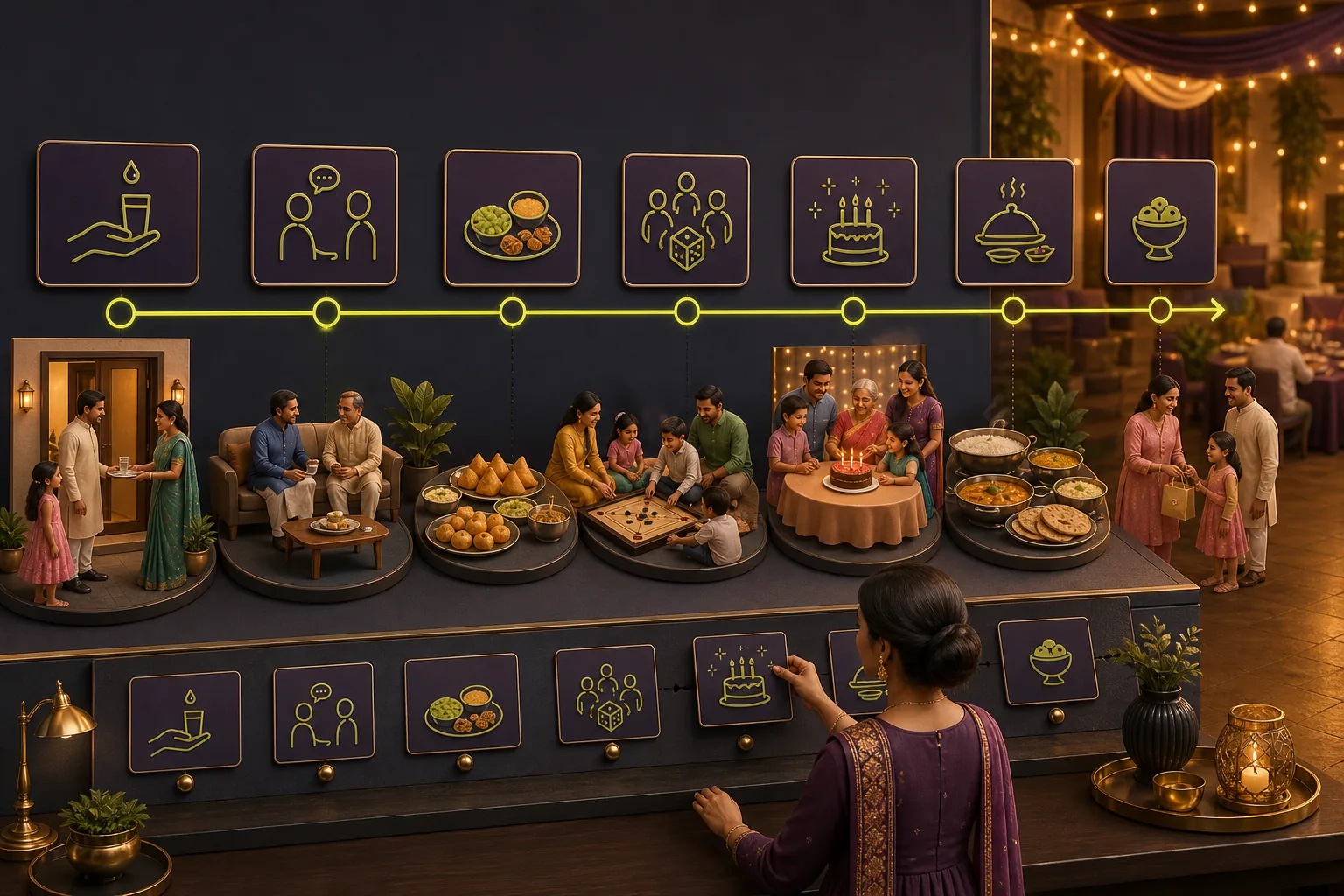
A party timeline should reduce waiting and confusion without making guests feel managed. The worst schedules usually fail in one of two ways. Some contain no structure, so food opens late, games interrupt conversations and the main celebration happens after guests begin leaving. Others plan every five minutes, leaving no room for delayed arrivals, children, meaningful conversation or a vendor who needs extra setup time.
The useful middle ground is a flexible flow built around a few fixed anchors. Guests know what is happening, important moments occur on time and optional activities can expand or shrink according to the room. This guide shows how to build that flow for home parties, birthdays, family lunches, kitty parties, office events and casual game nights.
Start with the event’s fixed anchors
Anchors are moments that cannot move easily. Common anchors include venue access, the stated guest start time, a meal service, a cake or ceremony, a performance, transport and the required finish time. Vendor arrival and hall closing are also anchors when a contract sets them.
Write these first. Do not begin with games or decoration. If a hall must close at 10:00 p.m., the main meal cannot sensibly begin at 9:50. If a child party ends before evening traffic, the cake and return-gift process must happen early enough.
For every anchor, note:
- the earliest possible start;
- the latest acceptable start;
- who controls it;
- what must happen immediately before it;
- what can be removed if the event falls behind.
This creates a schedule that can recover rather than collapse.
Define the guest experience in three phases
Most social events feel natural when they have an opening, a central period and a closing.
The opening helps people arrive, settle, find water and understand the room. Avoid starting the most important activity immediately at the invitation time because arrivals are rarely simultaneous. Offer a simple welcome element and make seating obvious.
The central period contains the meal, celebration, games or main purpose. Alternate active and relaxed moments. Several high-energy activities in a row can exhaust the group, while a long unbroken meal may leave children restless.
The closing provides a final shared moment, dessert or thanks, then allows people to leave without uncertainty. A party that simply fades can create awkwardness and transport delays.
Estimate arrival realistically
The invitation time should mean the event is ready, not that setup is still happening. Guests may arrive across a window because of traffic, family routines or work. The size of that window depends on the group and occasion, so use past experience rather than a universal assumption.
Plan a welcome activity that people can join or leave easily. Light conversation prompts, a photo corner, simple snacks or an open Spin the Wheel for casual choices can work. Do not use a game where late arrivals disturb teams or scoring.
Keep the main entrance clear and assign a greeter during the busiest period. The host should circulate rather than stay trapped at the door.
Work backward from the finish time
Backward planning protects the final hour. Begin with when guests and vendors must leave. Then place the closing, dessert, main meal and central activity before it with realistic gaps. This reveals whether the event contains too many items.
For example, if a hall closes at 10:00, vendors need 30 minutes to remove equipment and guests need 20 minutes to leave, the public program should not continue until 9:55. A closing announcement around 9:20 or 9:30 may be more realistic depending on the event.
At home, the absence of a rental deadline does not mean unlimited time. Consider neighbours, public transport, children and the host’s energy. State an expected finish when it helps guests plan.
Build buffers where delays actually happen
A buffer is not empty wasted time. It is protection around uncertain transitions. Food delivery, outfit changes, group photos, stage setup and moving a large crowd often take longer than expected. Place extra minutes around those points rather than padding every activity equally.
Do not announce the buffer as an item. Guests experience it as conversation, refreshments or an easy transition. The organizing team knows it is available for recovery.
Useful buffers include:
- vendor access before guests arrive;
- 15 to 30 minutes after the stated start before a major activity;
- movement time between floors or rooms;
- claim verification in Tambola;
- serving time before speeches or games;
- a closing margin before venue handover.
If the event runs on time, let the buffer become relaxed social time.
A flexible three-hour sample timeline
This sample suits a casual birthday or family gathering. Adapt it rather than copying it blindly.
| Event minute | Guest experience | Host action | Flexible range |
|---|---|---|---|
| 0 to 25 | Arrival, water, light welcome snacks and conversation | Greeter handles entrance; host circulates | Extend by 10 minutes if important guests are delayed |
| 25 to 40 | Short welcome and easy group activity | Explain participation is optional | Skip activity if conversation is already lively |
| 40 to 75 | Starters, mingling or open activity stations | Monitor food and seating | Protect at least 25 minutes |
| 75 to 100 | Main shared game, cake or celebration moment | Gather guests with a clear transition | Move earlier for children or older guests |
| 100 to 140 | Main meal | Keep water and dietary options visible | Do not rush eating |
| 140 to 160 | Dessert, photos or final light game | Begin quiet closing tasks | Select only one option if behind |
| 160 to 180 | Thanks, return gifts and departures | Check transport and belongings | Protect venue finish time |
The table intentionally includes choices. A timeline is stronger when optional items are identified before the party.
Match food timing to the invitation
Guests interpret food expectations from the time and wording of the invitation. If an event overlaps a normal meal period, provide a suitable meal or communicate the format clearly. Do not keep hungry guests waiting for a photo session or game that can move.
Coordinate with the caterer using the party food planning guide. Confirm delivery, holding, serving and refill times. Opening starters too early may reduce demand for the main meal; opening them too late can create a rush.
Keep drinking water available from arrival to departure. It should never depend on the formal food opening.
Schedule games by energy, not just duration
Different activities ask different things from guests. An icebreaker needs low pressure. A team game needs attention and movement. A conversation game needs enough quiet for people to hear. Place games where the group’s energy supports them.
Start with a short, optional activity. Put the main game before a heavy meal or after guests have had time to settle. Avoid complicated rules when food service is beginning. End with something easy to pause.
For group selection, use the Random Name Picker or Team Generator after preparing the list. Random groups are useful for casual play, but the host may adjust them when mobility, age or skill balance requires care.
If using Truth or Dare, explain the pass rule and boundaries before the round. A timeline never justifies pressuring someone to participate.
Give the main celebration enough space
A cake, announcement, ceremony or performance needs setup, guest gathering, the moment itself and a transition afterward. Hosts often schedule only the visible part. Moving 40 people into position and distributing cake may take longer than the song or speech.
Assign one person to prepare required items and another to guide guests. Check candles, lighter alternatives, microphone, serving plates and camera placement before announcing the moment. Keep flames and electrical equipment under appropriate adult supervision.
Do not repeat a long group photo process for every combination. Create a short priority list and allow casual photos later.
Use clear and respectful transitions
A transition tells guests what is changing. It can be one sentence: “Food is now open in the next room,” or “In five minutes we will begin Tambola for anyone who wants to join.” Give people enough information to decide without making them feel ordered.
Use the microphone only when the group and venue require it. Repeated loud announcements can disrupt conversation. For small gatherings, ask a few helpers to spread the message naturally.
Avoid surprise participation. Tell guests before calling them to a stage, speech or game. People may have accessibility, privacy or anxiety reasons for declining.
Prepare a simple run sheet for helpers
The guest-facing invitation remains simple. The internal run sheet contains operational detail.
| Time | Public activity | Behind-the-scenes task | Owner | Backup decision |
|---|---|---|---|---|
| ___ | Guest arrival | Check water, entrance and seating | ___ | Open overflow seating |
| ___ | Welcome | Prepare first activity | ___ | Skip if arrivals are late |
| ___ | Starters | Confirm main meal readiness | ___ | Delay game, not food safety |
| ___ | Main moment | Prepare plates, prizes or microphone | ___ | Shorten photos |
| ___ | Main meal | Begin leftovers and vendor check | ___ | Refill priority items |
| ___ | Closing | Transport, gifts and lost items | ___ | Remove final optional game |
Keep the sheet to one page when possible. The complete party host checklist provides the wider setup and closing process.
Create versions for different event types
Children’s birthday
Keep the event shorter and place the main activity and food before children become tired. Alternate movement with calmer time. Build in handwashing, washroom and parent-communication time. Avoid a late cake moment if young guests leave early.
Family lunch
Allow a generous arrival and conversation period. Serve older guests and children according to need rather than waiting for a perfect group moment. A short game can sit before or after lunch, but should not delay food.
Kitty party
Plan welcome refreshments, one easy mixer, the central games, meal or snacks, and prizes. Prepare materials in separate labelled sets. Use a visible but flexible order so conversation remains important.
Game night
Start with rules and a short game, then move to the main activity. Place food where it does not damage equipment. Include a backup game for a different group size and a clear last round.
Office party
Respect work schedules, transport and different comfort levels. Keep formal messages concise, label optional activities and avoid placing all networking at the beginning when people may arrive alone. Remote or hybrid participation needs separate technical rehearsal.
Tambola gathering
State winning patterns before the first call, allow time for claims and keep the Tambola Caller visible. Do not schedule the final prize after the meal if many guests may leave early.
Know what to shorten first
Decide the priority order before delays occur. Protect safety, core ceremony, food, transport and venue rules. Shorten decoration photos, repeated speeches, extra game rounds and optional performances first.
Never recover time by rushing guests while eating, ignoring an accessibility need or skipping a safety check. A shorter party can still feel complete when the opening, central moment and closing remain clear.
Use simple phrases among helpers: “Plan B means one game only,” or “If food is 20 minutes late, move photos forward.” Pre-agreed decisions reduce debate during the event.
Watch the room instead of the clock alone
The schedule is evidence, but the guests are stronger evidence. Notice whether people are still arriving, whether children are restless, whether older guests need food, whether the noise level prevents conversation and whether an activity is losing energy.
Assign one person to monitor the timeline while the lead host watches people. This prevents the host from checking a phone every few minutes. The timeline helper can give private five-minute reminders.
Change the schedule for a clear reason, then communicate the new transition. Constant changes create more confusion than a modest delay.
Plan the closing as carefully as the opening
Begin closing tasks before the final minute. Stop launching long activities, prepare return gifts, identify leftover containers and check transport. Offer a final shared moment such as dessert, thanks or a group photo.
Tell guests the event is concluding without making them feel pushed away. At a hall, respect the contracted finish. At home, lower music and begin natural goodbyes. Keep a helper near the belongings area to reduce lost items.
After the public close, vendors and helpers still need time. The run sheet should include cleanup, rental count, payment approval, food storage and venue handover.
Common timeline mistakes
Planning from the invitation time forward only
Work backward from the required finish so the final meal and closing are protected.
Treating every item as compulsory
Label optional activities before the party. Otherwise the host tries to force a full plan into reduced time.
Forgetting movement and setup
Gathering guests, changing rooms, serving plates and checking equipment all require time.
Starting high-pressure games immediately
Allow arrivals and low-pressure conversation first. People participate more comfortably after settling.
Letting photos delay food
Take priority photos efficiently and protect meal timing, especially for children and older guests.
Frequently asked questions
How long should a home party last?
The appropriate duration depends on the occasion, meal, ages, neighbours and activities. Many casual gatherings fit within a few hours, but communicate the expected timing and build the schedule around real guest needs rather than a universal rule.
Should the invitation include the finish time?
Include it when venue access, transport, children’s routines or neighbour considerations make the boundary useful. Clear timing helps guests plan and is not impolite.
How many games fit in a three-hour party?
Usually fewer than hosts expect. One easy welcome activity and one main game may be enough when food, conversation and a celebration moment are also included. Choose quality and participation over quantity.
What should I do when the party is running late?
Protect food, safety, the core celebration, transport and venue closing. Remove or shorten optional games, speeches and repeated photos. Tell helpers the revised plan privately and give guests a clear transition.
Final takeaway
A guest-friendly party timeline has fixed anchors, flexible activities and buffers at uncertain transitions. Work backward from the finish, give arrivals room, protect food and the main celebration, and decide in advance what can be shortened. Use a one-page run sheet for helpers while keeping the guest experience natural. The goal is not to make every minute happen exactly as written. It is to make sure the event has a welcoming beginning, an enjoyable centre and a calm ending even when real life changes the plan.