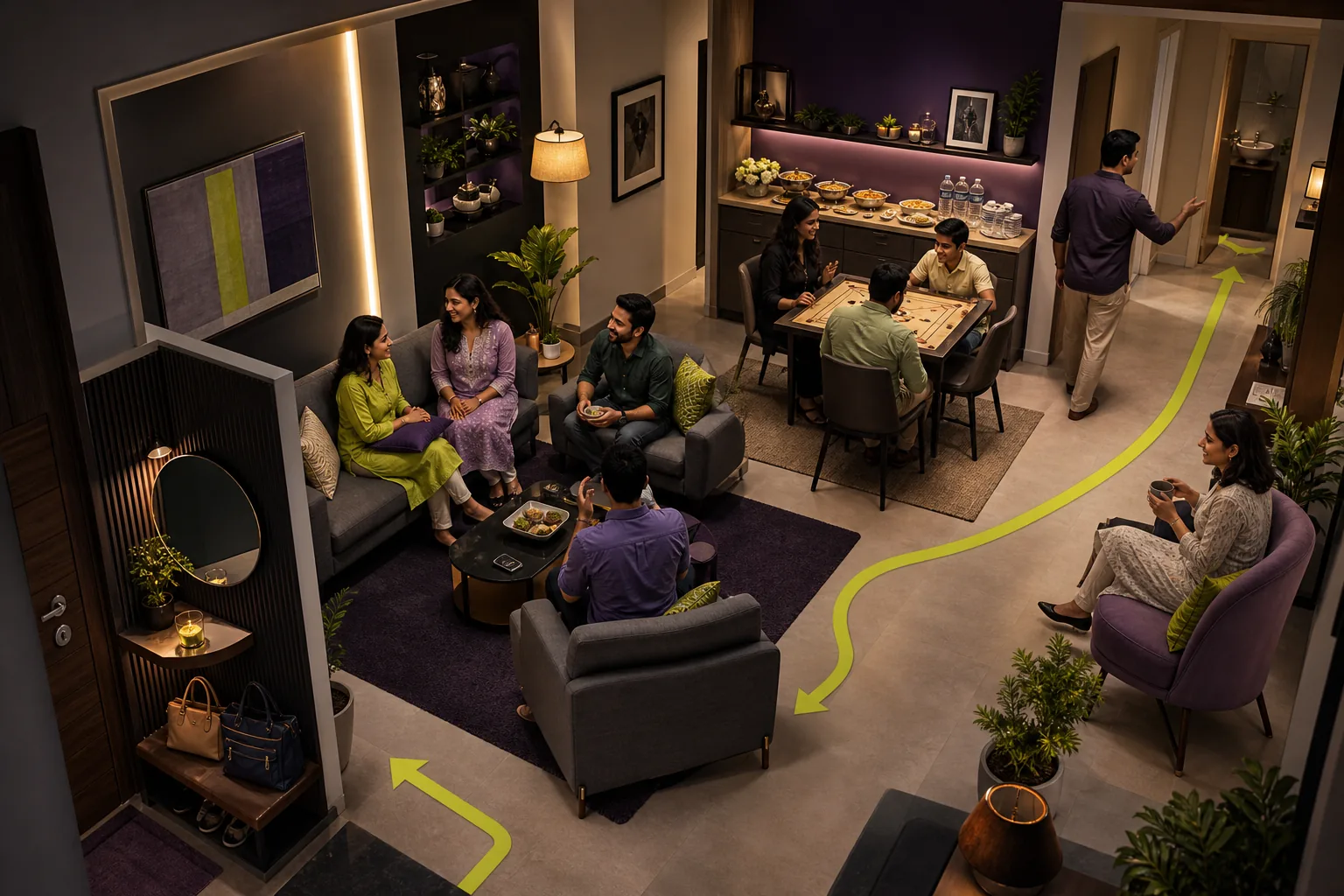
A small flat can host a warm, memorable party when the plan respects the space. Problems begin when a host treats an apartment like a compressed banquet hall: too many guests, too much furniture, a buffet in the main walking route and music that ignores shared walls. The solution is not to remove all comfort or invite nobody. It is to design the gathering around what the home can genuinely support.
Apartment parties work especially well for birthdays, game nights, kitty parties, family tea, small festive gatherings and relaxed dinners. This guide explains how to choose the guest count, create useful zones, handle food and games, communicate with neighbours and protect the home without making guests feel restricted.
Begin with the apartment’s real capacity
Do not count total bedrooms or advertised square footage. Count only the rooms and floor area guests will actually use after furniture, the food station and personal belongings are included. Private bedrooms, a busy kitchen and storage corners are not party capacity.
Use the process in our guest-count guide. Place the expected furniture, then walk from the entrance to seating, water and the washroom. Ask another person to stand in the route. If movement already feels awkward, reduce the list or change the layout.
The right number allows guests to sit in mixed groups, move without squeezing past several people and reach an exit easily. Never invite beyond safe capacity because you expect declines.
Check building and society rules early
Apartment buildings may regulate visitor entry, parking, lift use, terraces, common areas, deliveries, music and quiet hours. Read the rules or speak with management before sending invitations. Ask whether guest names must be shared with security and provide only required information.
Do not assume a clubhouse, roof or corridor can be used because it appears empty. Common areas usually need permission and may have separate safety limits.
Note vendor access. A caterer or decorator may need a service lift, delivery window or gate approval. Schedule deliveries to avoid blocking residents during busy times.
Tell immediate neighbours respectfully
For a one-off gathering, inform immediate neighbours about the date and expected finish, especially where sound or visitors may affect them. A brief courteous message is enough. It does not replace compliance with building rules.
Keep a phone available for a genuine concern, but do not publish personal numbers in a public area. Place speakers away from shared walls and control noise when guests arrive and leave.
If a neighbour has a small child, older resident or night shift, consider whether the timing can reduce disruption. Thoughtfulness costs nothing and protects future relationships.
Create five functional zones
Even one living room can have clear functions. Zones reduce crowding because guests understand where things happen.
- Welcome zone: a clear entrance, small place for bags or footwear and quick directions.
- Conversation zone: stable seating arranged so people can see one another.
- Food and water zone: a side wall or dining surface that does not block a door.
- Activity zone: open floor or table area suited to the planned game.
- Quiet zone: one lower-noise seat for an older guest, child or anyone needing a break.
The zones do not need signs. Furniture placement and lighting can make their purpose obvious.
Compact apartment layout table
| Common constraint | Layout response | Avoid |
|---|---|---|
| Narrow entrance | Keep shoes, bags and deliveries to one side | Greeting groups in the doorway |
| Large sofa dominates room | Use it as the main seating anchor and remove small unused tables | Moving heavy furniture without help |
| Dining table blocks flow | Push safely to a suitable wall as buffet or game table | Creating a queue across the washroom route |
| One washroom | Keep route clear and supplies checked | Storing party boxes near the door |
| Open kitchen | Define a boundary and assign one food coordinator | Allowing children near hot vessels |
| Balcony | Keep access controlled and follow safety limits | Using it as overflow capacity without supervision |
| Limited chairs | Mix stable seating and shorten the event | Expecting guests who need seats to stand |
Sketch the final layout and test it before decorating.
Remove objects instead of adding storage
The fastest way to improve a small room is to remove non-essential objects. Store fragile decor, floor lamps in walking routes, extra side tables, open paperwork, medicines and personal devices in a secure private area. Do not create unstable piles in a bedroom that somebody may need.
Keep a few useful surfaces for glasses and plates. An empty clean surface is more valuable than another decorative object.
Protect valuables and privacy without making the home look closed. Decide which doors remain private and communicate discreetly if needed.
Arrange seating in small clusters
Rows of chairs can make a home feel like a waiting room. Use the sofa as an anchor, add a few stable chairs at angles and keep a clear route through the centre or edge. Reserve appropriate seats for older adults, pregnant guests and anyone unable to stand for long.
Floor cushions may suit some young guests, but they are not a substitute for accessible seating and can become trip hazards. Keep them outside the main route.
Test whether seated guests can place a drink safely. Avoid unstable stools, beds used as public seating or chairs that block doors.
Keep decoration vertical and focused
Choose one wall or corner for photos and decoration. A clean fabric, a few paper elements, warm safe lights and existing plants can create a complete look without consuming floor space. The low-budget party ideas guide offers more reusable options.
Keep ceiling fans, sprinklers, switches, exits and ventilation clear. Do not run wires across the floor or attach heavy objects with unsuitable tape.
Use two or three coordinated colours. A small apartment becomes visually crowded quickly, so negative space helps it feel more premium.
Plan ventilation and temperature
More people generate heat, and cooking adds humidity. Test fans, air conditioning and window options before the event. Do not block ventilation with a backdrop. If windows are open, consider noise, insects and child safety.
Keep the kitchen exhaust available when cooking. Avoid strong room fragrances that may affect guests with sensitivities. Fresh air and a clean space are more useful than perfume.
Provide water from arrival. Warm rooms increase demand, so plan refills rather than placing one small bottle on a crowded table.
Use a focused food format
A long buffet does not fit most flats. Choose a compact menu with limited variety and a clear serving sequence. The party food planning guide explains menu balance and portion worksheets.
Use one surface for plates and food, with drinking water at the side or a nearby separate station. Place items in the order guests need them. Keep hot vessels stable and away from edges, children and loose fabric.
Serve smaller refill batches when safe. Store backup food under correct temperature controls, not on a bedroom floor or balcony. Assign one person to coordinate refills so several relatives are not opening the kitchen simultaneously.
Consider a seated snack or family-style meal
For very small groups, passing a few dishes or serving at the dining table may reduce queues. Make sure servers can move safely and guests have stable surfaces. Family-style service feels personal but requires enough table space for hot dishes.
Individual snack boxes can simplify distribution for a short event, but they create packaging and may not suit different appetites. Choose the format based on the group rather than appearance.
Communicate whether the party includes a full meal so guests can plan.
Keep the kitchen controlled
An open kitchen can become a social gathering point, but it may also contain hot oil, knives, gas, appliances and delivery bags. Define who is allowed to handle food. Keep children supervised and away from hazards.
Finish complicated cooking before guests arrive. Choose recipes you have tested and avoid running every appliance at once on unsuitable electrical circuits. Follow appliance and building guidance.
Clear dirty preparation items before opening service. A calm kitchen supports the host and makes safe food handling easier.
Choose apartment-friendly games
Select games that work with the available seating and noise level. Conversation games, Tambola, Antakshari at a reasonable volume, charades, card games and simple random-choice activities can fit well. Avoid running, jumping or throwing games near glass, balconies or neighbours below.
Use the Spin the Wheel for choices, the Random Name Picker for turn order, or the Team Generator for small groups. Test the device and keep the screen visible without placing a cable across the room.
One main game is usually enough. Leave time for natural conversation.
Manage music without losing conversation
Place a small speaker on a stable surface away from the shared wall and floor vibration. Test volume from outside the apartment and in adjoining rooms. Keep music low enough that guests do not need to shout.
Create the playlist in advance and disable disruptive notifications on the playback device. Do not give an unlocked personal phone to every guest.
Lower volume before the building’s quiet period and during departures. Loud corridor goodbyes can disturb more people than indoor music.
Plan lift, stairs and visitor flow
Send a correct location pin, tower or block name, flat number and entry instructions. Stagger vendor deliveries before guests where possible. Do not ask the lift to hold open while a group talks.
Check whether older guests or people with mobility needs can reach the flat during a power failure or lift problem. If access cannot be made suitable, choose another venue or arrangement.
Keep corridors and stair landings clear. Never store shoes, boxes or decorations in emergency routes.
Handle parking honestly
Tell guests when parking is limited. Share approved visitor spaces or a legitimate nearby option, but do not promise availability you cannot control. Encourage car-pooling where reasonable.
Ask drivers not to block gates, fire access or another resident’s space. Assign one person to answer arrival calls so the host does not repeatedly leave the party.
For late events, consider safe departure transport and the building’s entry rules.
Make the washroom guest-ready
Remove medicines and personal products, then provide soap, toilet paper, hand-drying supplies and a covered bin. Check the lock, light and water. Keep a plunger or basic cleaning supplies discreetly accessible to the host.
The route should not cross the food queue. Assign a helper to check supplies during the event without making public announcements.
Do not use strong fragrances as a substitute for ventilation and cleaning.
Protect children and pets
Secure balcony doors and windows appropriately, cover or remove reachable hazards, and keep hot food, sharp objects and cleaning products away. Children require active supervision; a room full of adults does not automatically mean someone is watching.
Pets may become stressed by noise, unfamiliar people and open doors. Create a secure, comfortable private space with water and familiar items, or use another suitable care arrangement. Tell guests not to enter the pet’s safe area.
Never place a pet on display as entertainment.
Use a shorter timeline
Small spaces become tiring when the event is too long. A clear arrival period, one activity, food or cake and a calm closing often work better than a full-day program. Use our party timeline guide to arrange anchors and optional items.
State the expected finish when neighbour, child or transport considerations make it useful. Begin lowering music and closing activities naturally before that time.
Avoid starting a new game when several guests are preparing to leave.
Apartment party checklist
| Before invitations | Day before | Event day | Closing |
|---|---|---|---|
| Confirm safe guest count | Remove fragile and private items | Test ventilation and sound | Lower music on time |
| Check building rules | Arrange zones and seating | Prepare water and washroom | Check belongings and corridor |
| Inform neighbours if appropriate | Confirm food and helpers | Brief greeter and food coordinator | Store leftovers safely |
| Review parking and access | Charge devices and test tools | Keep kitchen and balcony controlled | Remove waste as permitted |
| Collect dietary needs | Prepare host kit | Monitor lift and entrance | Thank neighbours and helpers |
The complete party host checklist covers the wider operational process.
Frequently asked questions
How many people can I invite to a one-bedroom flat?
There is no universal number. It depends on usable room area, furniture, exits, washroom capacity, building rules and event format. Test the actual layout and keep the count below the point where movement becomes uncomfortable.
How can I keep neighbours from being disturbed?
Follow building rules, inform immediate neighbours when appropriate, place speakers away from shared walls, keep volume reasonable and control noise in corridors, lifts and during departure.
Where should I put the buffet in a small apartment?
Use a stable wall-side surface that does not block the entrance, kitchen, balcony, washroom or emergency route. Keep hot food away from edges and children, and create a simple one-way serving flow.
Should I move all furniture out?
No. Keep useful stable seating and surfaces, remove only unnecessary or risky items, and avoid heavy moving without appropriate help. The room still needs to feel comfortable and functional.
Final takeaway
A successful apartment party is designed for the home rather than squeezed into it. Choose an intentional guest count, respect building rules, divide the room into simple zones and keep food, games and decoration focused. Protect movement, ventilation, neighbours, children, pets and private spaces. When the layout is calm and the timeline is short enough, a small flat feels intimate and generous—not limited.