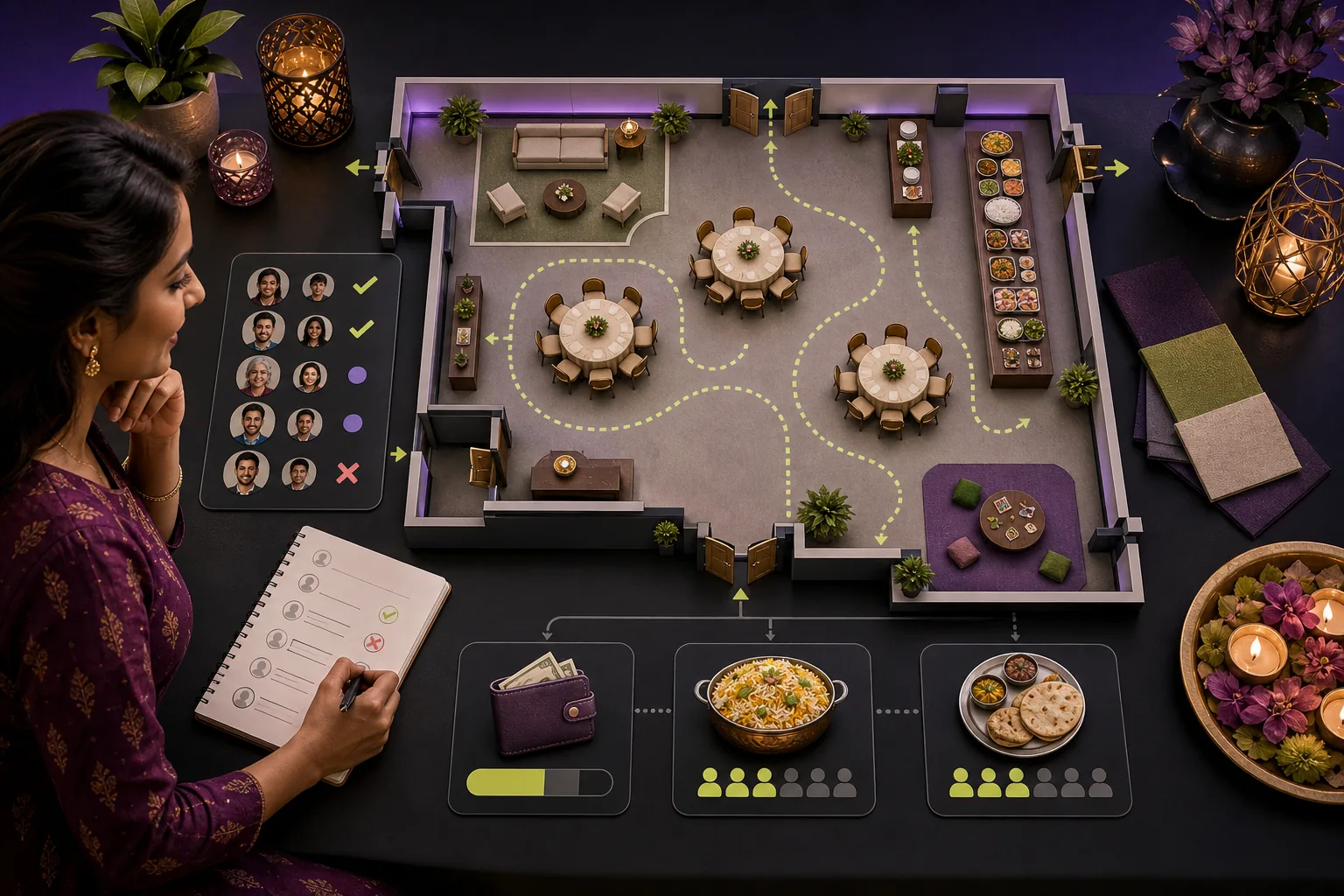
Choosing the guest count is one of the most important party decisions because it changes almost everything else. A larger list needs more food, seating, serving time, parking, washroom access and host attention. A smaller list may cost less and feel more personal, but it can also seem quiet if the event depends on dancing, team games or a lively crowd. The right number is not the largest number your room can physically hold. It is the number you can host safely, comfortably and within budget.
There is no universal formula that says a birthday needs 30 people or a house party needs 12. Two homes with the same floor area may have very different usable space. One family may enjoy a busy open-house style gathering, while another wants a calm dinner where everybody can talk. This guide gives you a practical way to make the decision without relying on guesswork.
Begin with the purpose of the party
Write a one-sentence description of the event before making the list. Examples include a relaxed dinner for close family, an energetic birthday with games, a children’s afternoon party with parents, or a networking-style office celebration. The purpose tells you whether the gathering benefits from intimacy or scale.
A seated meal normally needs more space and coordination per guest than a short tea-and-snacks gathering. A game night works best when the group size matches the games. A milestone celebration may include several family circles, while a casual weekend gathering can stay intentionally small. If the purpose is unclear, the guest list usually grows through obligation rather than design.
Ask three questions:
- Do guests need individual seats or table places?
- Is the main activity conversation, food, dancing, games or a ceremony?
- Does the host need meaningful time with each person?
The answers create a sensible starting range before names and emotions enter the decision.
Calculate usable space, not total property size
Do not use the advertised area of a flat, house or hall as the party area. Bedrooms, storage corners, fixed furniture, kitchen work zones and private rooms may not be available to guests. Measure or estimate only the zones people can actually use.
Sketch the room and mark the entrance, serving area, seats, walking paths, activity space and emergency exit. Leave enough space for people to move without asking several others to stand. Keep doors, stairs, balconies and cooking zones clear. A room that fits 25 chairs tightly may only feel comfortable with 15 people once a buffet table, bags and normal movement are included.
For a home party, perform a simple physical test. Place the planned furniture and serving table in position, then walk from the entrance to the washroom and food area while someone else sits or stands nearby. If the route already feels narrow, reduce the count or change the layout.
Use this capacity table as a planning prompt
The table below is not a legal occupancy calculation. Building rules, venue licences, fire limits and local requirements always take priority. It is a comfort-focused worksheet for early planning.
| Event style | Space pressure | What each guest needs | Planning approach |
|---|---|---|---|
| Seated lunch or dinner | High | Chair, table place and serving access | Keep the list close to confirmed seats |
| Tea, snacks and conversation | Medium | Mixed seating and easy movement | Provide seats for older guests and anyone who needs one |
| Children’s party | High | Activity room plus adult supervision | Count children and accompanying adults separately |
| Dance or music party | Medium to high | Clear activity zone and safe edges | Protect the dance area from furniture and cables |
| Game night | Medium | Seats or standing positions suited to each game | Match the list to team sizes and game limits |
| Open-house gathering | Variable | Smooth arrival, food and exit flow | Stagger invitations only when timing is clearly communicated |
| Banquet hall event | Venue-defined | Seating plan, service paths and stage access | Follow the venue’s safe maximum, then plan below it for comfort |
Do not treat a venue’s maximum occupancy as the recommended guest count. Maximum capacity may describe a legal upper limit for a particular layout, not a comfortable number for your buffet, stage, decorations or activities. Ask the venue manager for the capacity of your exact seating style.
Let the budget set a real boundary
Guest count is one of the strongest cost drivers. Food and drinks usually rise per person, while tables, chairs, return gifts, transport and service staff may increase in steps. A list that grows from 25 to 40 can change more than the catering bill; it may require a larger venue or a different event format.
Use the Party Budget Calculator to test several counts. Enter the same fixed costs and change the guest number and food cost per person. Add realistic extras rather than comparing only menu prices. If the estimated total exceeds your limit, reduce the list before sending invitations. Planning with money you do not genuinely have creates stress that guests never asked you to accept.
Build a small contingency into the budget for unavoidable changes, but do not use that buffer to justify an oversized list. Our detailed party budget guide explains how to separate fixed, variable and hidden costs.
Count households carefully
An invitation to one person can sometimes be understood as an invitation to a partner, children or the whole household. Avoid vague wording. Write the names of invited guests or politely state whether the event is adults-only, family-inclusive or limited by seating.
For children’s birthdays, track at least three numbers: invited children, likely accompanying adults and siblings who may attend. Ten children may create a gathering of 20 or more people when caregivers stay. Ask parents whether an adult will remain and whether siblings are included. Clear communication is kinder than discovering the difference at the door.
For family celebrations, group names by household but count individuals. A row labelled “Sharma family” is not useful for food or seating unless you also record how many people it represents.
Separate the wish list from the working list
Start with categories instead of writing every contact you remember. Typical categories include immediate family, close relatives, close friends, neighbours, colleagues and people connected specifically to the occasion. Decide which categories are central to the party’s purpose.
Then create three internal planning groups:
- Essential: people whose presence is central to the occasion.
- Welcome: people you genuinely want to include if space and budget allow.
- Expansion: additional guests considered only if the event format grows.
These labels are private planning tools, not judgments about a person’s value. Never show or discuss rankings. They simply prevent random additions from pushing the event beyond its limits.
Avoid inviting people only because you expect them to decline. They may accept, and an invitation should be sincere. Do not send a second wave in a way that makes people feel like replacements. If you must invite in stages, use a natural reason such as separate event sessions, and communicate honestly.
Estimate attendance without pretending to know
Not every invited guest will attend, but the response rate depends on the event, travel, date, relationship and notice period. A local family function may receive high attendance. A weekday office gathering or destination event may have more declines. Generic internet percentages are unreliable for a specific social circle.
Use evidence you actually have. Review similar events in your family or group, consider travel and school schedules, and ask for a clear RSVP. Plan for the confirmed count plus a modest, affordable margin where late changes are common. Never invite beyond safe capacity because you assume many people will decline.
Track replies in a simple sheet:
| Guest or household | Invited people | Confirmed yes | Declined | Awaiting reply | Food or access note |
|---|---|---|---|---|---|
| Example household A | 4 | 3 | 1 | 0 | One step-free seat needed |
| Example friend B | 1 | 0 | 0 | 1 | Vegetarian |
| Running total | 5 | 3 | 1 | 1 | Review before final order |
Update the running total instead of depending on memory or scattered chat messages.
Match the count to food service
The way food is served affects capacity. A formal seated meal requires enough places at the same time. A buffet needs a queue that does not block the entrance or main activity. Finger food allows more flexible movement but still needs surfaces for plates and glasses. Children may need low, safe eating areas and closer supervision.
Ask the caterer how long service takes for the proposed count and whether staff, counters or serving stations must increase. A menu that works smoothly for 20 people can create a long queue for 60. Our party food planning guide provides a portion worksheet and waste-reduction process for the next stage.
Protect accessibility and comfort
A comfortable guest count includes different needs. Reserve proper seats for older adults, pregnant guests and anyone who cannot stand for long. Keep routes wide enough for mobility aids where required. Check washroom access, lighting, ventilation and temperature. Loud sound and crowded rooms can be exhausting for children, older adults and guests with sensory sensitivities.
Create a quieter seating area when possible. Make sure it does not become an isolated afterthought. If the venue has stairs, confirm whether there is a suitable lift or alternative access before inviting someone who may need it. Accessibility questions should be asked respectfully and handled privately.
Consider the host’s attention capacity
Space and money are not the only limits. A single host cannot welcome arrivals, coordinate food, run games, answer vendors and solve problems for a large crowd at the same time. If the list grows, assign reliable helpers with clear roles.
For a small party, one host may manage everything. For a bigger gathering, designate someone for the entrance, food coordination, photos, children’s activity or game hosting. A random name picker can make casual player selection easier, but important responsibilities should be agreed in advance rather than assigned by surprise.
Choose a number that allows you to participate in the event. If you will spend the entire evening managing chairs and serving plates, the scale may be too large for the available support.
Review noise, parking and neighbours
A guest count affects the surrounding area. More arrivals mean more vehicles, lift use, corridor activity and noise. Apartment societies and residential neighbourhoods may have rules about visitors, common areas and quiet hours. Check them before confirming the list.
Share practical transport advice and discourage guests from blocking gates or reserved spaces. If parking is limited, suggest car-pooling or a suitable drop-off point without promising security or availability you cannot guarantee. Keep speakers away from shared walls, and tell neighbours about a one-off gathering when appropriate.
Set an RSVP deadline that supports real decisions
Ask for replies early enough to confirm food, seating and venue requirements. A deadline is useful only when it is clear. Include the date, start and finish time, location area, who is invited and how to respond. Follow up once with people who have not replied, then plan based on confirmed information.
Do not count a message such as “will try” as a definite yes. Mark it as awaiting confirmation and explain that final numbers are being closed. When someone declines, respond warmly instead of pressuring them. Good RSVP handling protects relationships as well as logistics.
A five-step final guest-count check
Before sending invitations, complete this review:
- Purpose check: Does the number suit the kind of experience you want?
- Space check: Can people sit, move, eat and exit comfortably?
- Budget check: Can you afford the realistic total without financial strain?
- Support check: Are there enough responsible hosts or helpers?
- Safety check: Does the plan remain below every venue and building limit?
If one answer is no, reduce the list or change the format. Possible adjustments include two smaller gatherings, a shorter open-house window, a simpler menu, an outdoor venue with proper permission, or a hall designed for the required layout.
Frequently asked questions
Should I invite extra people because some guests may decline?
Do not invite more people than the space can safely handle. Use a realistic RSVP process and plan for confirmed guests plus a manageable margin. Every invitation should be genuine, not based on hoping the recipient says no.
How many seats should a casual home party have?
Provide proper seating for anyone who needs it and enough mixed seating for the event style. If food must be eaten with plates and cutlery, guests need stable, comfortable places. Test the actual furniture layout instead of relying on a fixed percentage.
Can I say no to uninvited plus-ones or children?
Yes, when capacity or event format is limited, but communicate before the event with polite, specific wording. Address invitations clearly and avoid blaming a particular guest. Consistent rules reduce misunderstandings.
Is a bigger party always more memorable?
No. Guests usually remember how welcome, comfortable and involved they felt. A well-paced small gathering can be more enjoyable than a crowded event with long queues and little host attention.
Final takeaway
The right guest count sits where five limits meet: purpose, usable space, affordable cost, host capacity and safety. Begin with the experience you want, calculate the space you can truly use, count every individual, request clear replies and refuse to plan beyond safe capacity. A thoughtful list is not about excluding people; it is about keeping the invitation you send. When every confirmed guest can move, eat, participate and receive genuine attention, the party has room to feel generous rather than crowded.