Food can make guests feel cared for, but it is also one of the easiest parts of a party to overcomplicate. Hosts often add dishes because they fear the menu will look small, then discover that guests filled their plates with only a few favourites. Other times, the total quantity seems generous but the balance is wrong: too many starters, not enough main course, several rich dishes and no simple option for children or older guests.
A useful food plan is not a promise that every guest will eat an identical amount. It is a structured estimate that considers the time, event style, age mix, weather, service method and menu. This guide helps you build that estimate responsibly. It does not replace a caterer’s professional quotation or food-safety advice, and all quantities should be adjusted for your actual guests.
Start with the event, not a list of dishes
Write down the date, start time, expected finish time and main purpose of the party. A two-hour evening game night needs a different menu from a wedding lunch or a child’s afternoon birthday. Guests arriving directly after work may expect a more substantial meal. A late event may need lighter food and fewer courses. Hot weather changes drink demand and makes heavy fried food less appealing.
Decide whether food is the central activity or support for another activity. If people will sit for a meal, service and table space matter. If they will play games, choose items that are easy to pause, carry and eat without damaging cards or equipment. For a mixed-age family function, comfort and familiarity may matter more than novelty.
Record the basics:
- confirmed guest count and likely changes;
- adults, children and older guests;
- meal time and event duration;
- seated, buffet, passed snacks or self-service format;
- dietary, allergy, religious and access requirements;
- kitchen, refrigeration and serving capacity.
These details are more useful than choosing dishes from photographs.
Confirm guests before estimating portions
Begin with the process in our guest-count guide. Count every adult and child rather than estimating by household. Ask for replies by a clear date and keep uncertain guests separate from confirmed guests. Children do not always eat a fixed fraction of an adult portion; age, activity and familiarity with the food matter.
Ask about dietary requirements in a neutral way. Useful categories may include vegetarian, vegan, egg-free, Jain, gluten-related medical needs and food allergies, but never assume that a label tells you everything. A person with a serious allergy may need information about ingredients, shared oil, utensils and preparation surfaces. When you cannot guarantee safe preparation, say so honestly and allow the guest to decide what is appropriate.
Avoid turning dietary questions into public discussion. Record only what is needed for service and share it with the responsible cook or caterer.
Build a balanced menu framework
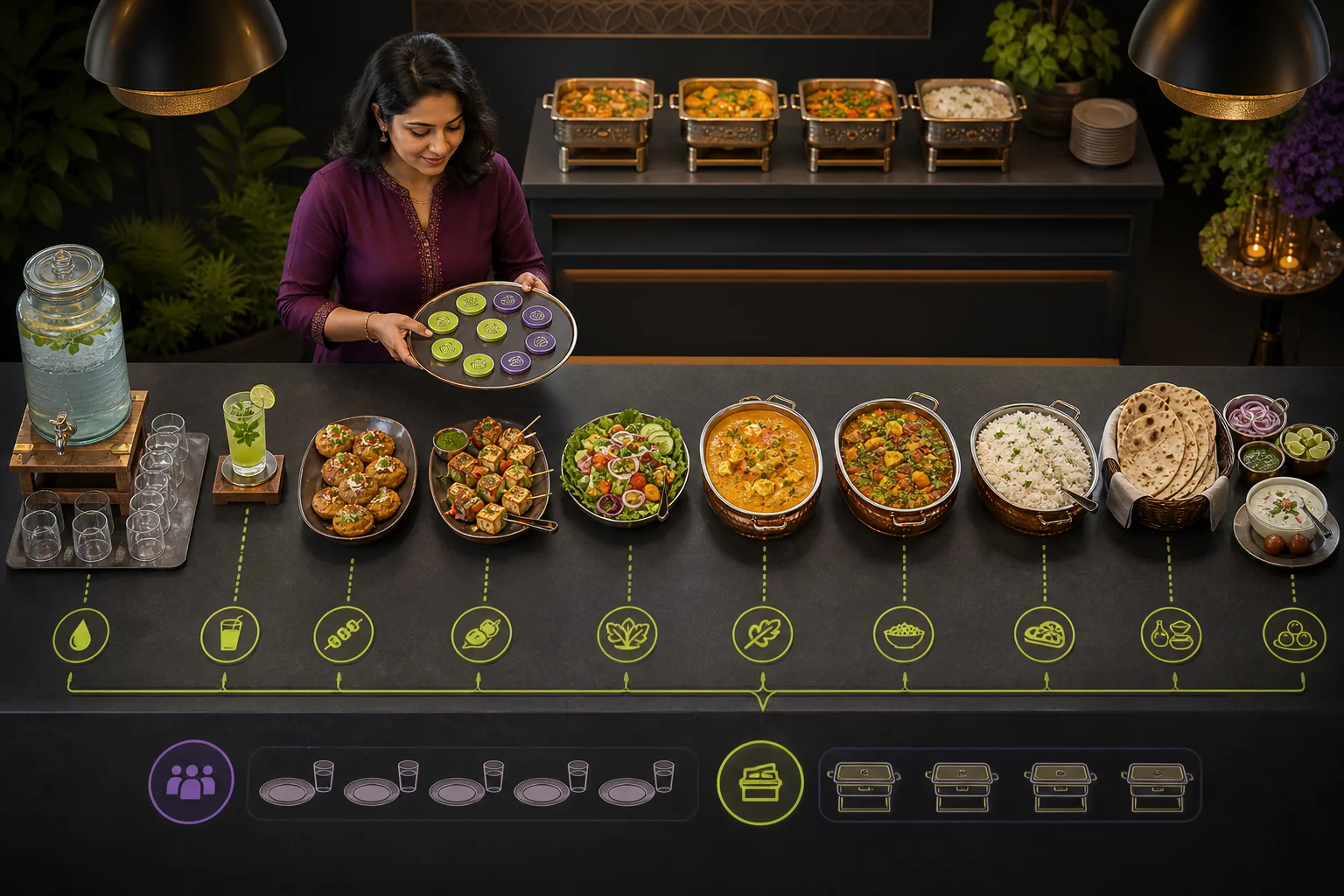
Instead of collecting favourite dishes randomly, fill roles. A practical buffet framework may include welcome drinks, one or two starters, a simple salad or fresh element, main dishes, a starch such as rice or bread, accompaniments and one dessert. The exact number depends on the event scale, but every additional item increases purchasing, preparation, labelling, serving space and leftover risk.
Use contrast to make a small menu feel complete:
- one crisp or fresh item with rich food;
- one mild dish beside a spicy option;
- one familiar dish beside a more distinctive choice;
- a dry dish and a gravy dish rather than several similar gravies;
- a light drink option in addition to sweet beverages.
Balance is more valuable than length. Four well-chosen dishes served at the right temperature usually create a better experience than ten dishes competing for limited space.
A menu-balance worksheet
| Menu role | Planning question | Common mistake | Better approach |
|---|---|---|---|
| Welcome drink | Will guests arrive hot, tired or thirsty? | Only very sweet drinks | Offer water prominently and one suitable alternative |
| Starter | How long before the main meal? | Too many heavy fried starters | Choose limited variety and refill in smaller batches |
| Fresh element | What lightens the plate? | Salad left uncovered for hours | Prepare safely and bring out near service time |
| Main protein or substantial dish | Are there satisfying choices for key diets? | Vegetarian option treated as an afterthought | Plan complete choices, not only substitutions |
| Rice or bread | Which works with the main dishes and service setup? | Both prepared in excessive quantity | Estimate based on menu and guest preference |
| Accompaniments | Do they add contrast or only clutter? | Too many open bowls | Use a few relevant, clearly placed items |
| Dessert | Is it suitable for weather and storage? | Several similar sweets | Choose one reliable favourite or two contrasting small options |
| Drinks | Is safe drinking water easy to find? | Water hidden behind sugary drinks | Keep water visible, accessible and continuously replenished |
This table is a decision tool, not a compulsory menu. A small home party may use fewer roles, while a formal event may separate courses.
Estimate portions by menu structure
Per-person figures can create false confidence when they are copied without context. Consumption changes when there are many dishes, when starters are served for a long time, or when guests arrive after another meal. Caterers also measure food differently: raw ingredients, cooked weight, pieces, trays or serving bowls.
Use a range and confirm the unit. Begin with the caterer’s recommended quantity for the exact menu and group, then test whether the combined portions make sense. If you offer three starters, do not order a full independent portion of every starter for every person unless the service plan requires it. Guests normally sample across choices.
For home cooking, use recipes you have made before. Record how many realistic party portions one batch produced. Scaling a familiar recipe is safer than applying an online number to an unfamiliar dish.
Practical per-person planning worksheet
Fill this table with your caterer’s units or your tested recipe yields. The blank structure is intentional because a universal gram figure would ignore your menu and guests.
| Item | Service unit | Planned choices | Expected share of guests | Quantity per participating guest | Buffer | Final order or batches |
|---|---|---|---|---|---|---|
| Starter A | Pieces or tray | 1 | ___% | ___ | ___ | ___ |
| Starter B | Pieces or tray | 1 | ___% | ___ | ___ | ___ |
| Main dish A | Cooked weight or bowl | 1 | ___% | ___ | ___ | ___ |
| Main dish B | Cooked weight or bowl | 1 | ___% | ___ | ___ | ___ |
| Rice | Cooked weight or tray | 1 | ___% | ___ | ___ | ___ |
| Bread | Pieces | 1 | ___% | ___ | ___ | ___ |
| Dessert | Pieces, cups or tray | 1 | ___% | ___ | ___ | ___ |
| Water and drinks | Bottles or litres | Multiple | 100% | ___ | Weather-based | ___ |
Check the worksheet as one menu. If every row contains a large buffer, the total buffer becomes excessive. Apply extra quantity thoughtfully to flexible staples or high-demand items rather than multiplying every dish.
Understand fixed and variable costs
Food price is not only the menu rate. Delivery, staff, crockery, fuel, live counters, transport, taxes, minimum order quantities and late service can change the total. Add these to your realistic party budget before approving the menu. The Party Budget Calculator can compare different guest counts and per-person estimates.
Ask vendors what the quotation includes, how long service lasts and what happens when the confirmed count changes. Confirm whether leftovers can be packed safely and who supplies containers. Do not select a vendor solely because the headline plate price is lower.
Choose a service style that fits the space
A buffet can handle variety but needs queue space and clear direction. Place plates at the beginning, food in a logical order and cutlery where guests will not drop it while serving. Avoid positioning the queue across a doorway or the route to the washroom. Keep vegetarian and allergen-sensitive items separated and labelled accurately where possible.
Family-style table service feels warm but requires table space and timely refills. Passed snacks reduce crowding around a counter but need servers and careful waste control. Individual boxes make distribution predictable but can generate packaging and may be less flexible for different appetites.
At home, simulate the route before the event. Carry an empty plate through the serving area while another person stands nearby. If you cannot move easily, change the layout or serve in stages.
Plan timing, temperature and refills
Guests judge food by condition as much as quantity. A large tray left out too long may become unsafe or unappealing. Prepare smaller batches when practical and refill them. Keep hot food properly hot and cold food properly cold using suitable equipment and professional guidance. Do not rely on smell or appearance to prove food is safe.
Create a service timeline:
- Confirm when prepared food arrives.
- Assign who checks quantities and labels.
- Decide when starters begin and stop.
- Announce or open the main meal at the planned time.
- Refill in smaller amounts while monitoring demand.
- Clear and store leftovers promptly according to safe guidance.
One named person should coordinate with the caterer so instructions do not conflict.
Reduce waste before the party
Waste prevention begins while ordering, not after guests leave. Keep the menu focused, collect replies, avoid several near-identical dishes and use tested yields. Choose ingredients that can be safely used in normal household meals if plans change. Rent reusable serving items where feasible rather than buying disposable decoration-oriented pieces.
Do not use huge serving plates merely to create a visual impression. Smaller trays refilled neatly can look abundant while protecting food quality. Place modest serving spoons with rich items and keep water easily available.
If your caterer allows count revisions, set a reminder before the deadline. Update the order using confirmed attendance instead of leaving the original invitation number unchanged.
Handle leftovers responsibly
Make a leftover plan before service begins. Keep clean food-storage containers, labels and refrigerator space available. Food that has been held or served incorrectly may not be safe to save. Follow reliable food-safety guidance and your caterer’s instructions; when uncertain, discard it rather than taking a health risk.
Do not promise donation without checking whether a suitable local organization can accept the food, at what time and under which safety conditions. Randomly transporting exposed food can create more risk than benefit. For guests who want takeaway portions, pack only food that is suitable and do it without delaying safe storage.
Label stored food with the item and time. Reheat appropriately and use it within safe limits rather than repeatedly warming and cooling the same container.
Make the menu inclusive without creating chaos
An inclusive menu does not require a separate buffet for every preference. It requires at least one complete, satisfying route through the meal for key dietary groups. A vegetarian guest should be able to build a proper plate rather than eat only salad and bread. A mild option should still taste intentional.
Use clear serving utensils and prevent them from moving between dishes. Labels should describe what the food actually contains, not make unverified claims. For serious allergies or medical diets, discuss preparation controls directly with the vendor and communicate limitations honestly.
Children may appreciate simple familiar food, but avoid assuming every child wants the same thing. Keep choking hazards, hot vessels, sharp skewers and unstable drink stations away from young children and provide appropriate supervision.
Common party food mistakes
Choosing quantity before confirming the format
The same number of guests can require different food in a two-hour snack party and a full dinner. Decide the format first.
Adding dishes to impress people
Extra variety can divide demand, increase leftovers and weaken quality. Use contrast and reliable execution instead.
Forgetting non-eaters and dietary needs
Ask respectfully before finalizing the menu. Do not guess based on age, name or appearance.
Serving everything at once
Large exposed quantities lose temperature and freshness. Refill smaller batches when the setup permits.
Hiding drinking water
Water is not a decorative extra. Make it easy to see and reach throughout the event.
Frequently asked questions
How much extra food should I order for a party?
There is no safe universal percentage. Use confirmed attendance, the event type, tested yields and your caterer’s experience. Apply a modest buffer to flexible high-demand items rather than adding a large buffer to every dish.
How many dishes should a party menu include?
Enough to provide a complete and balanced meal for the guests, but not so many that preparation and service suffer. A focused menu with contrasting roles is usually more useful than a long list of similar dishes.
Should children be counted as half portions?
Not automatically. Age, activity, menu familiarity and event timing affect appetite. Count children separately and ask the caterer how the proposed menu is normally planned for that age group.
How can I reduce buffet queues?
Use a logical one-way layout, keep plates ready, avoid placing the counter in a doorway and consider duplicate access to popular items when the venue and caterer can manage it safely.
Final takeaway
Good party food planning combines a confirmed guest count, a focused menu, realistic recipe or vendor yields, safe service and a plan for leftovers. Start with the event experience, fill menu roles instead of collecting dishes, and review the whole quantity rather than buffering every item separately. Guests do not need endless choice. They need food that suits them, arrives at the right time, is easy to access and has been handled responsibly. That approach feels generous during the party and leaves far less regret after it.