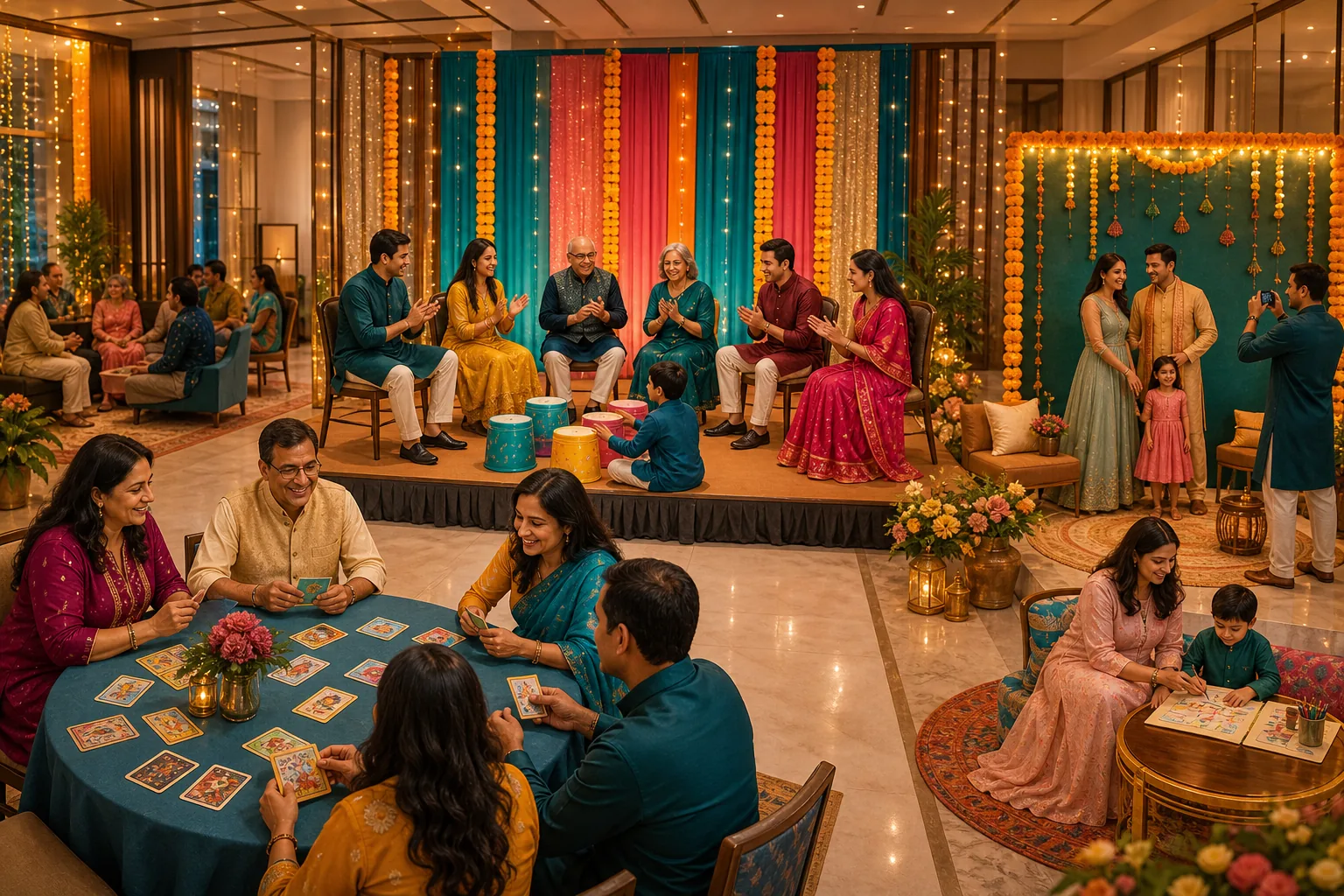
A Sangeet becomes memorable when performances, conversations and playful moments feel connected. Games can help both families mix, fill a short stage reset and include guests who are not performing. They should never make the programme feel like a compulsory competition. The best activities are brief, clearly explained and easy to leave without embarrassment.
This guide focuses on practical Sangeet games for Indian family celebrations. Every family and community has its own preferences, so confirm the final list with the couple and event hosts. Avoid jokes about marriage pressure, body shape, accents, money, former relationships or private family matters. Participation should always be optional.
Decide where each activity belongs
Do not put every game on the main stage. A loud stage round can energise the room, but repeated announcements interrupt conversations and food service. Use three participation zones: stage games for moments when everyone is already watching, table games for flexible involvement and foyer or photo-area activities that guests can try at their own pace.
| Activity zone | Best use | Ideal duration | Suitable guests | Main caution |
|---|---|---|---|---|
| Main stage | One high-energy team round | 8 to 12 minutes | Willing performers and audience | Test microphones and keep transitions short |
| Guest tables | Conversation cards, quizzes and observation games | 5 to 15 minutes | Mixed ages and quieter guests | Do not interrupt dining |
| Open floor | Simple movement or music games | 5 to 10 minutes | Mobile guests who opt in | Keep cables and floor edges clear |
| Photo area | Self-guided prompts and memory cards | Flexible | Arriving guests | Do not block photographers or entrances |
| Family lounge | Calm games and storytelling | 10 to 20 minutes | Seniors, children and small groups | Provide seating and lower sound levels |
Place games around the confirmed party timeline, not the other way around. The host should know which round can be cancelled if a performance, dinner or ritual runs late.
1. Two Families, One Beat
Create mixed teams with volunteers from both families. Play short instrumental rhythm clips or have a dhol player make an easy pattern. Each team repeats the rhythm by clapping. Start slowly and add one beat in every round. The activity needs no singing skill and can include guests from different language groups.
Limit the game to three rounds. People with sound sensitivity should be able to watch from a quieter place, and the host should never suddenly increase volume near seated seniors or small children.
2. Finish the Celebration Phrase
Prepare incomplete, original phrases connected with music and celebration, such as “A dance floor is ready when…” or “The best family performance needs…”. Teams get thirty seconds to write a funny but respectful ending. The audience applauds for the answer it enjoys most.
Because the lines are original, the activity does not depend on recalling film dialogue or copyrighted lyrics. Screen the answers before reading them aloud if guests are writing freely.
3. Dance Step Relay
The first volunteer performs one simple dance movement. The next repeats it and adds another. The sequence grows until the team completes five movements together. Use hand movements and gentle steps rather than lifts, jumps or floor work.
Offer a seated version so mobility is not treated as a disadvantage. Clear the performance area and ask participants to avoid loose props, slippery footwear and movements that could disturb clothing or jewellery.
4. Family Introduction Cards
Before the event, invite willing relatives to share one neutral fact: a favourite snack, hobby, city or music style. The host reads the facts, and mixed tables guess the person. After the answer, that guest can wave or say hello from their seat.
Use only details approved for public sharing. This game works especially well early in the evening because it helps guests remember names without forcing long introductions.
5. Who Chose This Song?
Ask five willing performers or family members to privately choose one song for the evening. Display the five names and play a short licensed or venue-approved excerpt from each selection. Tables match each song to the person who chose it.
The fun comes from musical taste rather than revealing private information. Check playback rights and venue rules. A host can instead hum an original rhythm or read the song title if recorded music use is restricted.
6. Couple Choice Cards
Give each partner two cards: “me” and “you”. Ask ten light questions approved in advance, such as who checks the route, who starts dancing first or who remembers birthdays. They raise a card at the same time.
Never surprise the couple with questions about money, arguments, children, household roles or former relationships. Add a visible “skip” card and treat skipping as completely normal. For more couple-friendly formats, see the broader Indian wedding games guide.
7. Performance Prediction Sheet
Place a small prediction sheet at each table with neutral prompts: first performance with a prop, first group dance, first colour change on stage or first standing ovation. Guests mark guesses before the programme begins and check them during the evening.
This is a low-pressure activity for people who prefer watching. Do not include predictions about mistakes, appearance or whether someone will forget steps.
8. Sangeet Bingo
Create original bingo cards with moments likely to occur: a three-generation photograph, a matching costume, a dhol beat, a group selfie or guests clapping in rhythm. Use several card layouts so the result is not identical for every table.
Players should observe from their places and never interrupt a performance to complete a square. A small prize can be awarded after a natural break rather than during a song.
9. Name That Dance Prop
Place safe props inside opaque bags: a fabric flower, ribbon wand, paper fan or lightweight sunglasses. A volunteer feels the object without looking and has twenty seconds to identify it. Clean reusable items between players, or let participants touch the bag from outside.
Avoid sharp, valuable, religious or fragile objects. This works as a short stage reset while equipment is being moved.
10. Silent Song Situation
Give a player an original situation card such as “the music suddenly stops,” “the photographer asks for one more picture” or “the group cannot decide its final pose.” The player acts silently while the team guesses.
Do not ask anyone to imitate a real relative, community, accent or disability. Keep every card based on familiar event situations rather than personal characteristics.
11. Table Rhythm Challenge
Each table receives a printed sequence of clap, tap and pause symbols. They practise quietly for one minute, then perform it together when called. The host combines two tables for a final rhythm.
Use hands or soft shakers instead of hitting glassware, cutlery or furniture. Coordinate with food service so the activity does not begin while hot dishes are being carried.
12. Memory Tray: Backstage Edition
Display fifteen safe performance items for thirty seconds: hairpin box, artificial flower, ribbon, cue card, soft scarf and similar objects. Cover the tray and ask tables to list what they remember. All teams receive the same viewing time.
Do not use real jewellery, cosmetics shared between guests, sharp pins or expensive equipment. A projected original illustration of the objects can replace the physical tray.
13. Family Dance Map
Put a large card near the entrance with broad music moods: classic, folk, energetic, romantic and relaxed. Guests add a sticker beside the mood they would enjoy later. The DJ or host uses the result as a guide, not a binding vote.
This helps guests contribute without being called on stage. Keep the board anonymous and do not collect phone numbers or other personal data.
14. Guess the Rehearsal Clue
Ask each performance group to submit one neutral clue in advance, such as number of performers, a prop colour or the decade of its music. Read three clues before the act and let tables guess which group is coming next.
Avoid clues that reveal a surprise costume, personal announcement or protected music content. Coordinate with the programme manager so the game does not expose the running order accidentally.
15. Pass the Expression
Show the first player a simple emotion or celebration expression: delighted surprise, proud applause or “ready for the photograph.” The expression passes silently down a line and the final person identifies it. Keep teams small so the round stays visible and fast.
The host should model exaggerated but respectful expressions. Never use emotions connected with grief, fear, intoxication or a specific guest.
16. One-Minute Choreography
Give each willing group three simple movement cards, such as clap twice, turn once and form a line. They have one minute to arrange the movements and then perform a twenty-second sequence. Judging can focus on teamwork rather than technical skill.
Provide a seated option using hand and shoulder movements. A flat, clear area is essential; do not run this game on a crowded stage or near loose cables.
17. Family Connection Hunt
Give tables a list of voluntary connections to discover: two people who enjoy the same breakfast, two who have visited the same city or two who prefer morning celebrations. Guests can ask only people at their own or a neighbouring table.
Nobody has to answer. Avoid prompts involving age, work status, relationship status, health, religion or finances. This is a conversation starter, not a data collection exercise.
18. Compliment Cards for Performers
Provide cards with prompts such as “A moment I enjoyed…” and “One thing your group did well…”. Guests leave short notes for performance teams. Collect and screen the cards before passing them on.
Positive feedback gives non-performing guests a meaningful role. Do not display notes publicly without permission, and remove comments about bodies, costumes or comparisons between relatives.
19. Musical Statue Poses
Play brief music segments while a small volunteer group moves gently. When the music stops, the host calls an easy pose: celebration wave, team photograph or namaste. Anyone uncomfortable with a pose can simply stand still.
There should be no elimination. The game ends after four rounds with applause for everyone. Keep the floor dry and avoid sudden stops for guests in heavy clothing.
20. The Final Family Formation
Call willing representatives from mixed family groups and give them a shape to form together: a circle, two lines, a heart outline or the couple’s initials using placards. Allow one minute and photograph the final formation only after consent.
This makes a friendly closing activity before open dancing. The host should not drag reluctant guests from their seats or separate people responsible for children or older relatives.
Choose games for different guest groups
One activity rarely suits the whole room. Build a small menu rather than a packed tournament.
| Guest need | Better choices | Adaptation |
|---|---|---|
| Guests who enjoy the stage | Rhythm challenge, one-minute choreography, dance relay | Invite volunteers before announcing names |
| Quieter or shy guests | Prediction sheet, bingo, compliment cards | Allow anonymous or table-based participation |
| Seniors | Family introductions, memory tray, seated rhythm | Provide clear audio, large print and nearby seating |
| Children | Prop guessing, simple poses, observation bingo | Use guardian supervision and non-breakable materials |
| Mixed-language groups | Visual clues, rhythm and movement games | Demonstrate rules instead of relying on long explanations |
| Mobility-limited guests | Seated choreography, cards and quizzes | Judge ideas and teamwork, not speed |
If children form a large part of the gathering, adapt ideas from the family party games guide rather than giving them an unsupervised activity corner.
Build a realistic Sangeet game schedule
A useful programme usually needs only two announced games and a few self-guided table activities. For example, place bingo cards before the show, run a ten-minute family rhythm game after the first performance block and use the couple choice cards before the final group dance. This keeps games visible without extending the evening.
Use the guest-number guide to estimate materials, and prepare ten percent extra printed cards. Assign one host, one timekeeper, one stage helper and one person who coordinates with the DJ or sound desk. The host should have a shorter version of every round.
| Programme point | Activity | Full version | Short version |
|---|---|---|---|
| Guest arrival | Bingo or family dance map | Flexible | Remove prize announcement |
| First stage reset | Prop guessing | 5 minutes | One player only |
| Mid-programme energy dip | Two Families, One Beat | 10 minutes | Two rounds |
| Before couple performance | Couple Choice Cards | 8 minutes | Five questions |
| Before open dance floor | Final Family Formation | 5 minutes | One mixed group |
For a tight budget, print fewer reusable table cards, use a shared display and borrow safe props. The low-budget party guide has more ways to reduce decoration and activity costs without reducing guest comfort.
Prepare the host script
Every explanation should answer four things: who may join, what they do, how long the round lasts and how it ends. A clear opening can be: “We need six volunteers who are comfortable joining a seated rhythm game. We will demonstrate the pattern, play three short rounds and finish in six minutes.”
Tell guests that watching is welcome. Avoid calling somebody repeatedly after they decline. If the room is noisy, demonstrate once instead of explaining louder for several minutes. Keep a printed cue card with rules, names and the stop time.
Use prizes without creating pressure
Prizes are optional. Small shared rewards—snack boxes, plants, stationery or a playful certificate—usually suit a family event better than expensive gifts. Avoid prizes connected with appearance, gender roles, alcohol or embarrassing dares.
For table activities, use a random draw among completed valid entries so the first table served or seated closest to the stage does not have an advantage. The site’s Spin the Wheel can help with a casual visible draw, but confirm names and rules before spinning.
Safety and consent checklist
Walk through the venue before the programme. Mark cables, stage steps, speaker edges and slippery areas. Keep active games away from hot food, glassware and entrances. Have water and seating available, and stop a game immediately if space becomes crowded.
Ask before photographing or projecting close-ups. Children need guardian supervision. Do not use blindfolds, food-eating races, lifting challenges, forced physical contact or activities involving personal phones and passwords. For a broader framework, follow the complete party host checklist.
Common planning mistakes
The first mistake is scheduling a game after every performance. Guests need time to talk, eat and absorb the show. The second is dividing teams only by “bride’s side” and “groom’s side,” which can strengthen rivalry instead of connection. Mixed tables often create a warmer result.
Another mistake is rewarding only speed, volume or dancing skill. Rotate between observation, memory, creativity and gentle movement. Finally, do not rely on surprise participation. Ask volunteers before the event or during a natural break.
Final takeaway
Successful Sangeet games do not need complicated equipment or constant stage time. Choose two short announced activities, add a few optional table formats and make every rule easy to understand. Mix both families, provide seated alternatives and protect the confirmed performance schedule.
When guests can join, watch or step away without pressure, games support the celebration instead of controlling it. That balance is what keeps performers confident, quieter guests comfortable and the whole evening moving naturally.