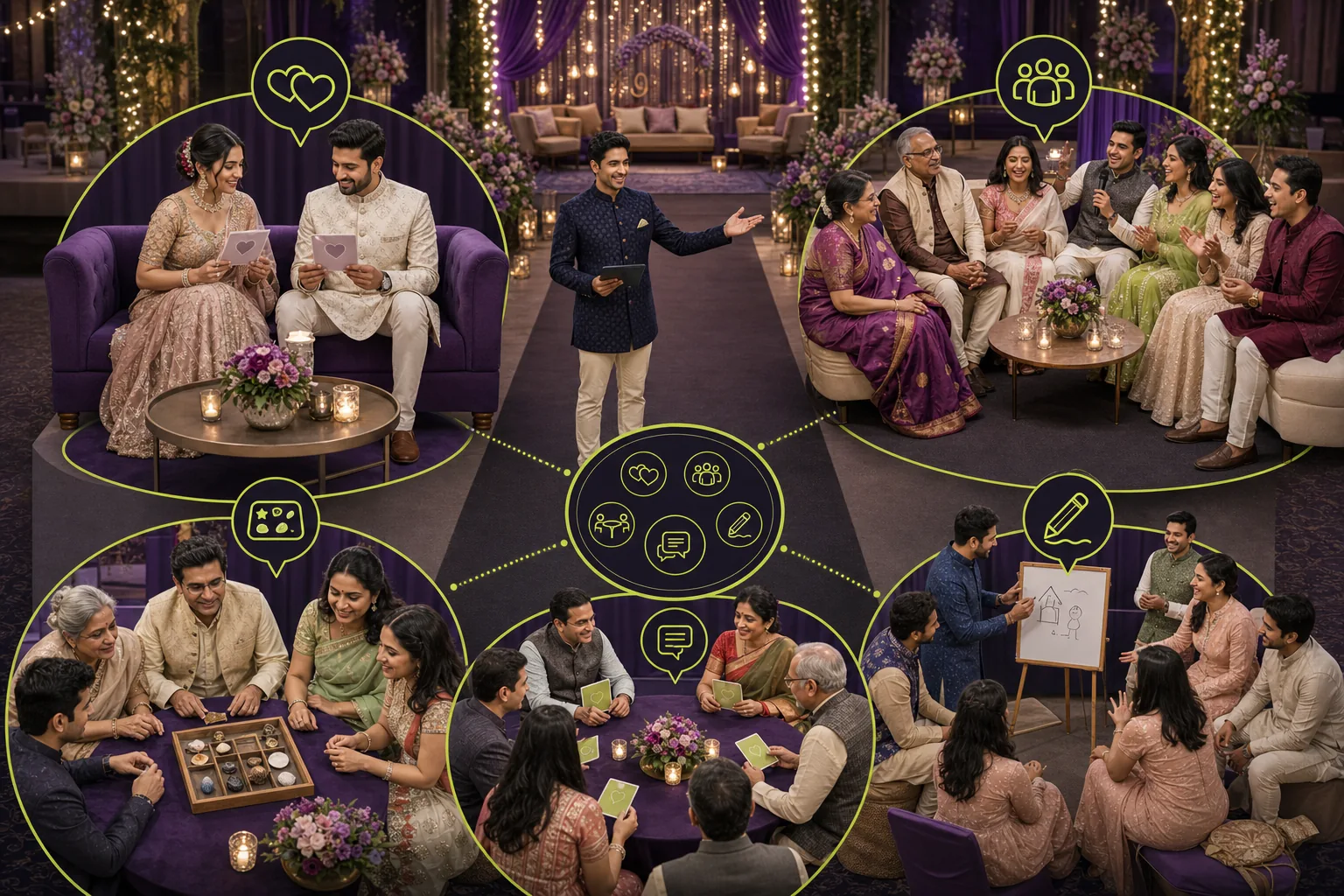
Wedding games can help two families relax, remember names and share a lighter moment between formal rituals. They work best when they support the function rather than taking over it. A five-minute couple quiz may energize a mehendi, while a long stage competition can delay food and leave most guests watching. The right game matches the venue, timing, relationships and comfort of the people present.
This guide offers original formats and practical adaptations for Indian wedding gatherings. Customs differ widely between families, regions, religions and communities, so treat every idea as optional. Confirm plans with the couple and relevant family hosts. Never turn a ritual, identity, marriage expectation or private relationship into a joke without clear agreement.
Choose games by function and energy
A wedding includes several different social settings. Guests at a daytime mehendi may enjoy relaxed table activities. A sangeet can support a short stage game between performances. A reception often has staggered arrivals, photographs and food, so self-guided table prompts may fit better than stopping the whole room.
Map the game to the function:
| Function or moment | Suitable game style | Useful duration | Main caution |
|---|---|---|---|
| Mehendi | Seated observation, music or table prompts | 5 to 15 minutes | Do not interfere with artists or wet mehendi |
| Haldi | Very short, low-contact family game | 3 to 8 minutes | Protect clothing, floors, eyes and ritual boundaries |
| Sangeet | Team music, couple quiz or stage relay | 8 to 15 minutes | Keep transitions short and microphones ready |
| Wedding-day waiting period | Self-guided cards or photo prompts | Flexible | Never delay ceremonies or processions |
| Reception | Table games, guest bingo or memory prompts | Flexible | Guests arrive and eat at different times |
| Post-wedding family gathering | Calm relay, audience voting | 10 to 20 minutes | Protect rehearsal and performance timing |
| Wedding day | Table cards, guest bingo, quiet name games | Flexible | Never interrupt rituals or food service |
| Post-wedding gathering | Couple and family conversation games | 15 to 30 minutes | Avoid intrusive expectations and stereotypes |
Coordinate with the party timeline guide and the person managing ceremonies. The game host should know immediately when to shorten or stop.
1. Family Name Match
Prepare cards with the first names of willing close family members and separate cards describing a neutral relationship, hobby or role. Teams match them after a short introduction round. Use only information people have agreed to share. This works well early in a small engagement gathering.
2. Who Knows the Couple?
Ask the couple for eight low-stakes questions in advance, such as favourite shared snack, preferred travel pace or who usually chooses films. Guests write answers, and the couple reveals them. Exclude former relationships, finances, conflicts, passwords and family-planning topics.
3. Couple Choice Cards
Give each partner two cards representing themselves and the other person. Ask playful questions such as “Who checks the route first?” Both raise a card together. Keep the round to ten questions and let the couple skip anything without explanation.
4. Wedding Memory Timeline
Display several approved family or couple moments as image cards without dates. Teams arrange them in order. Use photographs only with permission and avoid images containing people who would not want them displayed publicly.
5. Two Families, One List
Mixed teams have three minutes to find five neutral things they share: a favourite dish, city visited, language understood or game enjoyed. Every team shares one discovery. Do not require personal disclosures.
6. Guest Connection Bingo
Create original bingo cards with prompts such as “has travelled by train this month,” “can name three wedding songs,” “loves gardening” or “prefers tea to coffee.” Guests find willing people who match and write first names in the relevant squares.
Never include medical, marital, financial or appearance-based facts. Ask guests not to photograph completed cards if names and personal details appear.
7. Find Your Table Teammate
Place matching halves of original symbols or simple phrases on arrival cards. Guests find the person with the matching half, introduce themselves and answer one light prompt. This is useful when families do not know one another.
Keep participation optional and provide a host helper for older guests or anyone who prefers not to circulate.
8. Song Connection Round
Prepare neutral words connected with celebration, travel, seasons or friendship. Teams sing one line from a song containing the word. Follow local music and performance rules, and keep the round short.
Accept songs in all languages used by the families. Do not let one team monopolize the microphone. A simple rotation works better than shouting.
9. Antakshari Family Mix
Create mixed teams rather than dividing strictly by the couple’s sides. This encourages interaction and reduces competitive “us versus them” behaviour. Announce the starting rule, time limit and acceptable song languages.
Use a moderator to confirm disputed letters calmly. Keep volume within venue limits and stop before the next ritual or meal.
10. Wedding Charades
Prepare original cards with everyday wedding-related actions such as searching for a missing safety pin, posing for a group photo or finding the correct hall. Avoid mocking rituals, accents, professions or family members.
Players act without words for 45 seconds. Rotate the performer in each round. Keep the activity away from food, cables, lehenga edges and slippery floors. Offer a seated hand-movement version.
11. Wedding Whisper Chain
Seat each team in a line. Show the first player a short, neutral celebration sentence. It is whispered once from person to person, and the final player says what they heard. Use the same length and difficulty for both teams. Do not use private family information, accents as jokes or statements that could sound insulting when changed.
12. Wedding Pictionary
Teams draw neutral wedding-related objects or moments, such as invitation, garland, gift box or dance floor. No words or numbers are allowed. Rotate artists so drawing skill does not dominate.
13. Decor Detail Hunt
Give seated guests a printed or digital list of safe visual details to spot from their place: a particular flower colour, a geometric pattern or a lamp shape. Nobody should enter restricted areas, touch decor or interrupt photographers.
14. Memory Tray: Wedding Edition
Display 15 safe objects associated with celebration, such as ribbon, artificial flower, envelope, bangle stand or small bell. Cover the tray after 30 seconds. Players write remembered items. Do not use valuable jewellery, religious objects without respect or sharp items.
15. Table Story Cards
Place one original conversation card at each table. Examples: “Name a celebration food you enjoy” or “Share a useful hosting tip.” Guests can ignore the card. Avoid questions that assume everyone is married or wants marriage.
16. Advice Without Pressure
Invite guests to write one kind, practical wish for the couple. Make clear that advice is optional and should not concern children, gender roles, money or family obligations. The couple can read the cards privately later.
17. Recipe Memory Cards
Guests write the name of a family dish and one short memory or serving tip. The host collects the cards into a keepsake. Do not request proprietary business recipes or demand exact measurements.
18. Regional Word Exchange
Guests teach their table one friendly celebration word in a language they speak, with meaning and pronunciation. Participation is voluntary, and nobody’s accent is judged. This works particularly well for multilingual families.
19. Couple’s Playlist Vote
Prepare five approved song categories or moods, then let guests vote for the next dance segment. Use a Spin the Wheel only after the choices are suitable. The tool should select among approved options, not override venue timing.
20. Random Table Challenge
Use the Random Name Picker with table names or numbers to select one group for a simple challenge: create a cheer, name five celebration foods or pose for an optional photo. Do not enter guest phone numbers or sensitive data.
21. Mixed-Family Team Quiz
Create teams containing willing members from both sides using the Team Generator. Ask neutral questions about cities, foods, films or the venue. Adjust random teams when accessibility, language or age requires balance.
22. Wedding Object Relay
Teams pass a lightweight decorative token along a seated row using one hand. If it drops, restart from the previous person. Use a large safe object, not rings, glass or sacred items. Keep the relay seated to protect clothing and floors.
23. Garland Ring Toss Alternative
Use soft fabric rings and stable floor markers in a dedicated activity zone. Players toss from a short distance. Do not use actual ceremonial garlands or throw items near people, lights or decor. Provide a tabletop version for seated guests.
24. Dupatta Fold Team Challenge
Give teams equal pieces of plain practice fabric, not valuable clothing. They recreate a demonstrated fold on a table. Score teamwork and neatness. Avoid attaching fabric to a person or copying culturally specific drapes without respectful context.
25. Gift-Wrapping Sprint
Teams wrap identical empty boxes using reusable fabric or paper within three minutes. Score completion, material use and neatness. Keep scissors under supervision and provide pre-cut tape.
26. Children’s Celebration Art Table
Create a supervised station with washable, age-appropriate materials where children draw a celebration card. This is an activity, not childcare. A named adult remains responsible, and small parts stay away from young children.
27. Mini Tambola Between Functions
Run a short prize-only round using valid tickets and the Tambola Caller. Announce patterns and prizes before the first call. Keep the call history visible and stop when the next ceremony needs the space.
28. Closing Appreciation Circle
Invite a small willing group to name one thing they appreciated about the event, families or helpers. Keep comments brief and positive. Do not force emotional speeches or put hesitant guests on a microphone.
29. Celebration Category Wheel
Add approved categories such as food, travel, music, films and family traditions to the Spin the Wheel. After each spin, a selected table gives one answer without repeating an earlier response. Review every category before the event and remove topics that could expose religion, politics, money or private family expectations.
30. Photo Caption Cards
Show a small set of approved, non-private celebration photographs and ask teams to write a short, kind caption for each one. Read captions anonymously and let the couple select favourites later. Do not use images that could embarrass someone, and obtain permission before displaying or sharing any photograph.
Practical game planning table
| Game | Best participants | Time | Materials | Energy |
|---|---|---|---|---|
| Family Name Match | Close families | 10 minutes | Prepared cards | Low |
| Couple Choice Cards | Couple and audience | 10 minutes | Two card sets | Medium |
| Guest Connection Bingo | Adults and older teens | 15 minutes | Original bingo cards | Medium |
| Antakshari | Mixed family teams | 20 minutes | Host and timer | High |
| Memory Tray | Mixed ages | 7 minutes | Tray, safe objects, paper | Low |
| Pictionary | Teams | 15 minutes | Board and prompt cards | Medium |
| Mini Tambola | Seated guests | 20 minutes | Tickets and caller | Medium |
| Children’s Art Table | Children with adult supervision | Flexible | Age-safe art supplies | Calm |
Select two or three games, not the entire list. Account for setup and transition time.
How to host couple games respectfully
Send the questions to both partners before the function. A question approved by one person may still make the other uncomfortable. Agree on a visible pass signal and never ask why they skipped.
Avoid questions built around stereotypes such as who controls money, cooks, drives or must obey. Everyday preferences create enough humour without turning marriage into a public test.
Keep the round short. The couple should not spend the evening performing for guests.
Balance both families
Use mixed teams rather than permanent “bride side versus groom side” competition when rivalry may become uncomfortable. If a side-based round suits the families, keep scoring light and give both teams equal turns, materials and difficulty.
Learn and pronounce names carefully. Ask a family representative to review cards. Do not make jokes about region, language, caste, religion, class or accent.
A neutral host or one person from each family can share game leadership.
Plan around the venue and ceremonies
Check the activity area, sound limit, stage access and vendor routes. Keep games away from ritual items, food queues and photography equipment. Protect exits and accessible paths.
Use the complete party host checklist for roles and event-day handover. The ceremony coordinator should have authority to end a game immediately when required.
Prepare a five-minute version of every stage game. Long transitions create more delay than the game itself.
Prize ideas without overspending
Choose a few useful, pre-announced prizes: a small plant, notebook, food hamper, local craft item or dessert choice. Avoid prizes that comment on appearance, gender or marital status.
For team games, use a shared treat or symbolic title rather than buying many low-quality objects. Record prizes in the party budget.
If the event includes money, lotteries or paid entry, the organizer must check applicable laws and venue rules. Social prize-only games are simpler.
Photography and privacy
Tell guests when a game is being photographed or recorded. Provide a place outside the main camera frame where possible. Never post a surprised, emotional or embarrassing moment without permission.
Children’s images require appropriate guardian decisions. Do not display guest lists, phone numbers or private notes in photographs.
Collect advice or memory cards for the couple rather than reading every message publicly.
Common mistakes
Scheduling games before guests can eat
Protect meal timing, water and the ceremony. A game can be shortened; guest comfort should not be.
Treating the couple as contestants all evening
Use one short approved couple game and let them participate normally afterward.
Using family stereotypes for humour
Choose neutral everyday topics. Avoid jokes that can follow relationships long after the event.
Too many microphones and instructions
Explain one game clearly, run it and close it. Repeated announcements exhaust guests.
No backup for delays
Prepare a five-minute seated game and know which planned activity will be removed.
Frequently asked questions
How many games should an Indian wedding function include?
Usually one or two well-timed games are enough for a function that also includes rituals, food and performances. Small mehendi or post-wedding gatherings may support more relaxed activities.
What are good wedding games for older guests?
Memory Tray, Family Photo Clue, Antakshari, Mini Tambola, Table Story Cards and Regional Word Exchange can be played seated and adapted for hearing, language and mobility needs.
Are bride-side versus groom-side games a good idea?
They can be playful when both families enjoy the format and scoring remains light. Mixed teams are often better when guests are still getting acquainted or rivalry may become personal.
Can wedding games be played without prizes?
Yes. Applause, a playful title, first dessert choice or a shared photo can be enough. Participation should be driven by connection, not reward value.
Final takeaway
Indian wedding games work best when they support connection, respect ceremony timing and protect the couple from intrusive attention. Choose a small number of activities matched to the function, explain rules clearly and provide a pass. Balance both families, offer seated options and keep photography consensual. A short thoughtful game that brings people together is more valuable than a packed program guests must endure.