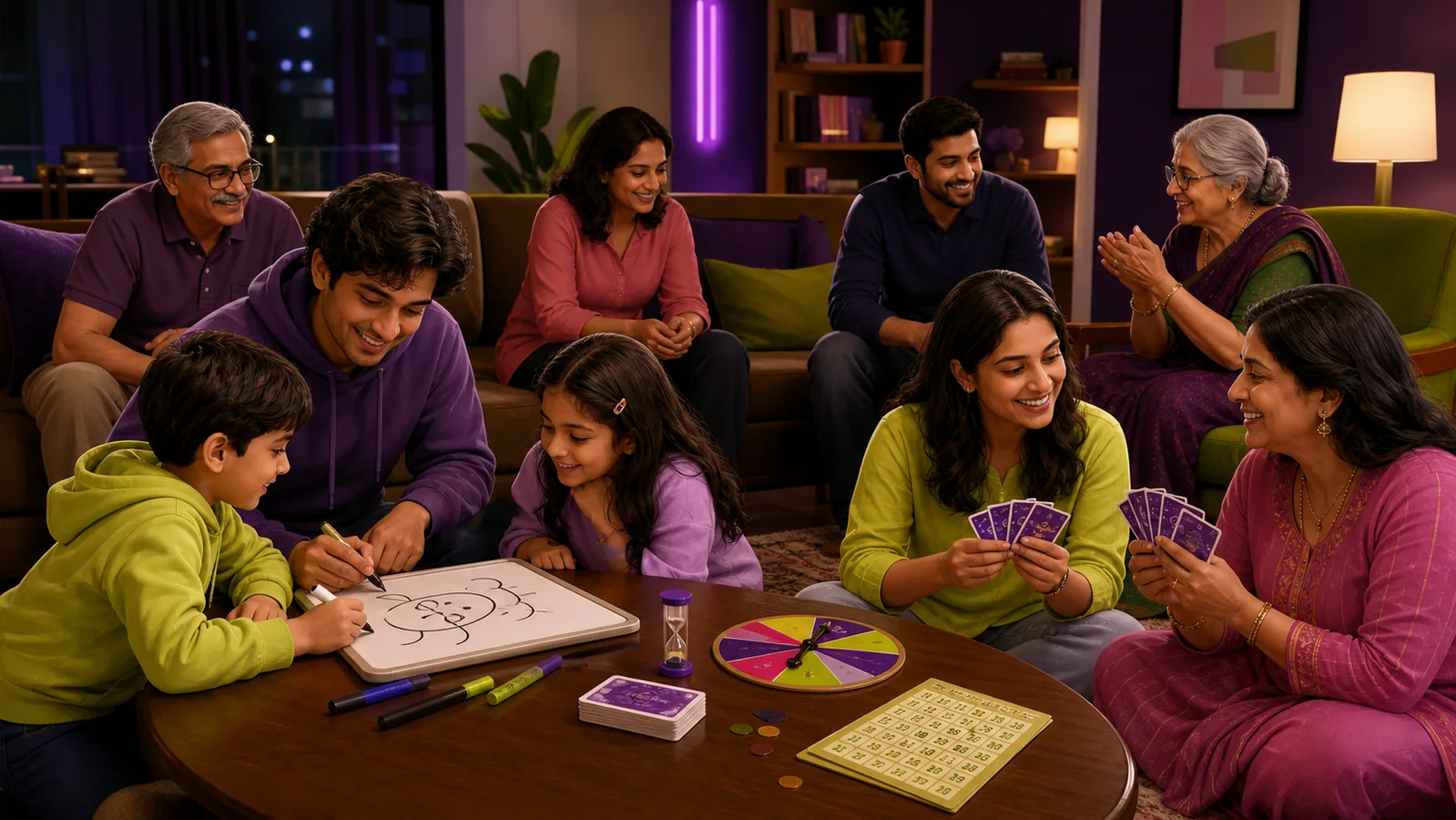
Family gatherings bring together people with different ages, energy levels and ideas of fun. Children may want to move constantly, teenagers may avoid anything that feels childish, adults may prefer conversation, and older relatives may need games that can be played comfortably while seated. The best family party games do not force everyone into the same style of participation. They create an easy way to laugh, talk or cooperate without embarrassing anybody.
This collection includes familiar party formats and original variations that work at birthdays, anniversaries, festivals, reunions, kitty parties and casual weekend get-togethers. Most require little equipment, and several can be run from a phone using free browser tools. Adapt every activity to the available space, language, mobility and comfort of your guests.
Choose games for the group you actually have
Do not select a game only because it looked entertaining in a video. Ask practical questions first. How many people are expected? Do they know one another? Can everybody stand and move safely? Is the event at home, in a hall or outdoors? Will neighbours be affected by noise? How much time is available after food and conversation?
Use a mix rather than ten versions of the same activity. A balanced plan might include one quick icebreaker, one team game, one quiet table game and an optional energetic activity. Keep two backups, but do not insist on completing the entire list.
| Game type | Best for | Typical time | Equipment |
|---|---|---|---|
| Quick random game | Starting the event | 5–10 minutes | Phone or none |
| Seated conversation | Mixed ages | 10–20 minutes | Prompt cards or browser tool |
| Team challenge | Familiar groups | 15–30 minutes | Simple household items |
| Music game | Celebrations | 15–25 minutes | Speaker or singing only |
| Memory game | Family reunions | 10–20 minutes | Paper, photographs or objects |
1. Family Name Wheel
Enter every willing participant into Spin the Wheel and use it to choose the next player, team captain or performer. The spinning animation creates anticipation without requiring a host to pick favourites. Check the list aloud before starting and remove anybody who prefers to watch. For young children, include one parent alongside them when a task may need help.
2. Two-Minute Family Quiz
Prepare short questions about harmless family memories: who makes a particular dish, which city a relative was born in, or what song is played at most gatherings. Avoid questions that expose private history or create arguments. Divide players into mixed-age teams so knowledge is shared rather than concentrated with one generation. Give teams a short time to discuss before answering.
3. Antakshari With a Theme
Classic Antakshari needs no special equipment, but a theme makes a familiar game feel fresh. Choose songs connected to travel, rain, friendship, celebrations or a particular decade. Allow humming when players cannot remember full lyrics, and agree how much of a song must be performed. Never shame somebody for singing ability; the goal is recognition and participation.
4. Pass the Parcel With Family-Friendly Tasks
Wrap a small prize in several paper layers. Between layers, place simple activities such as “tell a joke,” “name three fruits,” or “give someone a compliment.” Players pass the parcel while music plays and remove one layer when it stops. Avoid dares involving personal secrets, unsafe movement or unwanted physical contact. Use recyclable paper and keep the tasks readable.
5. Tambola With Simple Winning Patterns
Tambola works well for large mixed-age gatherings because players can remain seated. Explain the patterns before the first number and use the Tambola Caller so numbers do not repeat. Keep prizes modest and verify every claim against the visible history. When money is involved, hosts are responsible for following applicable local rules and age restrictions.
6. Guess the Family Photograph
Collect photographs with permission and display one at a time. Players guess the person, occasion or approximate year. Choose images that create warm memories rather than embarrassment. Do not use photographs received privately without asking. A variation is to show a cropped section—such as a hairstyle, toy or background—and reveal the full image after guesses.
7. One-Word Story Circle
Players sit in a circle and build a story one word at a time. The result becomes funny because nobody controls the full direction. Begin with a clear opening such as “Yesterday our family discovered…” and continue around the group. Let children use simple words and allow a pass. Stop after two or three rounds and ask one volunteer to read the strange final story.
8. Household Treasure Clues
Hide a small number of clues in safe, permitted areas. Each clue leads to the next using simple observations or family references. Keep private rooms locked and never hide objects near electrical equipment, balconies, cooking areas or fragile displays. For mixed ages, form teams containing an adult and a child. The final “treasure” can be snacks, stickers or the next activity.
9. Random Team Mini-Challenge
Paste participant names into the Team Generator and create balanced random groups. Give every team the same short challenge: build the tallest paper tower, arrange themselves by birthday month without speaking, or invent a team greeting. Random selection prevents repeated family groupings and helps relatives interact with people outside their usual circle.
10. Memory Tray
Place ten to twenty safe household objects on a tray. Show them for thirty seconds, cover the tray and ask players to write or say what they remember. Adjust the number of objects for age. Avoid tiny items around very young children. A cooperative version lets each team submit one combined list, reducing pressure on individual memory.
11. Who Am I? Family Edition
Write the names of well-known fictional characters, public figures or animals on cards. A player receives a card without reading it and asks yes-or-no questions to identify the answer. Do not use the names of family members if the clues could become insulting. Choose references understood across generations, or prepare separate card groups by age.
12. Compliment Circle
Each participant gives a genuine, non-appearance-based compliment to the person on their right. Examples include patience, humour, helpfulness or a skill. This works best in a group with established relationships. Do not force emotional speeches. A written version allows guests to place short anonymous appreciation notes in labelled envelopes for family members to read later.
13. Balloon-Free Dance Freeze
Play music while participants dance or move from their seats. When the music stops, everyone freezes. Anyone who moves performs a tiny harmless task or simply helps control the next music round; elimination is optional. The balloon-free format avoids loud bursting and latex concerns. Keep the floor clear, volume comfortable and movements appropriate for the space.
14. Family Pictionary
Prepare simple words such as kite, mango, train, wedding, cricket or umbrella. One player draws while the team guesses. Use a whiteboard, large paper or a tablet visible to the group. No letters or spoken hints are allowed unless you create an easier children’s round. Select words that do not depend on one profession, language or generation.
15. Charades by Category
Divide prompts into films, household activities, animals and everyday situations. The player silently acts while the team guesses within a time limit. Keep film choices broad enough for the players. A mixed-age team can choose its category before each turn. Avoid acting prompts that mock disability, religion, language or real family conflicts.
16. Would You Rather: Family Mode
Use the Would You Rather Generator in Family Fun mode. Read one two-choice question and ask everybody to show their choice by raising a hand or moving to one side of the room. Invite two or three explanations without debating which answer is correct. This game works especially well while people wait for food or another activity to begin.
17. Coin Flip Tournament
Players pair up and predict heads or tails using the Coin Flip. Correct guesses advance or earn a point. Because no skill is involved, keep prizes light-hearted and do not attach money. A cooperative variation asks teams to achieve three correct predictions together. Agree before each flip whether a technical interruption requires a repeat.
18. Family Bingo
Create bingo cards with descriptions such as “has lived in two cities,” “can cook a festival dish,” or “woke up before 6 a.m. today.” Guests mingle and find somebody matching each square. Avoid sensitive categories involving income, health, relationships or identity. Limit how often one person can sign a card so players speak with several relatives.
19. Minute-to-Win-It Cup Stack
Give each team identical paper or reusable cups and one minute to build and collapse a simple pyramid. Use a stable table away from food and fragile items. Children can compete against their own previous time rather than against adults. Clean and store reusable cups afterward; do not purchase large quantities of disposable plastic only for the challenge.
20. Guess the Spice or Ingredient
Place small amounts of familiar, safe ingredients in closed or clearly managed containers and ask teams to identify them by appearance or aroma. Do not ask guests to taste unknown items. Check allergies and avoid powders that could irritate breathing. A safer picture-based version uses printed or onscreen images of ingredients instead of real samples.
21. Family Talent Flash Round
Invite willing participants to share a talent for no more than sixty seconds: a poem, impression, drawing, tongue twister, short instrumental piece or mental-maths trick. Participation must be optional. Use the Random Name Picker only with people who agreed to join. Applaud every attempt and avoid scoring when ages and experience vary greatly.
22. Reverse Dumb Charades
Instead of one player acting for a team, the entire team acts the same prompt for one guesser. This produces lively visual confusion and lets shy guests participate as part of a group. Choose actions such as boarding a crowded bus, preparing for rain or looking for a lost remote. Keep the performance area free of obstacles.
23. Dice Decision Game
Assign a harmless category to each number on a die: one means tell a joke, two means name a favourite food, three means choose the next song and so on. Use the Dice Roller when physical dice are unavailable. Write the number meanings where everyone can see them and include a simple pass option.
24. Never Have I Ever Without Drinking
Open the Never Have I Ever Generator in Family Friendly mode. Players begin with five raised fingers and lower one when they have done the activity. Nobody needs to describe the experience. Avoid using alcohol or penalties, and stop any statement that feels inappropriate for the group. The purpose is discovering shared everyday experiences.
25. The Family Award Ceremony
Create warm, specific awards such as “Most Helpful Setup Partner,” “Best Storyteller,” “Calmest Traveller” or “Person Most Likely to Bring Snacks.” Ensure everybody receiving an award is comfortable with it. Avoid comments about appearance, marriage, income, academic performance or sensitive habits. Paper certificates or spoken announcements are enough; expensive trophies are unnecessary.
How to arrange the games during the party
Start with a low-pressure activity while guests are still arriving. Conversation games, a name wheel or a short quiz work better than dividing everybody into competitive teams immediately. Run the most energetic game before a heavy meal, not directly afterward. Use seated games during food service delays or when the group’s energy becomes lower.
A sample two-and-a-half-hour flow might look like this:
| Time | Activity | Host note |
|---|---|---|
| 0:00–0:25 | Arrivals and informal conversation | Do not force a game immediately |
| 0:25–0:40 | Quick quiz or Would You Rather | Include newcomers gently |
| 0:40–1:05 | Team challenge or charades | Keep rules short |
| 1:05–1:45 | Food and conversation | Lower the music volume |
| 1:45–2:10 | Tambola, Antakshari or Pictionary | Choose based on group energy |
| 2:10–2:30 | Awards, photographs and closing | Help with transport if needed |
Treat this as a sample, not a compulsory schedule. A family deeply engaged in conversation does not need to be interrupted so the host can complete every planned game.
Make family games inclusive
Use large, readable text and repeat instructions in the languages most comfortable for the group. Offer seated roles in active games, such as timekeeper, scorekeeper or clue reader. Avoid relying only on speed, hearing, vision or cultural references that exclude some participants.
Children should have appropriate adult supervision. Older guests should not be treated as incapable; ask how they would like to participate. Teenagers often respond better when given a meaningful hosting role rather than being ordered into a childish activity.
Consent matters even during “harmless fun.” A person may decline a performance, photograph, question or physical activity without explaining. A good host protects that choice and moves the game forward without drawing attention to the refusal.
Common hosting mistakes
The first mistake is explaining rules for too long. Demonstrate one example and begin a practice round. The second is creating excessive competition. Use points only when they add interest, and avoid public arguments about small decisions. The third is selecting games mainly to generate social-media content. Guests are people, not props.
Also avoid giving every winner a separate expensive prize. Team recognition, humorous certificates or choosing the next song can be enough. If prizes are used, explain the winning rule before the game begins.
Frequently asked questions
How many games should a family party include?
Two or three main games are often sufficient, with one or two quick backups. The right number depends on event length and how much the family enjoys conversation.
What games work for both children and older adults?
Tambola, a family quiz, memory tray, Pictionary, themed Antakshari and Would You Rather can be adapted for mixed ages. Provide readable materials and comfortable seating.
How do I encourage shy family members?
Begin with team or seated activities, offer small roles and never force solo performance. Accept a pass naturally. People often join later after seeing that the atmosphere is respectful.
Do family games need prizes?
No. Applause, choosing the next activity or a simple certificate can provide recognition. Use prizes only when they suit the event and budget.
Can these games be played in a small apartment?
Yes. Choose seated games, conversation prompts, quizzes, Tambola, Pictionary and browser-based random tools. Avoid running, loud music and crowded movement.
Final takeaway
Successful family party games are easy to understand, flexible across ages and respectful of personal boundaries. Choose a small mix suited to the actual guests, prepare materials before the event and let participation remain voluntary. Use random tools for fair selection, teams for gentle social mixing and familiar games for shared memories.
The host’s most important skill is not enforcing the schedule. It is noticing what the room needs. Continue when people are engaged, simplify when rules create confusion and stop while the energy is still positive. That is how a family gathering feels joyful rather than managed.