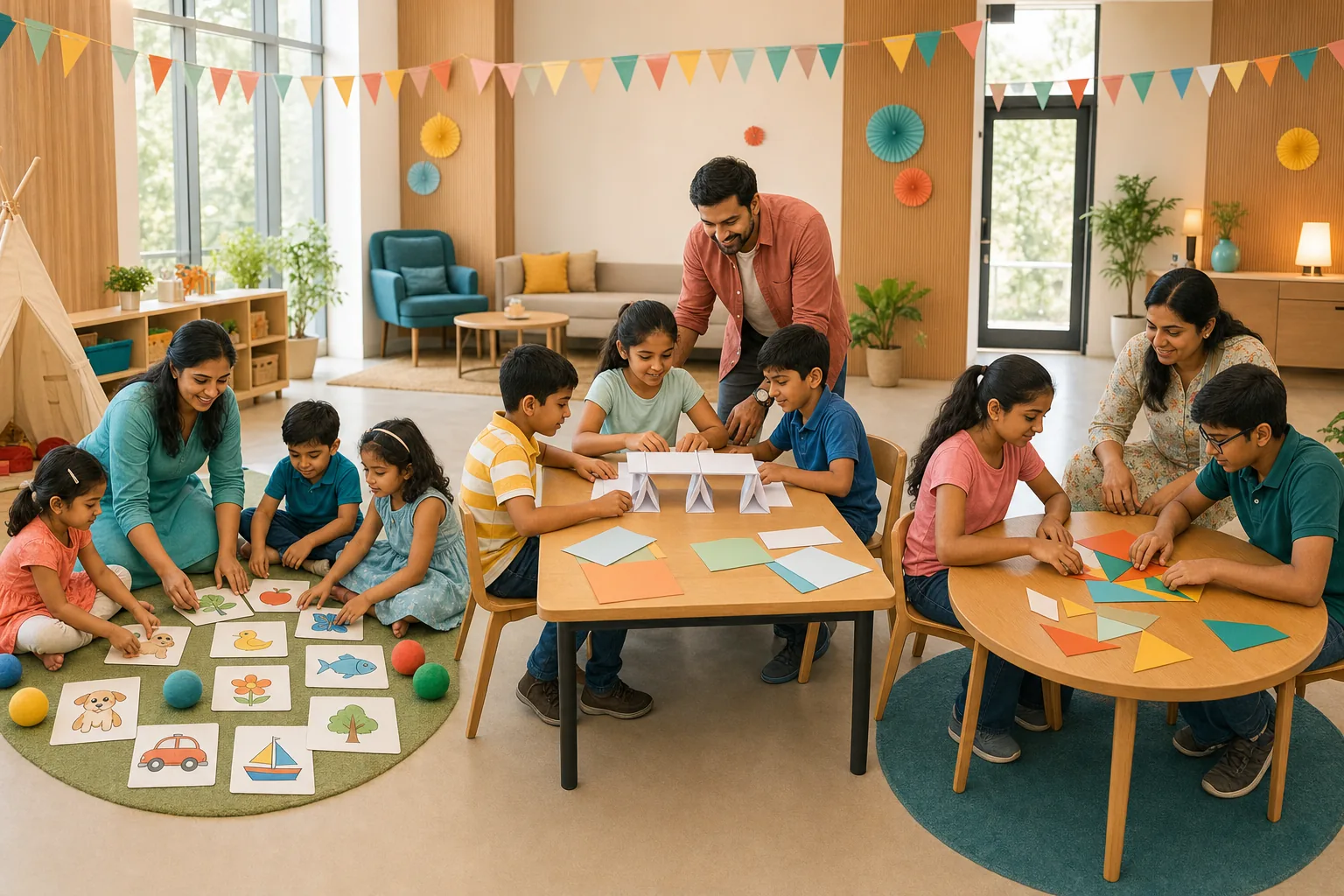
Children enjoy a birthday activity when its rules match their age, attention span and physical ability. A game that delights an eight-year-old may confuse a preschooler, while an activity designed for toddlers may feel childish to an eleven-year-old. The safest plan is not a long list of competitions. It is a small mix of movement, creativity and calm play with active adult supervision.
This guide helps hosts choose games by age group. It is general planning information, not medical or childcare advice. Parents and guardians know each child’s needs best. Ask about allergies, mobility, sensory requirements and supervision arrangements before the party. Participation must remain optional.
Start with supervision and a safe layout
Assign named adults to activity zones instead of assuming every adult is watching every child. One host cannot run music, receive guests, serve food and supervise active play at the same time. Keep entrances, stairs, kitchens, balconies, pools, parking areas and equipment rooms outside the play zone.
| Age group | Typical game length | Helpful format | Adult role | Avoid |
|---|---|---|---|---|
| 2 to 4 | 3 to 6 minutes | Imitation, colours, simple movement | Demonstrate and stay within reach | Elimination, tiny objects and complex rules |
| 5 to 7 | 5 to 10 minutes | Simple teams, matching and make-believe | Repeat rules and manage turns | Long waiting and rough races |
| 8 to 10 | 8 to 15 minutes | Puzzles, relays and creative challenges | Monitor fairness and physical safety | Public embarrassment and uneven teams |
| 11 to 13 | 10 to 20 minutes | Strategy, design and low-pressure social games | Give space while remaining available | Childish framing and intrusive questions |
| Mixed ages | 5 to 12 minutes | Stations and cooperative goals | Adapt roles by ability | One speed-based winner-takes-all contest |
Use the complete party host checklist to review exits, food service, first-aid contacts and pickup arrangements.
Games for ages 2 to 4
Preschool games should use one-step instructions and no elimination. Children may join for a few seconds and return later. Keep groups small and use large, soft materials that cannot become choking hazards.
1. Colour Corner Walk
Place four large coloured mats or sheets in separate corners. Call a colour and invite children to walk to it with an adult nearby. Demonstrate before starting and change the movement gently: walk, tiptoe or move like a slow elephant.
Do not ask children to run. Secure every mat so it cannot slide, and use colours with clear shapes for children who may not distinguish colour easily.
2. Copy the Animal
Show a card with a familiar animal and demonstrate one safe movement: flap arms like a bird, stretch like a cat or take slow elephant steps. Everyone copies together for twenty seconds.
Avoid jumping animals if the floor is hard or crowded. A child may make the sound, hold the picture or simply watch.
3. Soft Ball Roll
Children sit with adults in a wide circle and roll a large soft ball to one another. Say the receiver’s name before rolling. Add a second ball only if the group is calm and understands the pattern.
The ball should be too large to swallow and soft enough for indoor use. Do not throw it toward faces.
4. Picture Matching Trail
Place large pairs of original picture cards on a low table or clean floor: sun and sun, apple and apple, bus and bus. Children choose one card and find its match with adult help.
Use thick cards without sharp corners, and count every piece before and after the activity. Avoid small detachable decorations.
5. Bubble Watch and Pop
An adult blows bubbles in a clear outdoor or washable area while children point, clap or gently pop them. Keep the solution with the adult and prevent children from putting bubble wands in their mouths.
Stop if the floor becomes slippery. Check product guidance and skin sensitivities, and never blow bubbles near food.
Games for ages 5 to 7
Early primary-age children can follow two or three linked steps, but waiting for a turn still feels long. Use short rounds, visible demonstrations and small teams. Give every child a role.
6. Shape Treasure Search
Hide large paper shapes in one supervised room. Children work in pairs to find one circle, one triangle and one square. Mark the allowed area clearly, and keep shapes away from electrical points, furniture gaps and stairs.
This is a search, not a race. Once a pair completes its set, it can help place shapes on a display board.
7. Musical Movement Cards
Play a short music segment while children move in a clear area. When it pauses, show a card with a safe action: freeze, wave, touch shoulders or make a star with arms. Nobody is removed for moving late.
Keep volume moderate and offer ear protection or a quiet watching area. Follow venue rules for music use.
8. Build-a-Creature Collage
Provide large pre-cut paper shapes, glue sticks and crayons. Children combine shapes to invent a creature. Adults supervise materials and write the child’s chosen creature name on the page.
Use washable, non-toxic supplies suitable for the stated age. Avoid loose glitter, staples and very small craft pieces.
9. Beanbag Target Choice
Place large floor hoops or boxes at several distances. Children choose where to stand and toss a soft beanbag. Give points for participation or team totals rather than ranking children by strength.
Ensure nobody crosses the throwing line until all beanbags have stopped. Homemade bags must be securely sealed and large enough not to be a choking hazard.
10. Story Action Circle
An adult tells a two-minute original story with repeated cues. When children hear “rain,” they tap two fingers on a palm; when they hear “sun,” they stretch their arms. Practise the cues first.
Keep the story friendly and predictable. Avoid frightening characters, loud surprises and references to a child in the room.
Games for ages 8 to 10
Children in this group often enjoy problem-solving and team identity. Fair rules matter. Use balanced teams and avoid games where athletic confidence determines every result.
11. Paper Bridge Challenge
Teams receive ten sheets of paper and a limited strip of tape. They have eight minutes to build a bridge between two low boxes that supports a small toy. Demonstrate the safe test and keep scissors with an adult if they are needed.
Score teamwork, design explanation and successful support. Do not let children climb on or lean across tables.
12. Mystery Picture Grid
Give each team a numbered grid and a set of simple drawing instructions: colour square B2, draw a circle in C3 and connect two marked points. The final image reveals a birthday object.
Use original puzzles and provide large print. One child can read instructions, another draw and another check progress so different skills matter.
13. Cooperative Balloon Keep-Up Alternative
Use a lightweight beach ball rather than a latex balloon where allergy or burst noise is a concern. A team tries to keep it moving gently for thirty seconds without grabbing it. Set a boundary and stop if play becomes rough.
Never use this near fans, lights, food or breakable decor. Children with mobility differences can tap from a seated position.
14. Silent Scene Cards
Teams act an everyday scene without words: packing a school bag, making a sandwich or waiting for a bus. The other team has one minute to guess. Rotate performers and let children choose between acting, drawing or keeping time.
Do not include real teachers, classmates, disabilities, cultures or professions as jokes.
15. Code Word Relay
Each team receives an original symbol key where a star means A, a circle means B and so on for six letters. They decode a short word, then carry the answer card—not their bodies—through a hand-to-hand seated relay.
This keeps the relay cooperative without running. Use the same difficulty for every team and allow hints after two minutes.
Games for ages 11 to 13
Pre-teens usually respond better when an activity feels like a real design, strategy or social challenge. Avoid babyish language and do not put anyone’s popularity, appearance or personal life up for discussion.
16. One-Minute Commercial
Teams draw an ordinary safe object and invent a new, useful purpose for it. They have five minutes to prepare a one-minute presentation. Score the idea, clarity and shared participation.
Do not require acting. Teams may present a poster or have one speaker read a prepared description. Avoid copying real brands or making unsafe product claims.
17. Photo Composition Cards
Give groups cards naming a mood, colour and shape. They arrange paper props on a table and photograph a still-life composition. No faces need to appear. An adult handles sharing or deletion according to parent permissions.
Use a designated device rather than collecting children’s personal phones. Do not upload photographs publicly during the event.
18. Escape Envelope
Create three original paper puzzles that lead to a final number or word: a simple cipher, observation image and ordering clue. Put each puzzle in a numbered envelope. Teams solve them at a table without locks or dark rooms.
Offer hints on a fixed schedule and use identical puzzle sets. Avoid fear themes, confinement and time pressure that makes children anxious.
19. Playlist Mood Planner
Teams receive fictional event moments—arrival, cake, calm snack break and final group activity—and choose a music mood for each. They explain their plan without needing to play copyrighted music.
Accept different languages and tastes. The activity is about reasoning, not judging which music is “better.”
20. Would You Rather: Design Edition
Use neutral choices that lead to creativity: design a treehouse or a submarine, explore space or the deep sea, invent a snack or a board game. Children move a token to their choice and discuss in small groups.
Avoid questions about family money, bodies, popularity, romance, punishment or frightening situations. The site’s Would You Rather tool should be reviewed by an adult before use with children.
Mixed-age games that give different roles
When cousins and family friends span several ages, build stations. Younger children can match or colour; older children can read clues, keep scores or help assemble. Older children should not become unpaid supervisors—an adult remains responsible.
| Mixed-age activity | Younger role | Older role | Shared goal |
|---|---|---|---|
| Giant picture puzzle | Find colours and edge pieces | Sort shapes and read clue | Complete one image |
| Story mural | Draw one object | Connect scenes and add captions | Make a group story |
| Soft target trail | Choose target and toss | Record team total | Reach a combined score |
| Music mood cards | Select picture mood | Explain playlist sequence | Plan four event moments |
| Treasure map | Follow picture symbols | Read written clues | Find a shared craft box |
| Paper city | Decorate buildings | Plan roads and labels | Build one tabletop town |
For family gatherings with adults and seniors too, adapt more ideas from family party games.
Plan active and calm cycles
Alternating energy prevents the room from becoming overstimulating. Begin with a simple arrival table, run one movement activity, offer food and water, then shift to a craft or puzzle. Do not schedule several noisy games in a row.
| Party point | Activity style | Approximate time | Reset task |
|---|---|---|---|
| Arrival | Drawing, matching or building | 15 minutes | Confirm pickup contacts |
| First group block | Gentle movement | 8 minutes | Water and seating break |
| Middle block | Team puzzle or craft | 15 minutes | Clear materials before food |
| Food and cake | No organised game | 25 minutes | Check allergies and handwashing |
| Final block | One cooperative game | 10 minutes | Begin calm departure activity |
| Pickup window | Books, colouring or tabletop puzzle | Flexible | Release each child to approved adult |
The party timeline guide can help coordinate food, cake and activities without rushing children.
Create fair teams without public ranking
Ask children to draw colours or symbols from a bag, or use the Team Generator after a supervising adult enters first names. Avoid “captains choose teams,” which can leave one child visibly selected last.
Balance team size and adapt roles. A child can draw, read, arrange, time or explain. Do not publish children’s names, photographs or results online. Clear names from browser tools after use on a shared device.
Prizes and winning
Elimination can turn a short mistake into twenty minutes of watching. Prefer team totals, personal attempts or cooperative targets. If prizes are used, give every child a small equivalent item and use certificates or stickers for categories such as helpful teammate, careful builder or creative idea.
Check choking guidance, allergens and parent preferences before giving sweets or small toys. Do not tie food to performance.
Food, allergies and sensory needs
Keep craft and game materials separate from serving surfaces. Wash hands after shared play and before food. Ask guardians about allergies in advance and retain packaging for ingredients. Never use food-eating races or blind taste tests.
Provide a quieter area with seating, lower lighting and no requirement to talk. Tell children where it is without labelling it as punishment. Warn before music starts, lights dim or a group sings loudly.
Indoor and outdoor precautions
For indoor parties, secure rugs, protect sockets and keep active play away from glass, stairs and hot appliances. In an apartment, follow the noise and space suggestions in the small-party guide.
Outdoors, check heat, shade, hydration, insects, traffic, boundaries and weather. Pools, trampolines and inflatable equipment require specialist safety rules and close supervision; a general party game plan is not a substitute. Cancel or move activities when conditions are unsafe.
Explain rules so children can succeed
Gather attention, show the materials and demonstrate one complete turn. Use short sentences: “Choose one card. Find the matching picture. Put both on your team mat.” Ask a child to show the first turn instead of asking, “Does everyone understand?”
State that stopping or watching is allowed. Never use shame, loss of food or removal from the party as a game consequence. If a child is upset, pause and involve their guardian.
Final takeaway
Age-appropriate birthday games use short rounds, simple rules and active supervision. Preschoolers need imitation and large safe materials; younger school-age children enjoy matching and make-believe; older children can handle design, puzzles and strategy. Mixed-age groups work best when each child has a meaningful role.
Plan fewer games than you think you need, alternate active and calm moments, and keep participation optional. A safe, comfortable child who wants to play is more important than finishing every activity on the schedule.