How to play Antakshari: quick rules
To play Antakshari, split into two or more teams. One team sings a short, recognisable part of a song; the next team starts a different song using the agreed ending sound from that performance. Take turns, avoid repeating songs and award one point for each valid answer. Agree on the language, timer and ending-sound rule before the first round.
- Make two to four teams and choose a host to keep score.
- Agree which languages and song categories are allowed.
- Give each team 20 seconds to start singing, or choose a longer limit for beginners.
- Sing two recognisable lines; the host announces the next starting sound.
- Record used song titles so everyone can check repeats.
- Finish after an agreed number of rounds; the team with the most points wins.
How to play Antakshari in English
For an English-song version, use the same turn-taking format and agree on a clear cue rule. A simple beginner variation uses the last letter of the previous song title as the next title’s first letter. For example, the title Yesterday ends in Y, so the next team could choose Yellow; that title ends in W. This title-letter version is a house variation, not a universal Antakshari rule. If your group prefers the last sung sound, use that consistently instead.
For a mixed Hindi-English group, announce whether both languages are allowed on every turn. Display the next cue as a letter so pronunciation does not leave anyone guessing. No one needs to sing alone: pairs can answer together.
Antakshari help: stuck on a letter?
Try an easier practice round with familiar starting letters, allow one pass per team, or switch to a theme such as travel or friendship. Keep a visible song-title log and pause the timer if the host needs to resolve a disputed cue. For setup, use our random team generator and explore more family party games for Indian gatherings.
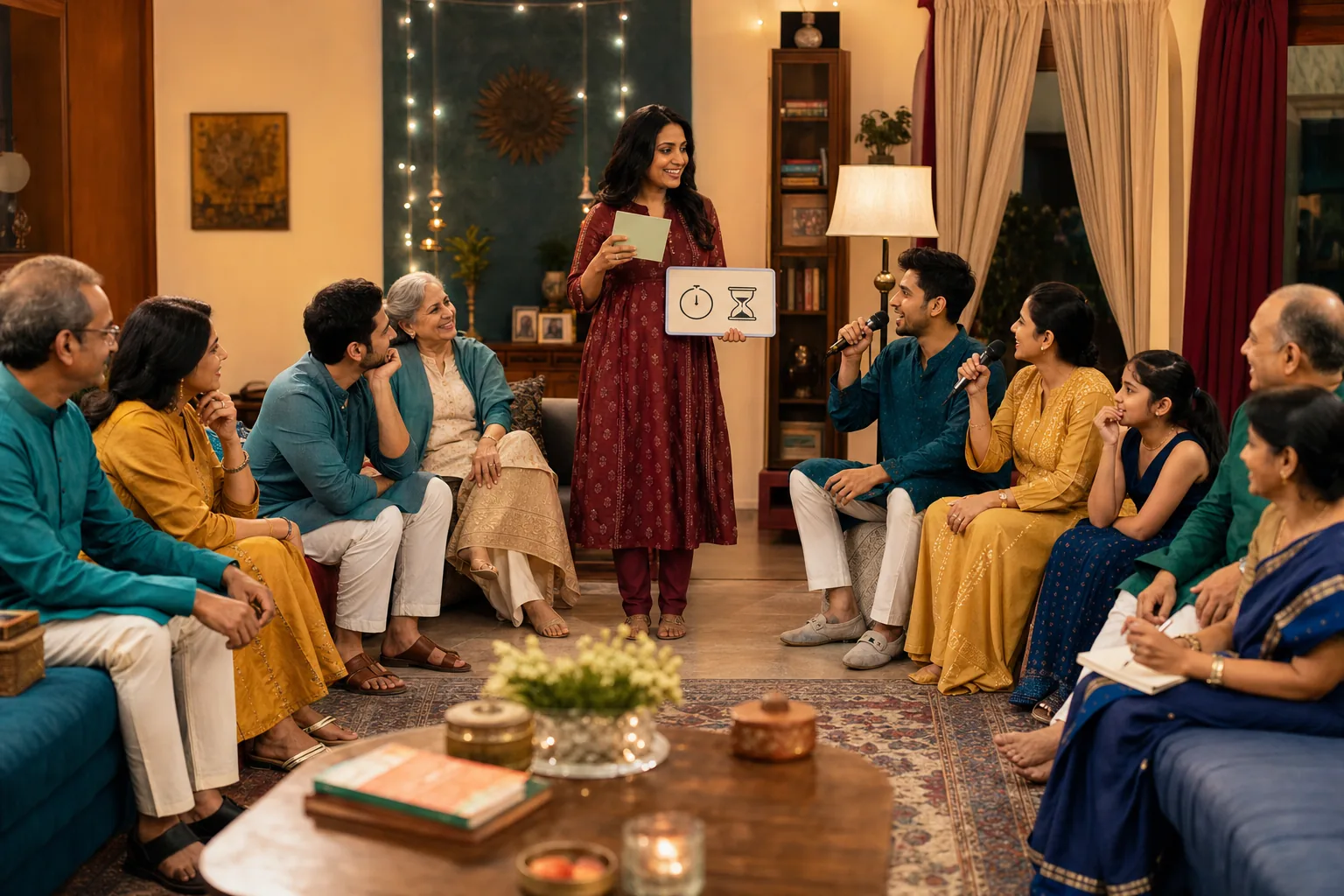
Antakshari works because the basic idea is easy: one team sings, and the next team begins from the ending sound or letter. Yet most disagreements happen when nobody has defined what counts as a valid song, how long a team may think or which sound should start the next turn. A two-minute rules briefing can prevent a forty-minute argument.
This guide offers a practical, respectful format for family gatherings, parties, offices and mixed-age groups. Antakshari traditions vary by language and group, so choose rules that your players understand. The goal is shared music and memory, not proving that one generation or language has better taste.
The basic Antakshari format
Divide players into two or more teams. The first team sings a recognisable portion of a song. The moderator identifies the ending sound according to the agreed rule, and the next team starts a different song from that sound before time runs out. Play continues for a fixed number of rounds or until the scheduled end time.
| Rule element | Recommended default | Decide before playing |
|---|---|---|
| Number of teams | 2 to 4 | Keep team sizes as even as possible |
| Thinking time | 20 seconds | Use one visible timer for all teams |
| Singing requirement | Two recognisable lines or about 15 seconds | Agree whether humming counts |
| Starting cue | Ending consonant sound | Decide how vowels and silent endings work |
| Repeated songs | Not allowed | Keep a simple song log |
| Languages | All languages understood by the moderator, or a stated list | Never change the rule mid-game |
| Scoring | One point for a valid turn | Decide penalties and bonus rounds in advance |
| Game length | 30 to 45 minutes | Use a fixed round count for large groups |
Announce that short lyric fragments are performed socially by players; the host should not print or display full copyrighted lyrics. Use song titles and starting letters on score sheets rather than copying lyrics.
Set up fair teams
Avoid captains choosing players one by one, which can leave somebody selected last. Mix ages and music knowledge where possible. Use the Team Generator for a casual random split, then make one or two transparent adjustments if a team has all experienced singers.
Each team can have different roles: singer, song thinker, timer watcher and song-log helper. Rotate the lead singer so confident performers do not take every turn. Watching and suggesting quietly should remain acceptable.
Choose the first starting sound
Use a neutral random method rather than asking one team to begin with a difficult letter. Put common starting letters on cards, roll a die linked to a six-letter list or use the Spin the Wheel after showing all options.
Remove sounds that are unreasonably rare in the languages being used. The first cue should start the game, not eliminate a team immediately.
Define the ending sound rule
Many Hindi Antakshari groups ignore a final vowel sound and use the last meaningful consonant sound. Other language groups may use the final spoken letter or syllable. There is no need to declare one tradition universally correct; the group needs one consistent method.
The moderator should repeat the next cue clearly: “The accepted ending sound is M, so Team Two begins with M.” If a pronunciation is disputed, pause the timer while the moderator decides.
Decide what counts as a valid song
A valid entry should be a recognisable released or traditional song within the agreed categories. The team sings the agreed minimum portion with a clear beginning. It may use any singer and may change key. Perfect pitch is not required.
Decide in advance whether the following count:
- Film songs, independent songs and folk songs.
- Devotional music, if appropriate to the group and setting.
- Advertisements, jingles, television themes or nursery songs.
- Translated or multilingual versions.
- A song already used in a medley.
Do not add a category only when a team needs it. Consistency matters more than strictness.
Use a simple scoring system
Award one point for a valid song completed within the time. If a team cannot answer, the next team may steal for one point using the same cue. After the steal, return to the normal rotation with a new cue based on the stolen song.
Avoid subtracting several points for one mistake. A harsh penalty makes teams argue about every detail. For a relaxed family game, track successful turns and give a small bonus for involving a new singer.
| Event | Points | Moderator action |
|---|---|---|
| Valid song in time | +1 | Record title and next cue |
| New lead singer for that team | Optional +1 once per player | Mark the rotation bonus |
| Repeated song | 0 | Ask for another song if time remains |
| Song starts from wrong cue | 0 | Explain and offer remaining time |
| Team passes | 0 | Offer a steal to the next team |
| Successful steal | +1 | Continue from the stolen song’s ending |
| Moderator error | No penalty | Reset the turn with full time |
Appoint a neutral moderator
The moderator explains rules, controls the timer, confirms cues and records used songs. They should not whisper answers to a favourite team. In a competitive group, use two moderators from different teams or appoint a non-playing host.
Keep a “review once” rule: a captain may request one brief review, the moderator hears the reason and makes a final decision. Do not spend longer debating than singing.
Classic round structure
Begin with two practice turns that do not score. Then play three blocks of five turns per team, with a short break between blocks. A fixed structure lets the host estimate the finish time and prevents the game from continuing until guests lose interest.
Use the party timeline guide to place Antakshari away from food service, speeches and quiet hours.
Variation 1: Theme Antakshari
Choose a broad theme for one round: travel, friendship, seasons, celebration or nature. Songs must reasonably connect with it. Announce the interpretation rule and accept more than one language.
Avoid themes involving grief, romance or religion unless they suit every participant and the occasion.
Variation 2: Decade Round
Assign a decade to each turn or let teams draw decade cards. This creates variety without demanding obscure trivia. Use broad periods when exact release years are difficult to verify.
The moderator should have a reliable reference for disputes. If the year remains uncertain, allow the song and move on rather than inventing a fact.
Variation 3: Word-in-Song Round
Instead of an ending sound, the host shows a neutral word such as rain, road, heart, night or friend. Teams sing a song that clearly contains the word in the agreed language.
Do not ask players to produce or display full lyrics as proof. A recognisable line containing the word is enough, subject to the group’s performance rule.
Variation 4: Picture Prompt Round
Show original or properly licensed illustrations: train, moon, flower, city, river or letter. Teams connect the picture to a song title or recognisable line. Accept reasonable interpretations.
This format supports mixed literacy levels and avoids difficult ending sounds. Do not download random copyrighted images without permission.
Variation 5: Humming Round
One team member hums a melody without words while teammates identify the song. After identification, the team sings the minimum agreed portion. Set a thirty-second limit.
Humming should not replace every turn because strong melody recognition can dominate. Use it as one bonus round.
Variation 6: Pass-the-Mic Round
Every successful turn must use a different lead singer. Teams plan their rotation and receive a small bonus after all willing members have led once.
The microphone may be symbolic; shared equipment should be handled hygienically. Nobody is forced to sing alone. Two players may lead together.
Variation 7: Table Antakshari
For a large event, each table plays its own five-turn mini-round using printed cue cards. Table captains record song titles. Winning tables send two volunteers to a short final.
This prevents fifty people from waiting for one stage turn. Provide the same cue difficulty and time limit at every table.
Variation 8: Reverse Antakshari
Give teams a starting sound and a required ending sound. They must find a song that begins and ends according to both cues. Use common sounds and a longer thinking time.
This is difficult, so play only two bonus turns and allow a pass without penalty.
Variation 9: One-Minute Song Chain
A team has one minute to build its own chain of short song openings, where each new title starts from the previous ending sound. Count valid, non-repeated songs rather than performance quality.
Use only short recognisable fragments; do not print lyrics. This matches interest in one-minute party games while staying clearly connected to Antakshari.
Variation 10: Collaborative Final
Remove team scoring for the last five minutes. The whole room tries to complete ten consecutive valid songs without a repeat or timeout. Display a simple progress counter.
This ends the event with shared success and reduces tension after a close score.
Adapt Antakshari for mixed ages
Children may know animation, school and contemporary music, while older guests may remember folk, film or regional classics. Use category blocks rather than expecting everyone to know the same catalogue.
| Guest need | Helpful adaptation |
|---|---|
| Young children | Pair with an adult and allow a prepared children’s-song round |
| Seniors | Provide seating, clear audio and longer response time |
| Shy singers | Allow pairs, humming, scorekeeping or picture prompts |
| Multilingual group | Rotate language-open and language-specific rounds |
| Hearing difficulty | Display the cue letter and timer visually |
| Large group | Use table rounds and a short volunteer final |
| Remote guests | Show cue cards on screen and use a strict speaking order |
For more mixed-age formats, see family party games.
Handle repeated songs
Keep a visible log containing only song titles and starting cues. When a repeat occurs, pause the timer, show the record and let the team choose another song with its remaining time. If the log is incomplete, give the benefit of the doubt.
Do not rely on one person’s memory for a long game. A paper sheet or shared display is enough.
Resolve language and pronunciation disputes
Ask a speaker familiar with the language to explain the ending sound. The moderator decides whether it meets the agreed rule. Nobody’s accent should be mocked, imitated or scored.
If two pronunciations are commonly used, accept either and announce the cue selected for the next turn. Consistency and respect are more important than winning a linguistic argument.
Keep music use appropriate
Live social singing is different from reproducing full recordings or publishing lyrics. The host should follow venue, platform and applicable licensing requirements when playing recorded music, streaming the event or posting clips.
Do not upload long performance videos or lyric sheets without the necessary rights and consent. Ask before recording individual guests.
A 40-minute hosting plan
| Time | Activity | Host task |
|---|---|---|
| 0:00–0:04 | Rules and practice | Confirm languages, timing and cue rule |
| 0:04–0:14 | Classic round | Rotate lead singers |
| 0:14–0:20 | Word-in-song round | Show five neutral words |
| 0:20–0:25 | Short break | Check song log and microphone |
| 0:25–0:33 | Picture or decade round | Keep prompt difficulty balanced |
| 0:33–0:38 | One-minute chain | One attempt per team |
| 0:38–0:40 | Collaborative final | End with shared applause |
Stop on schedule even if teams are tied. Use one pre-announced bonus cue as a tie-break, or let the result remain a tie.
Microphone and room setup
Seat teams so players can talk without shouting across the room. Keep speakers at a comfortable level and test the microphone before guests gather. Do not place cables across walkways or give active wireless equipment to small children.
Provide drinking water and a quieter seating area. At home, follow the noise guidance in the small apartment party guide.
Common hosting mistakes
The first mistake is using rare letters repeatedly because the host thinks difficulty creates excitement. It usually creates passes. The second is allowing one expert singer to answer every turn. Rotate leads and reward participation.
Other mistakes include changing language rules mid-game, arguing about exact lyrics, playing long recordings, ignoring the programme schedule and forcing shy guests to sing solo. Clear rules solve most of these problems.
Final takeaway
A good Antakshari game needs fair teams, one agreed ending-sound rule, a visible timer and a simple song log. Start with practice turns, rotate singers and use only a few variations. Picture prompts, theme rounds and a collaborative final make the game more inclusive without losing its familiar structure.
The moderator’s job is not to prove superior music knowledge. It is to keep turns clear, decisions consistent and the room singing together.