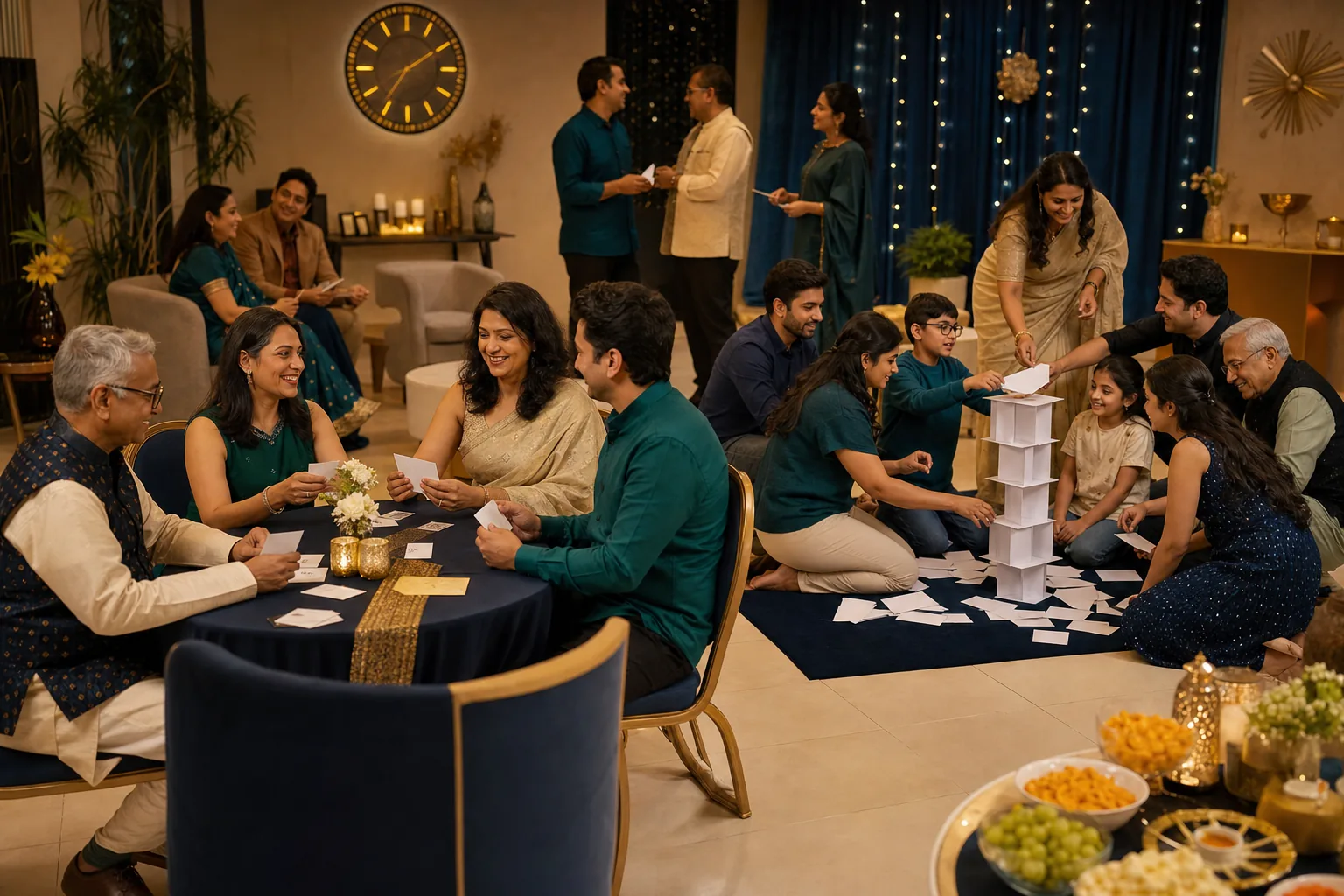
A New Year gathering has an unusual rhythm. Guests may arrive at different times, dinner can run late and attention becomes focused on the countdown near midnight. Games are useful when they fill natural gaps, introduce people gently and give the room a shared moment before the final celebration. They become frustrating when every guest is expected to perform or a long competition blocks food and conversation.
The activities below suit family homes, apartments, restaurants, offices and community halls. Most can be shortened, played at tables or adapted for guests who prefer to watch. Confirm venue timing, sound limits, transport and local rules before the event.
Match the activity to group size
Small groups can play one conversation or memory game together. Large gatherings need table teams, visible rules and a strict timekeeper. Do not run a single-file game for sixty people; most guests will wait rather than play.
| Group size | Better format | Useful game length | Host support |
|---|---|---|---|
| 4 to 8 | Whole-table cards, predictions and creative tasks | 5 to 12 minutes | One host can join the game |
| 9 to 20 | Two or three small teams | 8 to 15 minutes | One host and one scorekeeper |
| 21 to 50 | Table challenges and short stage reveal | 10 to 18 minutes | Host, timer and materials helper |
| 51 to 100 | Self-guided table cards plus one audience round | 8 to 12 minutes | Stage host, table captains and sound check |
| More than 100 | Stations, screen-based quiz or table voting | Fixed short blocks | Event team and written run sheet |
Estimate tables and materials after using the guest-number guide. Prepare a few extra cards, but avoid printing an entire pack for every person when one set per table will work.
1. Year in Headlines—Personal Edition
Guests write a fictional, positive headline summarising one ordinary achievement from the year: “Finally Learned to Cook Three Breakfasts” or “Read Twelve Books Without Losing the Bookmark.” The host mixes the cards and reads them aloud while the group guesses the writer.
Writing is optional. Avoid health, money, relationship and workplace subjects unless the writer freely chooses them. Screen cards before reading.
2. Memory Month Match
Ask willing guests to submit one neutral shared event in advance. Put event cards and month cards on a table, then let teams match them. Use only memories approved for the group.
Do not include photographs or stories involving people who have not consented. This works best with close friends or family, not new colleagues.
3. Future Postcard
Give each guest a card addressed to their future self at the end of the coming year. Prompts can be practical: a skill to practise, place to explore or habit to make easier. Guests seal and keep their own cards.
Nobody has to share. Do not collect addresses or promise to mail cards unless there is a clear privacy and storage plan.
4. Prediction Bowl
Prepare neutral predictions about shared interests: a colour that may become popular, a food the group will try, a travel style or a technology habit. Teams choose one of three options and place a token in a bowl.
Avoid politics, disasters, health, finances and real people’s private decisions. The activity is playful, not a claim about the future.
5. Countdown Category Round
Give a team a broad category such as things in a kitchen, travel items or indoor hobbies. Starting at ten, the host counts down while players name ten different items. The round ends at zero without eliminating anyone.
Use categories with many fair answers and accept words in languages represented in the group.
6. Midnight Pictionary
Prepare original cards with neutral New Year situations: calendar, alarm clock, group photograph, party hat, travel plan or morning tea. A player draws while the team guesses within forty-five seconds.
Avoid drawing real guests or culturally specific celebrations as jokes. Offer large paper and a seated role.
7. Resolution Without Pressure
Teams receive fictional characters and practical goals: a busy student wants to read more, a home cook wants less food waste or a traveller wants to pack lighter. They create one small first step for the character.
Using fictional scenarios keeps the game from becoming a public review of guests’ bodies, habits or productivity. Do not ask anyone to reveal a personal resolution.
8. One-Minute Paper Calendar
Give teams twelve month cards and several original event icons. They have one minute to place the months in order and match four seasonal icons. Add symbols rather than relying on colour alone.
Use identical card sets and a clear table. This quick game fits the rising interest in one-minute party activities without adding personal pressure.
9. New Year Bingo
Create several original bingo layouts with moments such as someone checks the time, a group photograph begins, a guest chooses dessert or a song from an earlier decade plays. Guests mark moments naturally.
Nobody should manufacture an event, interrupt conversation or photograph another guest to prove a square.
10. Best of the Year Categories
Tables choose favourites from neutral categories: home-cooked snack, useful app feature, book genre, outdoor activity or travel comfort. Each table explains one choice in thirty seconds.
This is not a popularity contest about people. Keep brands optional and avoid debates that become political or personal.
11. Paper Tower Countdown
Teams receive ten sheets of scrap paper and a short strip of removable tape. They have five minutes to build a free-standing tower that supports a paper star. A visible timer ends the challenge.
Keep drinks away from the building table and recycle materials. Score stability, teamwork and explanation, not only height.
12. Silent Timeline
Volunteers arrange four large cards—morning, afternoon, evening and midnight—without speaking. The host then gives activity cards such as breakfast, sunset photograph and countdown, and the group places them on the timeline.
This is a cooperative warm-up, not a test. Provide a table version for anyone who prefers not to stand.
13. Decade Music Mood Match
Display decade cards and mood cards such as relaxed, road-trip, celebration and dance. Teams pair a decade with a mood and suggest a song or music style. They explain one choice.
Nobody must sing or dance. Follow venue and platform rules for recorded music, and welcome all languages.
14. New Year Reverse Charades
One player guesses while the rest of the team acts the same prompt: watching a countdown, packing for a trip, finding a charger or taking a group photograph. The team has forty-five seconds.
Use gentle movements, allow seated acting and never include intoxication, accents, professions or real guests as prompts.
15. Clock Face Team Puzzle
Give each table a large blank clock face and number cards. Teams place the numbers correctly, then solve three simple time clues. Use original materials with large, high-contrast print.
This works for mixed ages but should not be framed as a school test. Offer hints after one minute.
16. Photo Caption Time Capsule
Show an original illustration of a harmless New Year situation, such as too many alarm clocks or a calendar page that will not turn. Teams write a caption and one invented sentence about what happens next.
The host screens entries and reads them anonymously. Do not use photographs of real people without permission.
17. Two Truths and One Hope
Instead of asking for personal secrets, provide fictional character cards containing two established facts and one possible hope. Teams identify which statement is the hope and explain their reasoning.
If close friends want to write their own cards, sharing remains optional and statements must stay low-stakes. No one should be pressured to reveal future plans.
18. Tabletop Scavenger List
Teams look only among items guests willingly place on the table: a blue pen, paper receipt, reusable bottle, round key ring or blank card. The host checks the list after two minutes.
Never request money, medication, identity cards, photographs, private messages or contents of a bag. Nobody should run through the venue.
19. Group Story: Twelve Months
The first player begins an imaginary year with one sentence. Each next player adds a month and one event. Stop after twelve short sentences. A timekeeper keeps each contribution under ten seconds.
The story must remain fictional and respectful. People may pass or serve as the recorder.
20. Year Ahead Design Board
Give teams paper icons for learning, rest, travel, food, friendship and creativity. They create a fictional balanced-year board for an imaginary community centre or family.
This avoids turning private goals into public content. Use reusable icons and no personal photographs.
21. Countdown Soundscape
Teams receive a safe scene such as a railway station at midnight, quiet city balcony or family kitchen before a celebration. They create gentle sound effects while one narrator describes it.
Set a volume limit and warn guests. People with sound sensitivity can write, narrate or keep time.
22. Team Name Picker
Enter willing team names into the Random Name Picker to decide presentation order. Show the list, remove duplicates and explain that the result controls order only.
Do not enter full names or personal details on a public or shared screen. Clear the list after the event.
23. Countdown Wheel
Add six short, neutral prompts to the Spin the Wheel: clap rhythm, group wave, choose a music mood, share a hosting tip, solve a category or pass. Spin once at selected points in the final half hour.
Include “pass” and review every prompt. The wheel should not trigger dares, drinking or unwanted performance.
24. First Kind Act Cards
Guests write one small, realistic act that could make a shared space better: label leftovers, return a borrowed book or thank a helper. Cards are mixed and displayed as ideas rather than promises.
Do not collect names or judge whether someone completes an idea. Keep suggestions lawful, safe and non-financial.
25. Midnight Applause Map
Give each table cards naming groups to appreciate: hosts, cooks, drivers, cleaners, decorators and guests who travelled. Before the countdown, the host thanks each group and invites brief applause.
Confirm names and roles in advance. Appreciation should not expose anyone’s employment status or leave a contributor out.
Select games by energy and noise
The final hour should not contain several loud activities. Pair one active game with calm table formats.
| Game | Energy | Noise | Best group size | Typical time |
|---|---|---|---|---|
| Future Postcard | Low | Quiet | Any | 8 minutes |
| Countdown Category | Medium | Moderate | 4 to 20 | 6 minutes |
| Paper Calendar | Low | Quiet | 4 to 40 | 3 minutes |
| Reverse Charades | Medium | Moderate | 8 to 30 | 10 minutes |
| Paper Tower | Medium | Moderate | 8 to 40 | 8 minutes |
| Bingo | Low | Quiet | Any | Flexible |
| Story: Twelve Months | Low | Moderate | 4 to 12 | 8 minutes |
| Countdown Wheel | Low | Moderate | Any | 1 minute per spin |
For an apartment, keep the late programme quiet and follow the small apartment party guide.
Plan the final ninety minutes
Finish the main game well before midnight. Guests need time for refreshments, photographs, transport decisions and the countdown. A self-guided card works better than a new fifteen-minute tournament at 11:50.
| Time before midnight | Activity | Host responsibility |
|---|---|---|
| 90 minutes | One table or team game | Explain, demonstrate and time it |
| 70 minutes | Food and conversation | Pause organised play |
| 40 minutes | Bingo check or one wheel spin | Keep announcement under five minutes |
| 25 minutes | Photographs and refreshments | Clear active game materials |
| 10 minutes | Confirm countdown source and sound | Stop all competitions |
| After midnight | Greetings and calm music | Check transport and guest wellbeing |
Build the wider evening with the party timeline guide.
Keep prizes simple
Use shared snack packs, notebooks, plants or playful paper certificates. A winning table can choose a music mood or photo backdrop rather than receive a physical prize. Avoid alcohol-centred rewards and expensive items that make casual results feel unfair.
If teams tie, explain the tie-break before using a random draw. Do not improvise a private or embarrassing task.
Alcohol, transport and late-night safety
Never connect game performance to drinking. Do not use drinking races, mystery beverages or penalties. Provide non-alcoholic choices, drinking water and food. Follow venue and local rules.
Plan safe transport before midnight, not after guests are ready to leave. Nobody who may be impaired should drive. Keep entrances and stairs well lit, secure cables and avoid active games near glassware.
Photography, privacy and consent
Ask before close-up photographs or posting images publicly. A group countdown does not remove individual consent. Provide a place where guests can stand outside the main camera view.
Do not collect phones for a game or request messages, galleries, contacts or passwords. Children’s images require guardian permission.
Explain every game in under a minute
State who joins, what they do, how long it lasts and how it ends. A clear script is: “Tables have five minutes to build a paper tower. It must stand by itself and hold the paper star for three seconds. Watching or keeping time is welcome.”
Demonstrate one example. Use a visible timer and stop on schedule even when no team has finished.
Final takeaway
Good New Year party games fit the group and leave space for the countdown. Small dinners suit memory cards and conversation; large events need table teams and short shared reveals. Use one main activity, a flexible background game and a calm final prompt.
When participation is optional, rules are clear and the final hour stays organised, games help guests connect without making the evening feel overplanned.