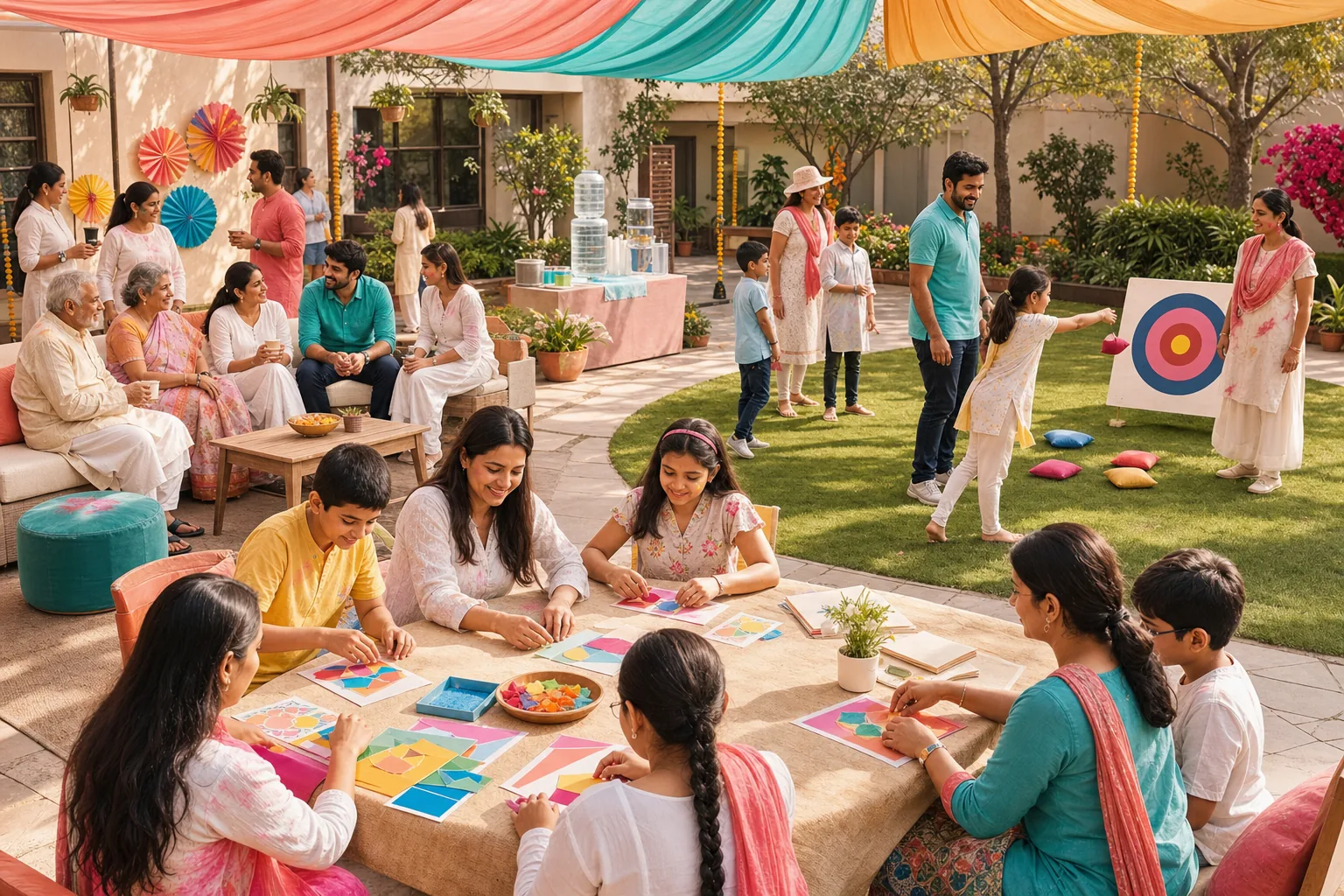
Holi gatherings can be joyful, energetic and visually memorable, but games need more planning than a normal indoor party. Colour, water, crowded movement, slippery surfaces, sun exposure and sound can affect guests differently. A good activity makes consent visible, protects quiet spaces and never treats discomfort as part of the fun.
This guide focuses on optional social games, including water-free formats. It is not medical advice or a substitute for product instructions, local rules or responsible adult supervision. Holi traditions vary between families and communities, so confirm the programme with the hosts and respect the meaning of the occasion.
Create clear participation zones
Do not make the entire venue a colour-play area. Mark a dry welcome zone, an active game zone, a quiet seating area, food service and a handwashing or cleanup point. Guests should be able to arrive, eat and talk without being touched by colour or water.
| Zone | Purpose | Useful setup | Key rule |
|---|---|---|---|
| Dry welcome zone | Greetings, bags and phones | Shade, chairs and labelled storage | No colour or water crosses the boundary |
| Water-free game zone | Cards, puzzles and table activities | Covered tables and washable mats | Clean hands before shared materials |
| Active outdoor zone | Gentle relays and target games | Flat ground and clear perimeter | No running on wet surfaces |
| Quiet zone | Rest and lower stimulation | Seating, shade and drinking water | No speakers, spraying or surprise contact |
| Food zone | Serving and dining | Separate utensils and bins | No game materials near food |
| Cleanup point | Handwashing and waste sorting | Water, towels and labelled bins | Adult supervision for children |
Use the complete party host checklist to review exits, electricity, first-aid contacts and pickup plans.
Consent comes before every game
Ask before applying colour, spraying water, taking a photograph or adding a person to a team. A general invitation is not permission for physical contact. Use visible participation choices such as coloured wristbands only if guests agree: one for dry games, one for colour play and one for watching. Explain what each means and let people change their choice.
Never chase, corner or shame someone who declines. Children need guardian guidance, but a child’s own discomfort still matters. Avoid games built around surprise colour application.
1. Holi Colour Match Cards
Prepare original cards with patterns made from two or three colours. Teams receive separate colour tiles and recreate the pattern within one minute. Add symbols to the tiles so the task does not rely only on colour perception.
This is a clean arrival activity. Laminate reusable cards with a matte finish or print on recycled paper and keep them in the dry zone.
2. Water-Free Rangoli Puzzle
Print an original geometric pattern and cut it into large pieces. Teams assemble identical sets on covered tables. The design can be inspired by spring colours without copying a living artist’s work.
Use pieces large enough for the age group and avoid loose powder. This works for offices, apartments and guests who want to stay completely dry.
3. Spring Observation Bingo
Create bingo cards with neutral visible moments: a flower decoration, a green scarf, someone choosing lemonade, a group photograph or a reusable water bottle. Players mark squares naturally.
Do not include colour application, religious actions or private behaviour as targets. Nobody should interrupt another guest to complete a square.
4. Colour Sequence Memory
Show a row of coloured shape cards for fifteen seconds, hide it and ask teams to rebuild the sequence. Increase from four to seven cards over three rounds.
Use the same viewing time for every team. Add printed shapes or numbers for guests with colour-vision differences.
5. Flower Petal Sorting Alternative
Use reusable fabric petals or large paper shapes rather than picking fresh flowers solely for a game. Teams sort them by shape, size or pattern and create a small table design.
Keep pieces away from toddlers and food. Reuse or recycle materials after the event.
6. Holi Pictionary
Prepare original cards with safe, neutral prompts: spring garden, sunglasses, water bottle, group photograph, snack plate or colourful umbrella. Players draw while teammates guess.
Avoid sacred imagery unless the hosts specifically review and request it. Do not caricature real guests, communities or traditional clothing.
7. Silent Spring Scene
One player acts an everyday outdoor scene without words: opening an umbrella, finding shade, filling a water bottle or arranging a picnic mat. The team has forty-five seconds to guess.
Offer seated acting and rotate roles. Never ask anyone to imitate intoxication, an accent, a disability or a specific person.
8. Colour Category Countdown
Announce a colour and invite teams to name safe everyday objects commonly associated with it. Each answer must be new, and the round ends after sixty seconds.
Accept reasonable regional and language variations. Do not ask children to run and collect objects from around the venue.
9. Paper Pichkari Design
Give teams a printed outline of a traditional water sprayer and coloured pencils. They create a fictional decorative design using three required shapes. This is a drawing task; no water equipment is involved.
Use washable, age-appropriate supplies. Display work only with the creators’ permission.
10. Team Scarf Wave
Each team receives a clean, lightweight scarf or fabric strip. Standing or seated players create a short sequence: lift, pass, circle and lower. The goal is to perform together, not move quickly.
Keep fabric away from faces, necks, fans and food. Do not use long cords or run with fabric.
11. Dry Beanbag Colour Targets
Place large coloured hoops or boxes on flat, dry ground. Players choose a distance and toss soft beanbags toward a target. Score team totals, with nearer targets worth fewer points.
Only collect bags after every throw has stopped. Do not use this activity on wet tiles, roads or near glass.
12. Sponge Transfer Without Throwing
If the hosts choose a water activity, place two buckets close together on grass or another suitable non-slip outdoor surface. Players carry a damp sponge by walking, squeeze it into a second bucket and return. Nobody throws the sponge or runs.
Use clean water, adult supervision and a small quantity. Skip the activity where water use is restricted, weather is cool, surfaces become slippery or guests do not consent.
13. Cup Measure Team Challenge
Teams use a marked cup to move water between nearby containers and try to reach a target line in three minutes. Participants walk slowly, and one adult watches the surface.
This is optional and should use minimal water. Keep it separate from food, electricity and dry zones. Stop immediately if the ground becomes unsafe.
14. Colour Flag Relay
Place large paper colour flags on a table at one end of a dry lane. A player walks to collect the colour announced by the host and returns it to the team board. The next player begins only after a hand signal.
Use walking, not running. Provide a seated version where players choose flags from a nearby set.
15. Spring Sound Story
Give teams an original short scene such as morning birds, a garden breeze or a family picnic. Members create gentle sound effects while one narrator describes it.
Set a volume limit and warn before starting. Guests with sound sensitivity can write the narration or keep time.
16. Holi Caption Challenge
Show an original illustration of a harmless situation, such as friends trying to organise colour packets by shade or a picnic blanket that will not fold. Teams write a short caption.
The host screens entries before reading them anonymously. Captions must not target skin tone, clothing, bodies, culture or people who avoid colour play.
17. Common Ground: Spring Edition
Mixed teams have three minutes to find four neutral things they share: a favourite fruit, preferred outdoor time, music mood or spring colour. Each group shares one discovery.
Passing is always allowed. Avoid health, religion, money, relationship status and personal celebration practices.
18. Music Mood Planner
Teams receive fictional programme points—arrival, calm snack break, active game and closing—and choose a music mood for each. They can suggest a style or song title and explain one choice.
Nobody has to sing or dance. Follow venue and platform licensing rules if music clips are played.
19. Safe Photo Composition
Give groups three cards: a colour, a shape and a mood. They arrange paper props on a table and photograph the still life. No faces are required.
Use a designated device and ask before sharing. Do not collect personal phones or post children’s images publicly.
20. Holi Quiz Without Ritual Testing
Build a short quiz about general spring, colour mixing, water conservation and safe hosting. Use questions with clear, verifiable answers and provide sources to the host.
Do not test religious knowledge or rank guests by how they celebrate. Customs differ, and a party game is not an exam.
21. Cooperative Colour Mural
Cover a table and give each guest one paper square to decorate using crayons or pencils. Join the squares into a group mural. Write names only with permission.
Use non-toxic, washable materials and avoid airborne powder or loose glitter. Keep the mural in the dry zone.
22. Team Name Wheel
For a casual prize or turn order, enter team names into the Spin the Wheel. Show the final list, remove duplicates and explain what the result decides.
Use this only for low-stakes entertainment. A regulated or high-value promotion needs written rules and appropriate legal review.
23. Gentle Cleanup Challenge
At the end, teams receive gloves and clearly labelled bags for safe, dry materials only. They sort paper, reusable props and general waste in a supervised area. The goal is a shared cleanup target, not a speed race.
Adults handle wet waste, broken items, unknown substances and anything near traffic or electricity. Children should never collect unsafe litter.
24. Appreciation Cards
Guests may write one thing they enjoyed: a conversation, snack, colour palette, quiet area or activity. Collect cards for the host to read later.
Writing is optional. Screen anonymous messages and do not ask anyone to explain why they avoided a particular activity.
Select water-free, active and calm options
Build a mix that gives every guest a comfortable way to join.
| Activity | Water use | Contact | Energy | Best location |
|---|---|---|---|---|
| Colour Match Cards | None | None | Low | Dry table |
| Rangoli Puzzle | None | None | Low | Home, office or hall |
| Pictionary | None | None | Medium | Covered table |
| Beanbag Targets | None | None | Medium | Flat dry outdoor area |
| Scarf Wave | None | Shared prop | Low to medium | Clear indoor or outdoor space |
| Sponge Transfer | Small amount | Shared prop | Medium | Suitable non-slip outdoor ground |
| Cup Measure | Small amount | None | Low | Controlled outdoor station |
| Appreciation Cards | None | None | Low | Quiet or departure area |
In apartments or water-restricted settings, choose only dry games and follow the small apartment party guide.
A safer three-hour schedule
Place water-free activities first so guests can arrive comfortably. If colour or water play is planned, announce its start and location clearly. Pause games during food service, then finish with a calm mural or cards while guests clean up.
| Time | Activity | Safety task |
|---|---|---|
| 0:00–0:30 | Dry welcome and table game | Confirm participation choices and storage |
| 0:30–1:10 | Optional colour or outdoor zone | Supervise boundaries, shade and water |
| 1:10–1:30 | Cleanup break | Dry surfaces and wash hands |
| 1:30–2:10 | Food and conversation | Keep all game materials separate |
| 2:10–2:30 | One dry team game | Demonstrate and use fixed timing |
| 2:30 onward | Mural, cards and departure | Match children with approved adults |
The party timeline guide can help coordinate setup, food and cleanup responsibilities.
Colour product precautions
Use only products intended for the stated use and follow packaging instructions. “Natural” does not automatically mean allergy-free or safe for eyes, breathing or ingestion. Do not mix unknown powders, apply colour to someone’s face or hair without specific permission, or use colour near food.
Guests with skin, eye or respiratory concerns should follow professional advice relevant to them. Provide clean water for handwashing and a clear route to stop participating.
Heat, hydration and outdoor planning
Provide shade, drinking water and seated breaks. Schedule active games away from the hottest period where possible. Watch for changing weather and stop if the ground, visibility or crowd behaviour becomes unsafe.
Do not combine games with roads, rooftops, balconies, pools or uncontrolled public areas. Follow local rules for water, sound, waste and public gatherings.
Photography and phone protection
Create a dry phone-storage option, but do not collect unlocked devices or accept responsibility without a clear arrangement. Ask permission before close-up photographs, especially when colour has been applied. Parents or guardians control children’s image permissions.
Do not post images publicly merely because they were taken at a group event. Give guests a simple way to request deletion.
Food and cleanup separation
Pause colour and water activities before serving food. Guests should wash and dry their hands, and serving utensils must remain in the food zone. Avoid blind tasting, eating races and uncovered food near airborne powder.
Use labelled bins and avoid washing large amounts of colour into unsuitable drains. Follow product and local disposal guidance. The party food planning guide covers portions and safer service flow.
Explain every activity clearly
State whether the game is dry or wet, whether any shared object is used, the boundary, time limit and way to opt out. A useful script is: “This is a dry, four-minute target game in the marked area. You may toss from the near line, keep score or watch.”
Demonstrate one turn. Stop a game when the surface changes, the crowd becomes too large or a participant shows discomfort.
Final takeaway
Safer Holi party games begin with visible dry and quiet zones, specific consent and responsible supervision. Water-free puzzles, drawing, observation and team challenges can include guests who do not want colour or contact. If water is used, keep quantities small, surfaces controlled and play separate from food and electricity.
The most successful programme gives people genuine choices: play actively, join a dry table, watch from shade or simply enjoy the gathering. Respecting those choices is part of the celebration.