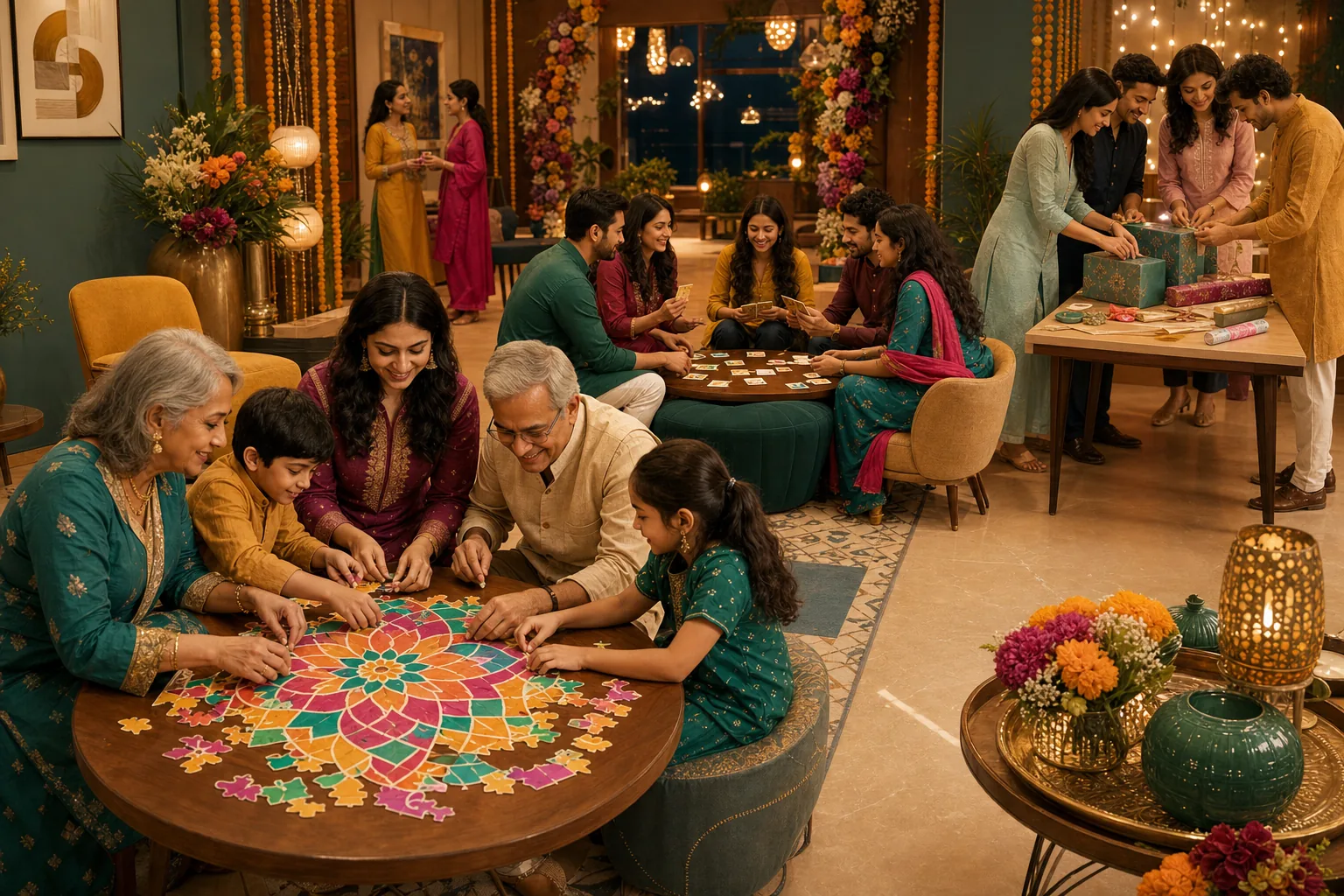
Diwali gatherings already have many moving parts: greetings, food, photographs, gifts, decorations and family traditions. Games work best when they add a shared moment without interrupting puja, meals or conversations. A short table quiz may suit a family dinner, while a collaborative design challenge may fit an office celebration. The right choice depends on the setting, guest mix and available time.
The ideas in this guide are optional social activities, not religious instructions. Diwali is observed differently across families, regions and communities. Confirm the programme with the hosts, respect the meaning of the occasion and never turn a ritual, belief, language or community into a joke.
Choose games for the setting
At home, space and noise may be limited. A community hall supports larger teams but needs firmer timing. An office celebration should remain professional, accessible and voluntary. Do not assume every attendee celebrates Diwali in the same way.
| Setting | Suitable game style | Useful duration | Main consideration |
|---|---|---|---|
| Family home | Seated quiz, memory game, creative cards | 5 to 12 minutes | Protect decor, food areas and quiet family time |
| Apartment clubhouse | Table teams and gentle movement | 8 to 15 minutes | Follow noise, capacity and cleanup rules |
| Community hall | Mixed-team stage and station games | 10 to 20 minutes | Coordinate sound, exits and food service |
| Office | Neutral design, observation and team puzzles | 8 to 15 minutes | Keep participation optional and workplace-appropriate |
| Friends’ dinner | Conversation cards and creative challenges | 5 to 10 minutes | Leave time for natural conversation |
| Virtual gathering | Visual quiz, category game and online draw | 10 to 20 minutes | Test audio and avoid sharing private details |
Place activities around the party timeline. Never delay a family tradition or meal because a game has not finished.
1. Festive Colour Match
Prepare large cards showing colour combinations inspired by the evening’s decor. Give each table a set of separate colour cards and ask it to recreate three combinations within two minutes. Use original printed shapes rather than photographs copied from the internet.
This is a calm arrival activity and needs no personal questions. Provide high-contrast symbols so the task does not depend only on colour perception.
2. Diwali Observation Bingo
Create original bingo cards with neutral moments such as a family photograph, a floral pattern, a guest choosing tea, a gift bag or a gold-coloured decoration. Players mark items naturally during the evening.
Do not include religious acts as targets or ask people to interrupt a ritual for a square. Use several card layouts and announce results during a planned break.
3. Rangoli Pattern Puzzle
Print an original geometric rangoli-inspired design, cut it into large pieces and give identical sets to teams. The goal is to assemble the pattern on a table. Use paper pieces rather than loose coloured powder in food or office areas.
This activity is about visual problem-solving. Present the design respectfully and avoid copying a living artist’s work without permission.
4. Light and Shadow Guess
Project or display original silhouette cards of safe household and celebration objects: lamp stand, flower, gift box, serving spoon or paper lantern. Teams identify each object within twenty seconds.
Use illustrations rather than an open flame to create shadows. Check that every object is culturally neutral and clearly drawn.
5. Sweet Name Category Round
Teams take turns naming Indian sweets or savoury festive foods within five seconds. Accept regional names and reasonable variations. End the round after one minute instead of eliminating players.
This is a word game only. Do not turn it into an eating race, and avoid judging anyone’s food preference or dietary restriction.
6. Celebration Memory Tray
Display fifteen safe objects for thirty seconds: ribbon, artificial flower, envelope, paper diya illustration, spoon, coaster and similar items. Cover the tray and ask teams to list what they remember.
Do not use real jewellery, money, lit lamps, glass items or religious objects. All teams should receive the same viewing time.
7. Family Recipe Story Cards
Guests who wish to participate write the name of a festive dish and one short memory or serving tip. Mix the cards and let tables guess whether each memory describes breakfast, snack, main meal or dessert.
Do not demand exact recipes or reveal who wrote a card unless permission was given. Keep allergy and diet comments respectful.
8. Gift-Wrap Design Relay
Provide teams with reusable fabric, paper ribbon and an empty box. Each player adds one part of the design for twenty seconds before passing it on. The result is judged on teamwork and reuse, not expense.
Use blunt safety scissors only under appropriate supervision, or pre-cut all materials. Keep ribbons away from small children and food service.
9. Festival Word Builder
Give each team the same set of large letter cards. Announce neutral themes such as light, welcome, food, colour or friendship. Teams build one valid word connected with the theme.
Allow words in the languages used by guests and have a fair way to confirm meanings. Do not treat one language or pronunciation as superior.
10. Two-Minute Lantern Design
Teams receive a paper outline of a lantern and coloured pencils. They have two minutes to create a pattern from three announced shapes. Display entries only with the creators’ agreement.
This is a drawing game, not a craft involving electricity or flame. Use washable, non-toxic supplies and protect tables.
11. Festive Pictionary
Prepare original cards with neutral objects and moments such as gift box, flower garland, family photograph, sweets tray or decorated doorway. Players draw while teammates guess.
Avoid sacred symbols unless the family specifically requests and reviews them. Do not draw real guests as caricatures.
12. Silent Celebration Scene
One player acts an everyday scene without words: arranging cushions, finding a missing gift label, taking a group photograph or offering a snack tray. The team has forty-five seconds to guess.
Never ask players to imitate a community, accent, elder or religious practice. Offer seated acting and rotate roles.
13. Common Ground: Festival Edition
Mixed groups have three minutes to find four neutral preferences they share: a favourite colour, morning or evening gatherings, sweet or savoury snack, or quiet versus energetic music. Each table reports one discovery.
Guests may pass on any topic. Avoid questions about religion, family finances, relationship status or personal observance.
14. Music Mood Cards
Prepare cards naming moods such as welcoming, calm dinner, energetic group activity and relaxed closing. Teams suggest a song or music style for each mood and explain one choice.
Nobody has to sing or perform. Follow venue and platform rules if recorded clips are played, and accept all languages represented in the group.
15. Decor Detail Hunt
Give seated guests a list of details that can be seen without moving objects: a triangle pattern, a flower colour, a circular light or a fabric texture. The first team to identify six details completes the hunt.
Participants must stay out of kitchens, staff areas, balconies and display zones. Nobody should touch lamps, wiring or fragile decorations.
16. Paper Diya Balance Challenge
Create flat paper diya shapes and give teams ten craft sticks. They have four minutes to build a table structure that holds the paper shape upright. No flame or electrical light is involved.
Use large, smooth materials and supervise children. The challenge should take place away from real lamps and serving areas.
17. Celebration Caption Cards
Show an original illustration of a harmless festive situation, such as too many gift labels or a family trying to fit into one photograph. Teams write a short caption. The host screens entries and reads them anonymously.
Captions must not target bodies, clothing, accents, age or beliefs. Original illustrations prevent image-rights problems.
18. Regional Greeting Exchange
Willing guests share one respectful festive greeting or welcome phrase in a language they speak. They explain its meaning and help the table pronounce it. Participation is voluntary.
Nobody’s accent is scored. If the gathering includes different observances, use a broad welcome phrase rather than assuming one greeting fits everyone.
19. Office Desk-Free Design Sprint
For an office group, give teams a fictional brief: design a reusable welcome card, plan a low-waste snack station or create a five-minute celebration break. They have six minutes and one sheet of paper.
Keep the task unrelated to job performance. Managers should not judge employees’ personality, presentation confidence or cultural knowledge.
20. Team Pattern Sequence
Display a sequence of coloured shapes for fifteen seconds, hide it and ask teams to recreate it with cards. Increase the sequence from four to seven shapes over three rounds.
Add symbols or textures for accessibility. Use identical viewing time and materials for every team.
21. Festive Would You Rather
Use low-stakes choices: handmade card or reusable gift bag, early dinner or late snack, group photograph or candid picture, quiet music or lively playlist. Guests place a token beside their choice and discuss in small groups.
Review prompts before using the Would You Rather tool. Avoid choices about religious practice, spending, family duties or diet.
22. Name Picker Prize Draw
For a small casual draw, enter willing participants or table names into the Random Name Picker. Show the list, explain the rule and remove duplicates before drawing.
This is suitable for low-value social prizes. Promotional or high-value contests may require written terms, eligibility rules and local legal review.
23. Cooperative Paper Garland
Give each table large paper shapes with pre-punched holes and short pieces of thick cord. Every guest decorates one shape, and an adult or designated helper joins them into a display.
Use age-appropriate materials, avoid loose glitter and keep cord away from young children. Ask permission before displaying names or messages.
24. Final Gratitude Cards
Invite guests to write one thing they appreciated about the gathering: a conversation, dish, decoration, activity or welcome. Cards go into a box for the host to read later.
Writing is optional. Screen anonymous cards, and do not ask guests to reveal personal beliefs or read messages publicly.
Choose a balanced game mix
Do not schedule several loud competitions in a row. Pair one thinking activity with one creative task and leave long gaps for food and conversation.
| Game | Energy | Best group | Materials | Typical time |
|---|---|---|---|---|
| Observation Bingo | Low | Families and mixed ages | Printed cards | Flexible |
| Rangoli Pattern Puzzle | Low | Tables and office teams | Original puzzle pieces | 8 minutes |
| Gift-Wrap Relay | Medium | Friends and family teams | Empty box and reusable wrap | 7 minutes |
| Festive Pictionary | Medium | Mixed teams | Cards and paper | 10 minutes |
| Decor Detail Hunt | Low | Home and community hall | Printed list | 8 minutes |
| Team Pattern Sequence | Low | Office or family tables | Shape cards | 7 minutes |
| Paper Garland | Low | Mixed ages | Large craft pieces | 15 minutes |
| Name Picker Draw | Low | Any willing group | Shared screen | 3 minutes |
For a home with limited room, use the zoning advice in the small apartment party guide.
A practical two-hour sequence
Keep the first twenty minutes free for greetings. Place bingo or a pattern puzzle at tables, then pause organised activities during any family observance and food service. Run one ten-minute team game after guests have settled. Finish with a casual draw or gratitude cards.
| Party point | Suggested activity | Host task |
|---|---|---|
| Arrival | Observation bingo | Explain that it is optional |
| Before food | Rangoli puzzle or colour match | Keep tables clear for service |
| Main family time | No game | Protect traditions and conversation |
| After meal | One team game | Demonstrate and use a timer |
| Closing | Gratitude cards or casual draw | Keep announcement under five minutes |
The party budget calculator can set limits for printing, reusable craft materials and small prizes.
Fire, electrical and crowd safety
Keep games completely separate from open flames, fireworks, hot oil, incense, overloaded sockets and temporary wiring. Children must have close adult supervision. Never use a blindfold near lamps or ask players to carry lit items.
Maintain clear exits and do not stretch decorative cords across walkways. Follow building, fire and local rules. If fireworks are part of a separate celebration, use only lawful products in an appropriate area under responsible adult control; do not turn them into a game or competition.
Food and allergy precautions
Games should not involve speed eating, blind tasting or mixing unknown ingredients. Keep craft materials away from food tables and wash hands before service. Retain food packaging or ingredient information where practical, and ask about allergies in advance.
Offer non-food prizes when guests’ dietary needs are not known. The party food planning guide has a broader quantity and service checklist.
Office inclusion and consent
An office Diwali event should welcome employees without testing cultural knowledge or requiring traditional clothing. Attendance, prayer, dancing, singing and personal storytelling must not be tied to performance evaluation or team approval.
Use neutral mixed teams, provide seated roles and schedule within approved work time. Ask before taking or sharing photographs. Avoid alcohol-centred prizes and jokes about leave, bonuses or salaries.
Explain and shorten every game
State the team size, task, time limit and end condition in under a minute. Demonstrate one example. Prepare a short version: three puzzle pieces instead of six, one charades round instead of three or a two-minute design instead of six.
If food arrives, an elder begins a family activity or guests are engaged in conversation, stop gracefully. A game is never more important than the gathering.
Final takeaway
Good Diwali party games are respectful, optional and easy to fit around the celebration. Use one quiet table activity, one short team challenge and perhaps a simple closing draw. Choose paper-based, low-mess materials and keep all play away from flames, wiring and food service.
When games respect different traditions, abilities and comfort levels, they help guests connect without taking attention away from the occasion itself.