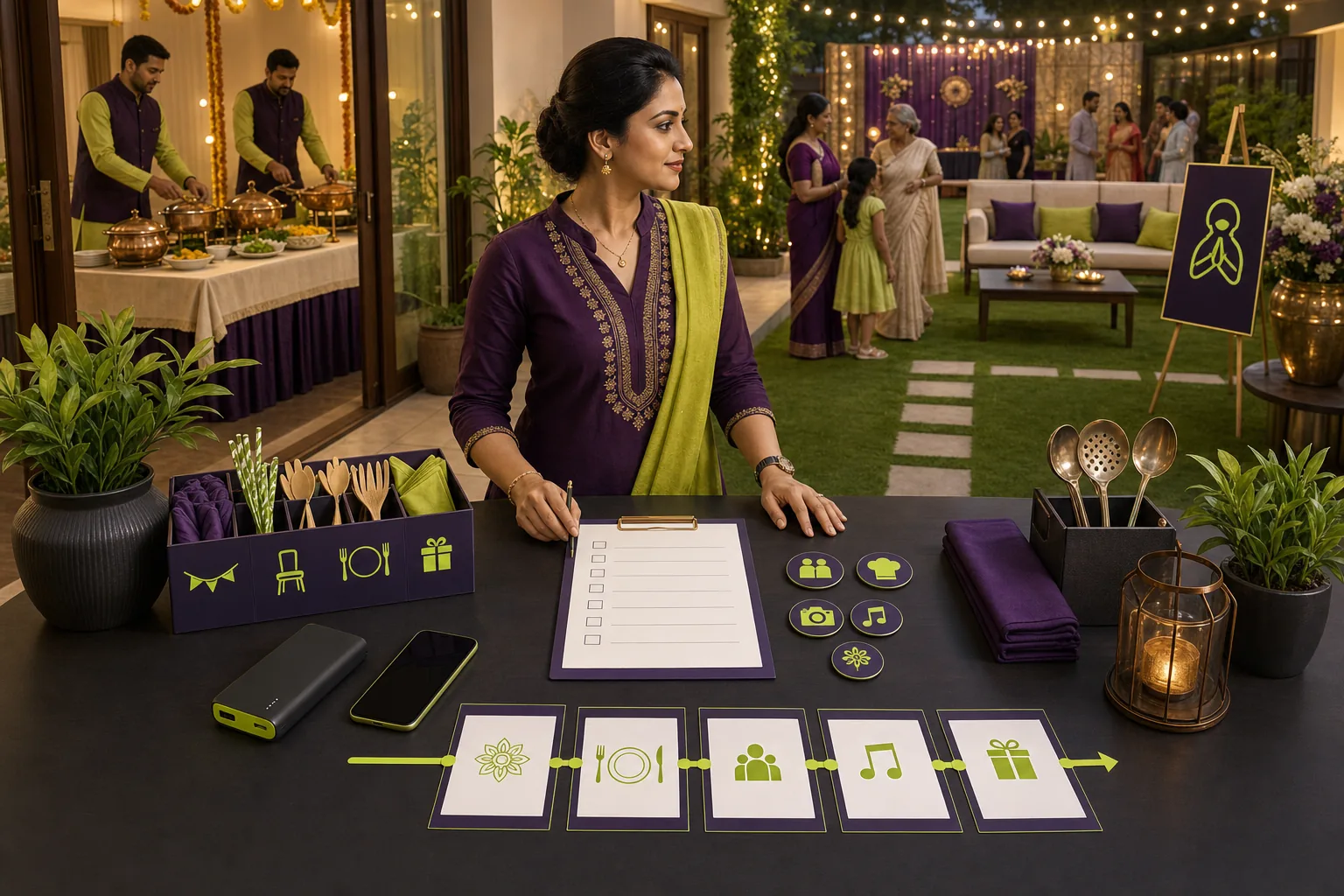
A good host does not personally perform every task. A good host makes sure important tasks have an owner, a time and a backup. Without that structure, the event day becomes a chain of interruptions: a delivery driver needs directions while guests arrive, the serving spoons are missing when food opens, the speaker battery is low and nobody knows who should check a dietary request.
This checklist turns the party plan into an operating plan. It works for home birthdays, family lunches, kitty parties, game nights, farewell gatherings and small hall events. Adapt it to the size and seriousness of your occasion. Safety, venue rules and professional vendor instructions always take priority over a generic checklist.
Start with one master event sheet
Keep the essential information in one place that at least one backup person can access. The sheet should include the venue address, event timing, confirmed guest count, vendor contacts, payment status, delivery windows, food notes, helper roles and a short timeline. Do not rely on dozens of chat messages.
Avoid placing passwords, payment card details or unnecessary personal information in a shared document. Include only the practical details helpers need. Print one copy if phone battery or mobile signal may be unreliable.
The master sheet should answer five questions immediately:
- What happens next?
- Who owns it?
- Where is the required item?
- Who should be called if it fails?
- What can be simplified or skipped without harming the event?
When those answers are clear, the host can welcome people instead of constantly searching.
Confirm the plan 48 to 72 hours before
Close decisions before the event day. Reconfirm the date, address, access time and finish time with the venue and key vendors. Share an accurate location pin plus a written landmark where helpful. Check whether another function, road closure or building rule may affect arrivals.
Update the guest count using confirmed replies. Send the caterer the final number within the agreed deadline. Review allergies and dietary requirements privately with the responsible food provider. Do not promise an allergy-safe dish unless preparation and cross-contact controls have genuinely been confirmed.
Use our guest-count guide and party food planning guide if the numbers or menu still need adjustment. This is the time to reduce complexity, not add extra dishes or activities.
Final confirmation checklist
- Venue or home access time confirmed
- Guest list and household counts updated
- Food order, service time and water confirmed
- Tables, chairs and serving equipment confirmed
- Decor scope and installation time confirmed
- Music, microphone and power requirements confirmed
- Photographer or designated photo helper confirmed
- Children’s supervision arrangements confirmed
- Accessibility requests checked
- Vendor balances, deposits and payment methods recorded
- Weather forecast and backup plan reviewed
- Neighbours or building management informed where appropriate
- Emergency contacts and local services known
Mark each line with a name and confirmation time. “Someone is handling it” is not a completed task.
Create a responsibility table
Delegation works when roles are specific and limited. Do not give one reliable relative every difficult job. Assign tasks that fit each person’s availability and confidence, and ask them rather than announcing the role publicly.
| Role | Main responsibility | Starts | Handover or backup |
|---|---|---|---|
| Lead host | Overall decisions and guest care | Setup begins | Named co-host |
| Venue contact | Access, furniture and building questions | Before vendors arrive | Lead host |
| Food coordinator | Delivery check, labels, service and leftovers | Food arrival | One service helper |
| Welcome helper | Door, directions, bags and essential guest notes | 15 minutes before start | Second greeter |
| Activity host | Games, prompts, prizes and transitions | First planned activity | Backup game leader |
| Child-area adult | Supervision and safe activity boundary | First child arrives | Parent rotation if agreed |
| Payment keeper | Approved balances and receipts | Vendor completion | Lead host |
| Closing helper | Left items, waste, rentals and final check | 30 minutes before finish | Venue contact |
For a small gathering, one person may hold several roles. The table still helps because it separates responsibilities mentally.
Prepare a simple host kit
Store useful supplies in one labelled box rather than different rooms and bags. Include only items suitable for the venue and event. A basic kit may contain tape, scissors, marker pens, blank labels, tissues, waste bags, charging cables, a power bank, extension equipment approved for the location, spare batteries, safety pins and clean food-storage containers.
Keep a separate first-aid kit that is appropriate and in date. Know where the venue’s first-aid supplies and exits are. Do not provide medicine to guests casually or pretend to treat a medical issue beyond your training. Contact qualified help when needed.
Add printed vendor contacts, the timeline and a few blank sheets. If prizes or game materials are involved, label them by activity and order of use.
Protect the venue before decorating
At home, move medicines, documents, valuables and fragile items away from guest areas. Decide which rooms remain private. Protect floors and furniture using appropriate materials that do not create trip hazards. Secure balconies, stairs, cables and hot cooking zones, especially when children attend.
At a hall, photograph the space at handover if the contract or deposit process requires condition evidence. Confirm which surfaces can accept tape, hooks or decorations. Never block emergency signs, sprinklers, fire equipment, ventilation or exits.
Use the comparison in our home party vs banquet hall guide to review venue responsibilities. Ask staff before moving installed equipment.
Set up by zones, not decoration order
Create functional zones first:
- Arrival and welcome
- Bags, footwear or coat storage if relevant
- Main seating and conversation
- Food and drinking water
- Activity or game area
- Quiet or lower-noise seating
- Washroom route
- Waste and cleanup station kept discreetly away from food
Walk through the venue as a guest. Can someone enter without crossing a game? Can an older guest reach a stable seat? Does the buffet queue block the washroom? Is drinking water obvious? Only after the flow works should decor fill the remaining space.
Event-day setup timeline
| Time before guests | Priority | Host check |
|---|---|---|
| 4 to 6 hours | Venue access, cleaning, furniture and major vendor setup | Space matches approved layout; exits remain clear |
| 2 to 3 hours | Decor, activity zones, equipment and signs | Nothing unstable, sharp or blocking a route |
| 90 minutes | Food-service area, water, washrooms and host kit | Supplies, labels and utensils are present |
| 60 minutes | Sound, lighting, games and backup power | Test at real volume; protect cables |
| 30 minutes | Host and helper briefing | Everyone knows first task and escalation contact |
| 15 minutes | Final walk-through and personal reset | Stop non-essential setup; welcome area is ready |
Build more time than the optimistic vendor estimate. If setup falls behind, protect safety, food and guest comfort first. A missing decorative item is less important than an unclear entrance or blocked aisle.
Test every tool and activity
Open digital tools on the actual device and connection that will be used. Charge the device, disable distracting notifications where appropriate and check screen visibility. If you plan to use the Spin the Wheel, prepare the names and remove accidental duplicates. For group play, the Team Generator can create quick random groups, but review the result if accessibility or skill balance matters.
For Tambola, verify tickets, prizes, winning patterns and the Tambola Caller before the first number. For Truth or Dare, establish a pass rule and use age-appropriate prompts from the Truth or Dare tool.
Keep one offline or no-equipment backup activity. Technology should support the party, not hold it hostage.
Brief helpers before guests arrive
Hold a five-minute briefing. Explain the event finish time, first activity, food opening time, key guest needs, private areas, child-safety boundaries and who makes final decisions. Share the location of water, washrooms, first aid, host kit and waste supplies.
Do not discuss a guest’s private medical or dietary information beyond what the responsible helper genuinely needs. Use respectful language such as “Please reserve this step-free seat” rather than announcing personal details.
Agree on a simple signal or message for help. Helpers should solve small issues without creating a public meeting around the host.
Welcome guests without creating a queue
Place one person near the entrance during the main arrival window. The greeter can show guests where to keep belongings, point out water and seating, and discreetly notify the host when someone important arrives. Keep the doorway clear.
If society security or venue reception needs a list, provide only the required information and follow privacy rules. Do not display phone numbers publicly. For children, confirm the responsible adult and never assume another guest is supervising.
The lead host should greet people, but does not need to conduct a long conversation at the door while others wait. Introduce new arrivals to one or two guests and continue circulating.
Manage food calmly
When food arrives, the coordinator should check the order, condition, labels and service equipment before signing or paying. Keep hot and cold food under suitable professional controls. Do not leave large trays exposed merely for appearance.
Open service according to the timeline, but adjust if guests are significantly delayed or children and older adults need earlier access. Keep water available from the beginning. Refill in smaller quantities where practical and monitor popular items before they run out.
Announce dietary options accurately. If preparation details are uncertain, ask the caterer instead of guessing. Keep separate serving utensils in place.
Keep the schedule flexible
A party timeline is a guide, not a performance script. Watch the room. If guests are deeply engaged in conversation, a five-minute delay may help. If children are restless, begin an activity earlier. Avoid starting a major game while food is being served or while many people are still arriving.
Use short transitions: explain what is happening, how long it will take and whether participation is optional. Never pressure guests into games, photos or speeches. A pass should be normal.
Protect the fixed points: venue closing, main meal, ceremony, transport and vendor departure. Flexible activities should move around those anchors.
Handle problems privately and proportionately
Small issues do not need dramatic announcements. Move a damaged chair, replace a missing utensil or adjust the music quietly. If a vendor issue affects payment, document it and speak with the responsible manager away from guests where possible.
For safety or health concerns, pause the event and act promptly. Keep people away from spills, exposed wires, overcrowded balconies, unsafe dares or hot equipment. Contact emergency services or qualified venue staff when appropriate. Entertainment never takes priority over wellbeing.
If a guest behaves disrespectfully, the host or a trusted person should set a clear boundary. Do not make the affected person manage the situation alone.
Control payments and receipts
Record which balances are due and who is authorized to pay. Avoid handling large payments in a crowded public area. Verify the invoice, included items and agreed adjustments before completing payment. Collect a receipt or confirmation.
Do not give payment credentials or phone access to casual helpers. A payment keeper can bring the invoice to the lead host for approval. Note refundable deposits and the conditions for return.
Update the final spending in the Party Budget Calculator or your budget sheet after the event so future estimates improve.
Begin closing before the final minute
Start a quiet closing process about 30 minutes before the scheduled finish. Stop introducing long activities. Check whether guests need transport help, return borrowed items and announce the final food or dessert service naturally.
The closing helper can collect game materials, identify lost belongings, separate rentals and organize leftover containers while the host thanks guests. Do not dismantle the event so aggressively that remaining guests feel pushed out, but respect venue and neighbour timings.
Count rented items with the vendor where possible. Photograph the final condition when required by the agreement.
After-party checklist
- Confirm all children and dependent guests leave with the correct responsible adult
- Check washrooms, seating, charging points and bag area for belongings
- Store or discard food using safe guidance
- Separate recycling and waste according to local arrangements
- Return rented or borrowed items as agreed
- Switch off approved equipment and remove temporary cables
- Settle verified balances and store receipts
- Check venue condition and deposit process
- Send urgent lost-item messages without exposing private information
- Thank helpers before everyone leaves
At home, do not attempt every cleaning task while exhausted. Complete hygiene and safety priorities, then schedule the remaining work.
Review the next day
Write a short note while the experience is fresh. Record the confirmed attendance, food that ran short or remained, useful vendors, timing that worked and tasks that needed more support. These observations are more valuable than generic party formulas.
Send thank-you messages suitable for the relationship and occasion. Share photos only with reasonable consent, especially when children are visible. Do not upload embarrassing game moments simply because they were funny in the room.
If an item was lost, describe it without publishing the owner’s private details. Follow up on deposits and outstanding invoices.
Frequently asked questions
How early should a host be ready before guests arrive?
Finish essential setup at least 15 to 30 minutes before the stated start so the host can change, drink water and complete a calm final check. Large or vendor-heavy events need a longer buffer.
How many helpers does a party need?
There is no fixed number. Assign enough people to cover welcome, food, activities, children where relevant and closing without overloading one person. Even a small event benefits from one backup host.
What should be skipped when setup is late?
Skip or simplify non-essential decoration and complicated activities. Protect safe access, seating, water, food handling, washrooms and the guest welcome process.
Should the host run every game?
No. A confident helper can lead games while the host watches the overall event. Give the helper rules, materials, timing and a backup option in advance.
Final takeaway
A smooth party day comes from clear ownership, realistic timing and the courage to simplify. Confirm the plan early, organize the space by function, brief helpers, test tools and keep safety and guest comfort ahead of decoration. During the event, protect the fixed anchors while letting conversation and activities breathe. Close deliberately, store food responsibly and record lessons the next day. The result is not a party with zero surprises. It is a party where ordinary surprises do not prevent the host from being present.