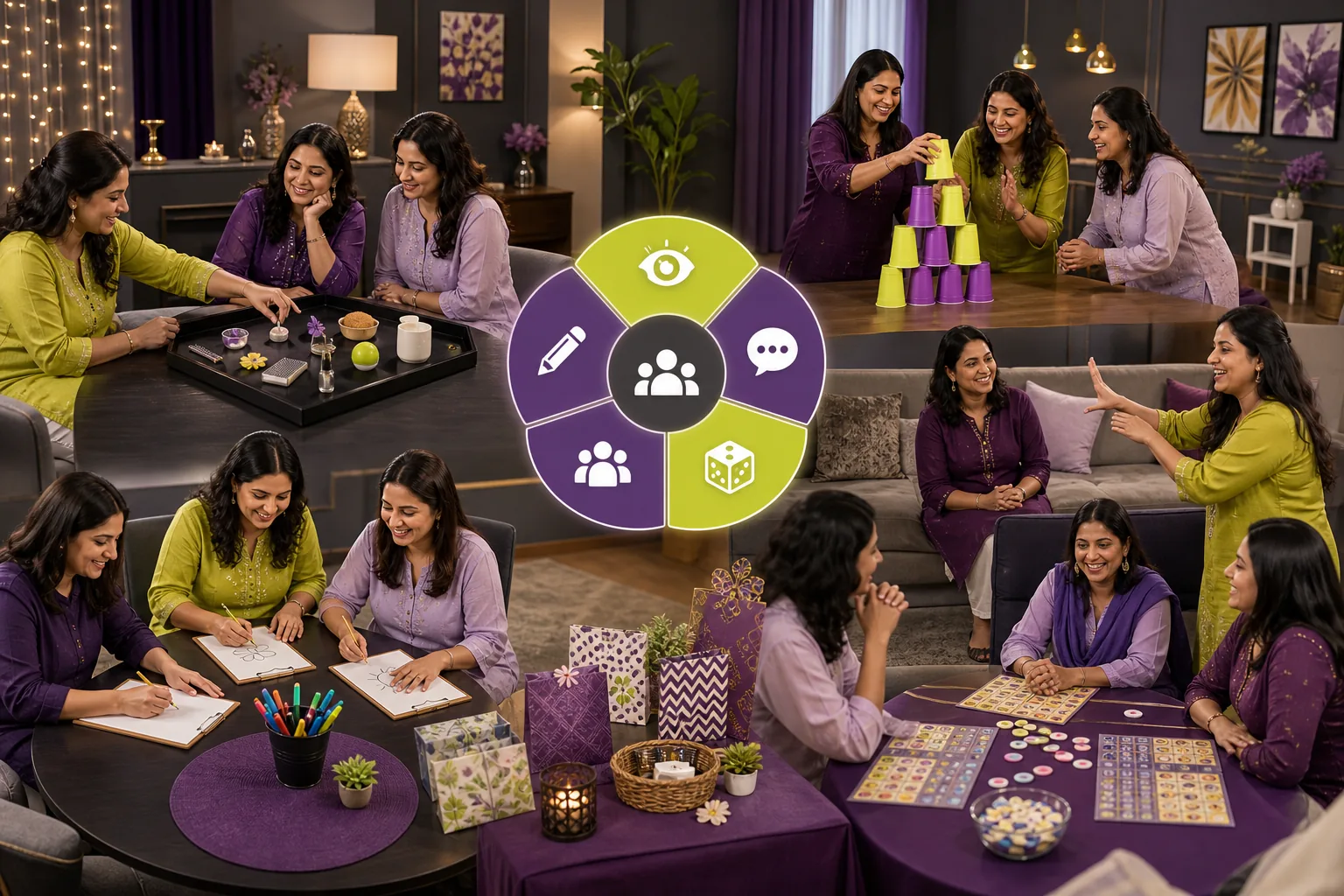
A good kitty party game is easy to explain, quick to start and comfortable for the people in the room. It does not need expensive props or complicated scoring. The best choice depends on group size, mobility, familiarity and available space. A lively action game may energize close friends, while a seated observation game may include a mixed-age group more comfortably.
The 30 ideas below were written and organized for Cockroach Janta Party. Adapt names, themes and difficulty to your group. Participation should remain optional, and nobody should be mocked for an answer, physical ability or lack of familiarity with a topic.
Plan the game session before choosing games
Do not try to play all 30 ideas. For a two- or three-hour gathering, one easy opener and two main games may be enough when conversation and food are also included. Use the party timeline guide so games do not delay the meal.
Check the room and create a stable activity area. Keep bags, cables and food away from movement games. Reserve proper chairs for anyone who needs them. Prepare materials in separate labelled envelopes or trays, then test every game with one helper.
State the rules, time and scoring before starting. If a tie is possible, announce the tie-break method in advance.
Quick game selector
| Game type | Best for | Space | Typical materials | Host note |
|---|---|---|---|---|
| Observation | Calm opener, mixed ages | Seated | Tray or image | Show items equally to everyone |
| Word game | Conversation and laughter | Seated | Paper or phone | Avoid topics that expose private information |
| Speed challenge | High energy | Tabletop or open area | Simple household objects | Demonstrate safe technique first |
| Team game | Larger groups | Moderate | Prepared cards | Use the Team Generator if random teams suit the group |
| Luck-based | Quick prize or transition | Any | Slips, dice or digital tool | Explain that the result is casual entertainment |
| Creative | Relaxed groups | Seated | Paper, pens, craft items | Reward ideas, not artistic skill alone |
1. Memory Tray
Place 15 to 20 safe household or party objects on a tray. Show it for 30 seconds, cover it and ask players to write as many items as they remember in two minutes. One point is awarded for each exact item. Avoid tiny medicines, sharp objects or valuables.
2. Missing Object
Display ten objects, let everyone observe them, then ask players to close their eyes while one object is removed. The first player to write the missing item wins the round. Run three rounds with different removal order. Written answers prevent shouting contests.
3. Guess the Price Range
Show five ordinary packaged or household items without displaying receipts. Give three reasonable price bands for each item. Players select a band, and one point goes to a correct answer. Use current local prices you verified yourself and avoid turning the game into criticism of shopping habits.
4. Purse Scavenger List
Prepare a list of common, non-sensitive items such as a pen, tissue, coin, hair tie or reusable shopping bag. Call one item at a time. A player earns a point by showing it safely. Never ask for identity cards, medicines, private photos, keys or financial items.
5. Colour Collection
Announce a colour and give players 20 seconds to touch or point to an item of that colour within the approved game area. No running, grabbing another person’s belongings or entering private rooms. Use a written tie-break when several players respond together.
6. One-Minute Coin Stack
Give each player the same number and type of clean coins or flat tokens. They build the tallest free-standing stack in one minute. Measure only after hands are away. Use tokens when handling currency is inconvenient, and keep small objects away from children.
7. Cup Pyramid
Provide identical lightweight reusable cups. Players build and return a small pyramid within the time limit. Run one person or one team at a time so the table stays safe. Do not use glass.
8. Spoon Transfer
Players move lightweight pom-poms or large safe beads between two bowls using a spoon for 45 seconds. The highest valid count wins. Keep the activity seated for accessibility, and never use food that will later be served.
9. Button Sorting
Mix large buttons or coloured tokens and ask players to separate them by colour using one hand. Count correctly sorted pieces after one minute. Avoid small items around young children and offer a larger-object alternative for anyone with dexterity or vision needs.
10. Straw-Free Paper Race
Place lightweight paper shapes at one side of a table. Players use a hand fan made from a card to move a shape across a marked finish line. This avoids shared straws and blowing near food. The first shape across without being touched directly wins.
11. Complete the Proverb
Prepare familiar proverb or saying beginnings that fit the languages used by the group. Read the first part and ask players to write the ending. Accept agreed regional variants. Avoid obscure phrases that reward only one age or background.
12. Opposite Answers
Ask simple questions, but players must give an obviously incorrect opposite-style answer within three seconds. For example, “Is ice hot or cold?” A valid playful wrong answer continues the round; a correct or delayed answer loses a life. Keep questions neutral and easy to hear.
13. Alphabet Category Chain
Choose a category such as foods, cities or household items. The first player gives an answer beginning with A, the next with B and so on. Allow a pass and avoid categories based on body, wealth or personal history. Use a 10-second turn limit.
14. Forbidden Word Conversation
Select one common word such as “party” that cannot be spoken for five minutes. Give the group a neutral topic. A helper quietly records slips; the fewest slips wins. Do not create a rule that prevents someone from expressing a safety or comfort need.
15. Three-Clue Object
Prepare cards containing an everyday object and three clues from broad to specific. Read one clue at a time. A correct answer after clue one earns three points, after clue two earns two, and after clue three earns one. Rotate who answers first to keep it fair.
16. Emoji Story Decode
Create short sequences of familiar emoji symbols representing a simple movie type, phrase or everyday activity. Display one card at a time. Players write guesses rather than calling out. Avoid copyrighted images; ordinary Unicode emoji and your own original clue combinations are enough.
17. Sound Recognition
Play or produce short, safe everyday sounds such as keys, paper tearing, a spoon touching a cup or a zipper. Players identify the source on paper. Keep volume comfortable and tell guests before making any sudden sound.
18. Mystery Texture Bag
Place safe, clean objects with distinct textures in opaque bags. Players feel the outside or reach in one at a time without looking, then write a guess. Avoid food allergens, liquids, sharp edges and objects that could cause fear.
19. Quick Doodle Guess
One player draws an object from an original prompt card while the team guesses within 45 seconds. No letters, numbers or gestures. Artistic skill is not judged. Prepare easy and medium cards and rotate the artist.
20. Paper Fashion Detail
Teams receive equal sheets of coloured paper and removable tape to create one wearable accessory such as a bracelet, badge or headband on a willing teammate. Set a five-minute limit. Do not attach tape to hair, skin or valuable clothing.
21. Napkin Fold Challenge
Demonstrate one simple fold using clean cloth or paper napkins, then unfold it. Players have two minutes to recreate it. Score for completion and neatness. Use napkins reserved for the activity, not items that will return to food service.
22. Story in Five Words
Give every player the same five neutral words. They have three minutes to write a short, original story using all five. Read entries anonymously if the group prefers. Award one prize for humour and another for creativity rather than declaring one absolute best writer.
23. Advertisement Without a Brand
Give teams an ordinary object such as a spoon, cushion or notebook. They create a 30-second playful advertisement without using a real brand name. Keep performances optional. Score clarity, creativity and teamwork.
24. Photo Pose Card
Prepare original cards with comfortable group poses such as “everyone points toward the centre” or “make a surprised face.” Teams draw one and have 30 seconds to arrange. Take a photo only with consent and do not post it publicly without permission.
25. Name Picker Challenge
Add willing participants to the Random Name Picker. The selected player draws a simple prompt: name three fruits, hum a tune, describe a place or answer a light question. Every player has one no-questions-asked pass. Remove duplicate names unless extra chances are intentional.
26. Spin the Category
Enter original categories such as food, travel, films, childhood games and household hacks into the Spin the Wheel. After the spin, each player gives one answer in that category without repeating earlier answers. Use categories appropriate for the group’s languages and interests.
27. Two Truths and a Gentle Fib
Each willing player shares three low-stakes statements, one invented. Others guess the invented statement. Ask players to avoid health, money, relationships, workplace secrets and other sensitive topics. Allow people to use harmless prepared examples instead of personal facts.
28. Seated Charades Relay
Players remain seated and act an everyday activity using upper-body gestures only. Their team has 45 seconds to guess. This reduces movement and can be more accessible. Prepare culturally clear prompts and allow an alternative clue card where gestures are not suitable.
29. Mini Tambola Round
Run one or two clearly defined patterns using valid tickets and the Tambola Caller. Announce rules and prizes before the first number, keep the call history visible and verify claims calmly. If money is involved, the host is responsible for applicable laws and age restrictions; a prize-only social round is simpler.
30. Secret Compliment Match
Give players identical slips and ask each person to write one respectful, non-appearance-based compliment about the group or event. The host reads them anonymously, and the group guesses who might have written each one. Do not pressure anyone to identify a specific recipient, and remove wording that could embarrass somebody.
Setup and prize planning table
| Game | Time | Materials | Group style | Simple prize idea |
|---|---|---|---|---|
| Memory Tray | 5 minutes | Tray, objects, paper | Individual | Notebook |
| Cup Pyramid | 4 minutes | Reusable cups | Individual or relay | Snack box |
| Complete the Proverb | 8 minutes | Prepared questions | Seated individual | Pen set |
| Quick Doodle Guess | 10 minutes | Cards and board | Teams | Shared treat |
| Story in Five Words | 8 minutes | Word cards, paper | Individual | Small plant |
| Spin the Category | 10 minutes | Phone or laptop | Whole group | Choice of dessert |
| Mini Tambola | 20 to 30 minutes | Tickets and caller | Whole group | Pre-announced gifts |
Choose useful, modest prizes within the party budget. A funny title or first dessert choice can replace physical gifts when the group agrees.
How to make scoring fair
Write the scoring method before the party. Use the same materials, time and starting condition for every player. When games run in turns, prevent later players from gaining an unfair advantage by changing the puzzle or using equivalent sets.
Announce tie-break rules. A quick Dice Roller or one neutral final question can resolve a casual tie if everyone agrees. Do not change a result because a popular player did not win.
Keep one scorekeeper and display totals only if that adds fun. Some creative games work better with category prizes or anonymous voting.
Keep participation comfortable
Offer seated alternatives and a pass. Never use games to comment on weight, age, marriage, fertility, money, clothing or private relationships. Avoid tasks requiring access to a guest’s phone, handbag contents beyond a safe voluntary list, social-media account or personal messages.
Tell people before taking photos. Do not publish embarrassing moments without consent. When children are present, an appropriate adult must supervise and materials must be age-safe.
A sample 90-minute game flow
| Time | Activity | Purpose |
|---|---|---|
| 0 to 10 minutes | Arrival and Forbidden Word begins | Easy background opener |
| 10 to 20 minutes | Memory Tray | Calm shared focus |
| 20 to 35 minutes | Refreshments and conversation | Natural break |
| 35 to 50 minutes | Quick Doodle Guess in teams | Higher group energy |
| 50 to 65 minutes | Mini Tambola or Spin the Category | Main game |
| 65 to 80 minutes | Food or dessert | Relaxed transition |
| 80 to 90 minutes | Story prize and thanks | Clear closing |
Adjust this flow to meal timing and the event’s full schedule. Do not force a final game when guests are ready to eat or leave.
Common hosting mistakes
Explaining rules while materials are missing
Prepare each game in a separate tray or envelope and test it before guests arrive.
Choosing only speed games
Mix observation, words, creativity and luck so different strengths have a chance.
Using private information as entertainment
Keep prompts low-stakes. A kitty party is not permission to expose phones, relationships or finances.
Giving too many prizes
Prize quantity can dominate the budget and shift attention away from fun. Use a few pre-announced categories.
Playing until the group is tired
Stop while energy is good. Conversation and food are important parts of the gathering.
Frequently asked questions
How many games should a kitty party include?
Usually two or three well-prepared games are enough for a gathering that also includes conversation and food. Choose one short opener and one or two main activities.
What are good games for a small seated group?
Memory Tray, Complete the Proverb, Three-Clue Object, Story in Five Words, Emoji Story Decode and a short Tambola round can work without much movement.
How can I run games without expensive props?
Use clean household objects, paper, pens, reusable cups and free browser tools. Preparation and clear rules matter more than elaborate equipment.
What should I do if a guest does not want to play?
Respect the choice. Allow the person to watch, help with scoring or continue conversation. Participation should never be a condition of belonging.
Final takeaway
The strongest kitty party games are clear, inclusive and easy to operate. Select a small mix of observation, word, creative and chance-based activities, prepare materials in advance and announce scoring before play. Protect privacy, provide seated options and treat a pass as normal. When games support conversation rather than competing with it, the gathering feels lively without becoming exhausting.