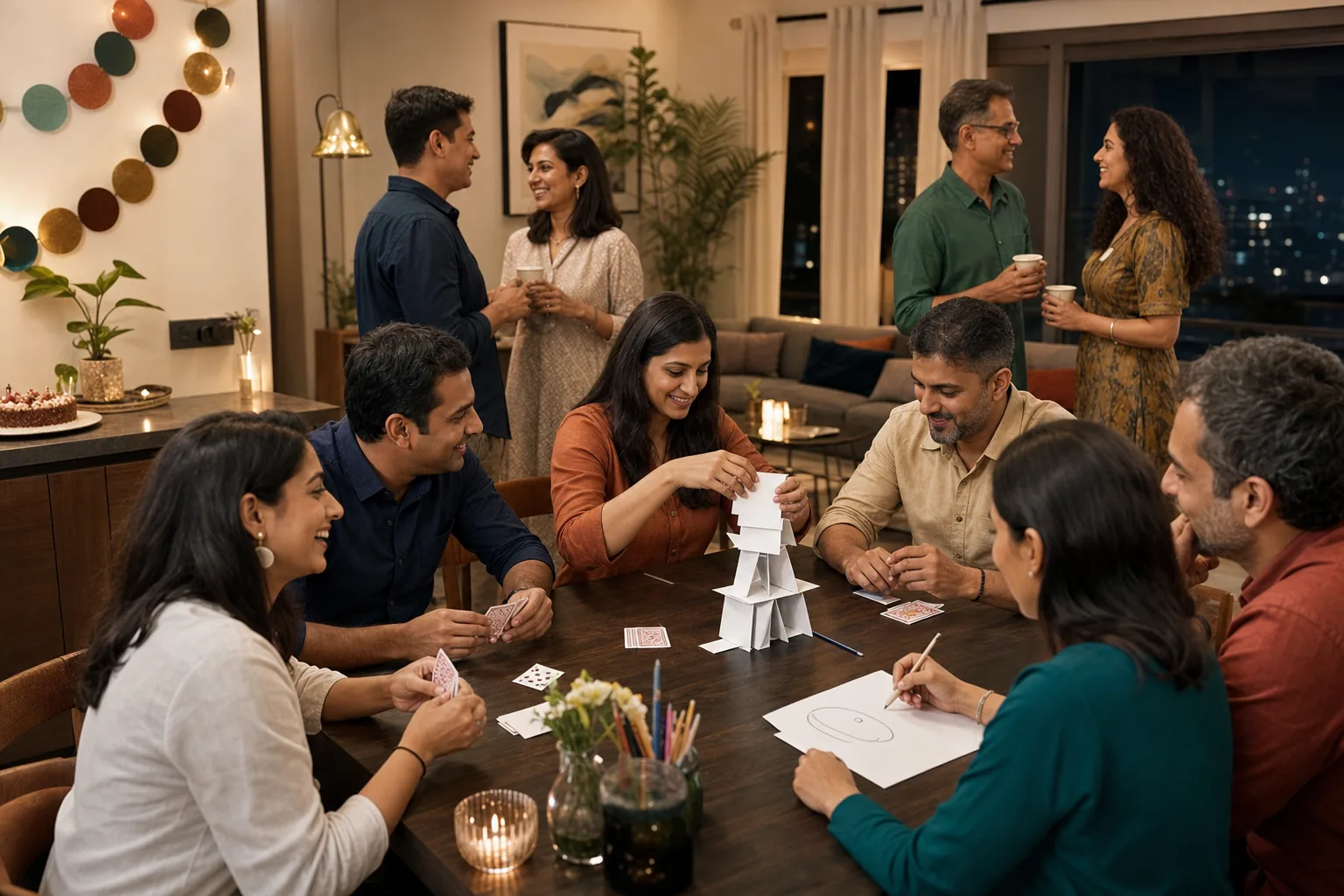
Adult birthday games often fail for one simple reason: the host tries to manufacture excitement before guests feel comfortable. A loud icebreaker, personal question or forced dance can make a friendly room suddenly tense. A better game gives people a clear task, lets them participate in a small group and makes watching an acceptable choice.
The ideas below work for home parties, restaurants, terraces and community rooms. They avoid humiliation, risky dares and intrusive questions. Choose only two or three structured games for an ordinary evening; conversation, food and music still need space.
Match the game to how well guests know each other
Close friends can handle shared memories and playful predictions. Colleagues or mixed social circles need more neutral prompts. If several guests are meeting for the first time, begin with team observation or creative tasks rather than asking individuals to perform.
| Group type | Good starting games | Avoid at the beginning | Useful team size |
|---|---|---|---|
| Close friends | Memory timeline, prediction cards, caption challenge | Old conflicts and private stories | 3 to 5 |
| Friends plus relatives | Table quiz, category relay, object story | Relationship assumptions | 4 to 6 |
| Colleagues | Visual puzzles, common-ground list, desk-free trivia | Workplace gossip and appraisal jokes | 4 to 6 |
| Mostly new acquaintances | Picture prompt, silent sorting, team scavenger list | Personal truth questions | 3 to 4 |
| Mixed ages | Observation bingo, music categories, gentle charades | Speed and floor challenges | 4 to 6 |
| Small dinner group | Conversation cards, two-minute design, prediction bowl | Long stage-style games | Whole table |
Estimate space and materials after confirming the guest list size. A game designed for twelve people becomes slow with forty unless it is divided into tables.
1. Birthday Timeline Mix-Up
Ask the birthday person for eight approved, low-stakes milestones: first concert, favourite trip, learning a hobby or adopting a plant or pet. Write each event on a card without the year. Teams arrange the cards in the order they think the events happened.
The birthday person reveals the answer and may share one short story. Do not use health events, relationships, job loss, money or photographs involving people who have not agreed to be included.
2. Common Ground in Three Minutes
Mixed teams list five neutral things everyone shares. Examples include a food preference, a city visited, a music mood or a daily habit. “Everyone is wearing shoes” is too obvious; the discovery should require a little conversation.
Guests may skip any prompt. Avoid age, religion, politics, family status, salary and health. This activity works well early because nobody has to stand alone in front of the room.
3. Caption the Party Moment
Show an original illustration of a familiar party situation, such as a cake box that barely fits in the refrigerator or friends trying to take a group photograph. Teams write a short caption in two minutes. The host reads entries without identifying teams, and applause chooses a favourite.
Use made-for-event visuals rather than random photographs from the internet. Captions should not target a real guest’s body, clothing, accent or personality.
4. Category Countdown
Give each team a category such as breakfast foods, travel items, indoor hobbies or things found in a kitchen. Players take turns naming an item within five seconds. Repeated answers are not allowed, and the round ends after one minute rather than eliminating individuals.
Use categories with many fair answers. Avoid specialist topics that reward only one profession or age group.
5. Mystery Object Story
Put safe everyday objects in a bag: a ribbon, wooden spoon, postcard, key ring or toy block. Each team draws three objects and creates a sixty-second fictional birthday story that includes all of them.
The story must be invented, not a disguised joke about someone in the room. Do not use medicines, valuable items, sharp tools or anything with private information.
6. Birthday Person Prediction Cards
Prepare pairs of neutral choices: beach or mountains, sweet or savoury, early plan or last-minute plan, board game or film. Teams predict the birthday person’s choices before the answers are revealed.
Ask for the choices in advance and include a “both” or “neither” option. The game should celebrate preferences without presenting them as permanent personality labels.
7. Five-Photo Observation
Display five approved photographs for twenty seconds, then hide them. Ask questions about visible details: number of mugs, background colour, type of weather or position of an object. All questions should be written before the game.
Only use images owned by the host or shared with permission. Avoid childhood images that might embarrass the birthday person or reveal another person’s private information.
8. Paper Tower With a Twist
Give teams ten sheets of scrap paper and a short strip of removable tape. They have four minutes to build a free-standing tower that supports a paper birthday flag. Measure height only after hands are removed.
Use a stable table away from drinks and food. The activity rewards planning and teamwork without requiring personal disclosure. Recycle usable paper afterward.
9. Reverse Charades
One player guesses while the rest of the team acts the same neutral word together. Suitable prompts include packing a suitcase, making tea, looking for a charger or posing for a photograph. The group has forty-five seconds.
Allow seated acting. Do not include professions, communities, disabilities, intoxication or real guests as prompts. Rotate the guesser instead of putting the same confident person at the centre.
10. Sound-Effect Scene
Give a team a simple scene card, such as morning traffic, a rainy picnic or a busy kitchen. Team members create sound effects while one narrator describes the scene. No recorded audio is required.
Set a comfortable volume limit and warn guests before the round begins. People with sound sensitivity can join as narrator, timekeeper or judge.
11. Tabletop Scavenger List
Create a list of objects guests may already have and are comfortable showing: a blue pen, paper receipt, reusable bottle or key with a round ring. Teams earn one point for each item placed on the table within two minutes.
Never request medication, money, identity cards, private messages, photographs, passwords or contents of someone’s bag. Nobody should run through the venue or borrow from staff areas.
12. One-Line Drawing Relay
Each team receives a large sheet. The first person draws for ten seconds without lifting the pen, then passes it on. The host announces a neutral subject such as a celebration cake, city park or imaginary vehicle. After six turns, the team names its artwork.
Use washable pens and a protected table. Judging should reward imagination, not artistic skill.
13. Music Mood Match
Prepare cards naming moods or situations: relaxed drive, energetic workout, rainy evening, celebration entrance or quiet Sunday. Teams choose a song title they associate with each card and explain one choice.
Do not require anyone to sing. If music clips are played, follow venue and platform licensing rules. Accept titles in any language used by the group.
14. Pass the Doodle
Every player begins a small drawing from an original prompt. After twenty seconds, papers pass to the right, and the next person adds something. Continue for four passes. The final drawings are displayed only if all contributors agree.
Use prompts such as “future birthday cake” or “ideal reading corner.” Avoid drawing real guests because caricatures can quickly become personal.
15. Two-Minute Product Pitch
Teams receive an ordinary object and invent a funny new use for it. They have two minutes to prepare and thirty seconds to pitch. A wooden spoon might become a desk reminder; a paper cup might become a tiny seed starter.
The pitch must not imitate a real brand or make unsafe claims. Score clarity, creativity and teamwork equally.
16. Birthday Bingo Without Personal Questions
Create cards with observable party moments: someone chooses tea, a group photograph begins, a guest discusses travel, a song changes or the cake knife appears. Players mark events naturally as the evening progresses.
Nobody should manufacture an event or interrupt another guest to complete a square. Use several card arrangements and announce results during a planned break.
17. Mini Puzzle Exchange
Give each table a different printed logic, word or visual puzzle of similar difficulty. After four minutes, tables exchange puzzles. The aim is to solve together, not race through advanced questions.
Use original puzzles or material licensed for reuse. Print in large, high-contrast text and provide a simple version for guests who want it.
18. The Helpful Advice Filter
Teams receive fictional party problems: rain begins before a terrace dinner, half the chairs arrive late or the music speaker stops. They have two minutes to propose a practical response. The birthday person chooses the clearest solution.
This is a cooperative planning game and can produce genuinely useful ideas. Keep problems fictional; do not turn a real event mistake into public criticism.
19. Silent Line-Up
Volunteers arrange themselves without speaking according to a neutral visible or chosen sequence: first-name alphabet, birthday month or distance travelled to the venue. They may gesture and show a number with fingers.
Do not use age, height, weight, income or relationship length. Offer a table-card version for anyone who does not want to stand.
20. Memory Menu
Write broad themes on cards: school snack, favourite festival food, first dish learned or comfort drink. Guests choose one and share a brief memory in groups of three. Passing is always allowed.
Avoid themes involving scarcity, dieting, alcohol or medical restrictions. This is best after food service begins, when conversation is already relaxed.
21. Friendly Debate Cards
Offer harmless choices: window seat or aisle, printed book or e-reader, planned holiday or spontaneous trip, starter or dessert. Teams get one minute to make a playful case for their assigned side.
Keep politics, religion, parenting, work disputes and relationship topics out of the deck. The point is creative argument, not changing anyone’s belief.
22. Name Picker Team Challenge
Put willing participants’ names into the Random Name Picker and draw one representative per table for a short neutral task, such as choosing a category or revealing an answer. Explain the method before drawing and allow people to opt out.
For a casual party this creates a visible, fair selection. Do not use it for a high-value promotional giveaway without written rules and local legal review.
23. Photo Pose Designer
Teams draw three cards: number of people, mood and safe prop. They design a group pose that fits the combination. Examples include four people, “surprised,” and a paper fan. A volunteer group may perform the pose if everyone agrees.
Do not require touching, lifting, kneeling or uncomfortable clothing adjustments. Ask permission before taking or sharing the photograph.
24. Final Compliment Round
Give each guest a card that says, “One thing I appreciated tonight…” They may write about the host, food, conversation, music or another positive detail. Collect cards in a box for the birthday person to read later.
Screen anonymous cards before handing them over. Do not pressure guests to write about a particular person or read private notes aloud.
Select games by energy and comfort
Variety matters more than quantity. Pair one thinking game with one creative or gentle movement game.
| Game | Energy | Personal disclosure | Space needed | Typical time |
|---|---|---|---|---|
| Common Ground | Low | Light and optional | Seated tables | 5 minutes |
| Paper Tower | Medium | None | One table per team | 7 minutes |
| Reverse Charades | Medium | None | Small clear area | 8 minutes |
| Prediction Cards | Low | Approved preferences | Seated | 8 minutes |
| Category Countdown | Medium | None | Seated or standing | 6 minutes |
| Pass the Doodle | Low | None | Table surface | 8 minutes |
| Silent Line-Up | Medium | One neutral fact | Clear floor | 5 minutes |
| Compliment Round | Low | Optional | Seated | Flexible |
In an apartment, choose seated games and protect shared spaces. The small apartment party guide covers furniture zones, noise and neighbour-friendly timing.
A simple two-hour game plan
Let guests arrive and settle for at least twenty minutes. Run Common Ground in small groups, then return attention to food and conversation. After the main meal, choose one eight-minute team activity such as Reverse Charades or Paper Tower. Keep bingo or caption cards available in the background and finish with an optional compliment card.
| Time | Activity | Host job |
|---|---|---|
| 0:00–0:20 | Arrival and conversation | Introduce guests; no forced game |
| 0:20–0:28 | Common Ground | Explain passing and team size |
| 0:28–1:10 | Food, music and conversation | Collect background game entries |
| 1:10–1:20 | One team game | Demonstrate rules and keep time |
| 1:20–1:45 | Cake and photographs | Pause all games |
| 1:45 onward | Optional cards or open conversation | Announce results briefly |
Use the party budget calculator to set a small materials and prizes limit. Games do not need expensive kits; paper, reusable cards and ordinary safe objects are enough.
Explain rules without creating pressure
Before starting, state who can join, the time limit, the winning condition and a safe way to opt out. A useful script is: “We are making teams of four for a six-minute drawing relay. Watching or keeping time is equally welcome.” Demonstrate one example and start quickly.
Do not call reluctant guests by name or ask the room to persuade them. Avoid elimination rounds that leave people watching for most of the game. Award points to teams and end after a fixed number of rounds.
Prize ideas that keep the mood friendly
Small shared prizes work well: tea, snack packs, notebooks, a plant or a playful paper certificate. You can also skip prizes and let the winning team choose the next music mood or dessert order.
If several teams tie, use the Spin the Wheel with team names after explaining the tie-break. Confirm the list on screen before spinning.
Safety, privacy and consent
Clear walkways, secure cables and keep active games away from hot food and glassware. Do not use blindfolds, drinking races, food stuffing, lifts or dares involving strangers. Respect venue sound limits and provide seats.
Personal phones should not be collected for a game. Never request messages, galleries, contacts or passwords. Ask before taking photographs, and do not post them publicly without permission. Review the complete party host checklist before guests arrive.
Final takeaway
Adult birthday games feel natural when they are short, team-based and free from personal pressure. Start with a neutral conversation or observation activity, choose one main game and let the rest of the evening breathe. Watching should always count as participation.
The goal is not to make every guest perform. It is to give people an easy shared moment that helps conversation continue after the game ends.