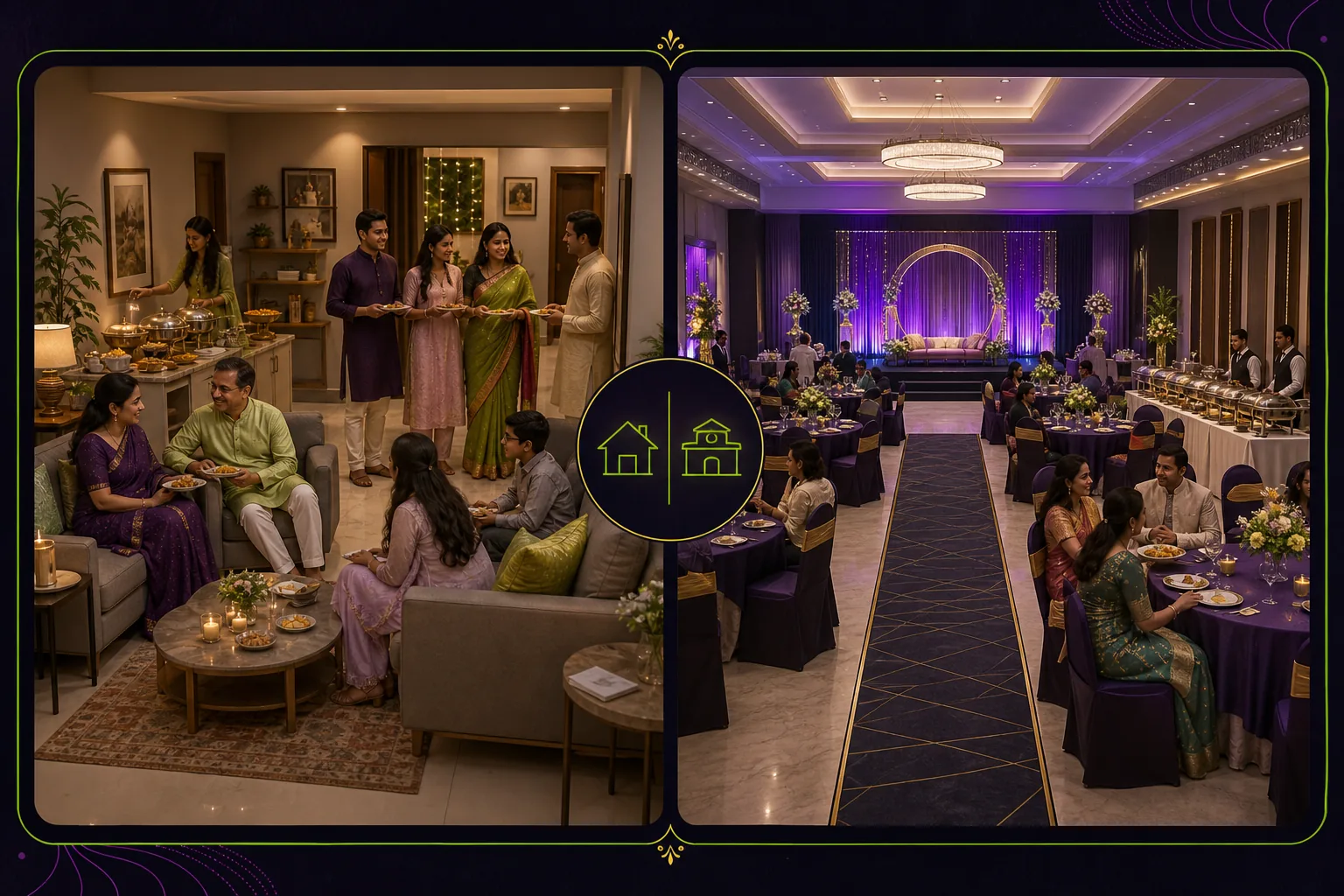
The venue shapes almost every part of a party. It affects how many people can attend, when the event must end, how food is served, whether children can move safely and how much work remains after the last guest leaves. Hosting at home can feel personal and flexible. A banquet hall can provide space, staff and infrastructure. Neither option is automatically cheaper, easier or more memorable.
The best choice depends on the event you are actually planning, not on photographs or social pressure. A comfortable home dinner for 14 people may feel more premium than an oversized hall. A family celebration for 80 people may become stressful and unsafe in a flat even if the venue cost appears lower. This guide compares both options using practical questions so you can choose with confidence.
Define the experience before comparing venues
Write one sentence describing the occasion, group and desired mood. For example: “A relaxed lunch for close family with time for conversation,” or “An energetic birthday for 60 guests with a stage, buffet and children’s games.” This sentence prevents you from judging venues only by decoration.
List the non-negotiables. These may include step-free access, a private room, a fixed closing time, a quiet corner, space for a ceremony or permission for outside catering. Keep the list short. If every preference becomes compulsory, you will either overspend or remain unable to decide.
Then separate the features that are merely pleasant: a photo wall, a particular chair style, a large entrance or a decorative ceiling. Compare venues on what makes the event work first.
Quick comparison: home party vs banquet hall
| Factor | Home party | Banquet hall | Question to ask |
|---|---|---|---|
| Atmosphere | Personal, familiar and informal | More event-focused and separate from daily life | Which mood supports the occasion? |
| Guest capacity | Limited by genuinely usable rooms | Defined by venue and layout | Can everyone move, sit and exit safely? |
| Cost structure | Low or no rent, but many separate expenses | Package or rental plus extras | What is the complete payable total? |
| Control | High control over timing, food and decor within local rules | Controlled by contract, venue policies and slots | Which restrictions matter most? |
| Setup | Host manages furniture, deliveries and protection | Staff may prepare tables and common areas | Who is responsible for each task? |
| Food service | Kitchen and serving space may be limited | Designed for catering, but vendor choices may be restricted | Is the food plan practical in the space? |
| Cleanup | Household carries most responsibility | Often partly included, with conditions | What must be removed and by when? |
| Noise and parking | Neighbours and residential rules matter | Better infrastructure may be available, not guaranteed | How will guests arrive and leave? |
| Accessibility | Depends on building, lift and washroom | Varies widely; never assume | Has the actual guest route been checked? |
| Weather backup | Indoor home space may be limited | Indoor capacity is usually clearer | What happens if outdoor space cannot be used? |
Use the table to identify which option deserves a detailed quotation and site check. It is not a scoring system where one column always wins.
Compare total cost, not venue rent
A home party may avoid hall rent, but the event still has costs. You may need extra chairs, tables, serving vessels, cleaning help, decorations, delivery, protective covers, cooling, parking assistance or temporary storage for household furniture. There may also be repairs if walls, flooring or shared areas are damaged.
A banquet hall quotation may include furniture, basic cleaning and staff, but important costs can sit outside the headline price. Ask about taxes, electricity, generator use, air conditioning, overtime, security, stage setup, sound equipment, corkage, mandatory catering, decoration fees, parking and damage deposits. Confirm cancellation and date-change terms in writing.
Use the same expense categories for both options. Our party budget guide and Party Budget Calculator help compare fixed and per-person costs. Include transport and cleanup rather than treating them as invisible.
Let the real guest count guide you
Do not choose a venue based on the largest possible invitation list. Use confirmed and likely attendance, then apply the process in our guest capacity guide. Count accompanying adults and children separately.
At home, calculate usable party space after placing furniture, the buffet, bags and activity equipment. Keep entrances, stairs, balconies and exits clear. A room may appear spacious when empty but become uncomfortable after 20 chairs are added.
At a hall, ask for capacity in your exact layout. Theatre seating, round tables, a dance floor and a buffet all use space differently. A legal maximum is not necessarily a comfortable target. Request a floor plan showing service routes and emergency exits.
If the home capacity works only when the weather allows use of a terrace or garden, create an indoor backup. Do not depend on guests accepting crowding if it rains.
Consider how much work the host can manage
Home gives you control because the space is yours, but that control comes with tasks. Somebody must receive deliveries, move furniture, organize waste, answer the door, protect private rooms, restock washrooms, coordinate food and restore the home afterward. The work begins before guests arrive and may continue the next day.
A hall can reduce physical setup, especially when furniture, service and cleaning are included. It does not remove the need for decisions. One person still needs to approve layouts, communicate with vendors, check bills and handle the schedule. Venue staff may manage only the tasks stated in the package.
Create a responsibility table before choosing:
| Task | Home owner or host | Caterer or vendor | Hall staff | Named helper |
|---|---|---|---|---|
| Furniture and layout | ___ | ___ | ___ | ___ |
| Guest arrival | ___ | ___ | ___ | ___ |
| Food service | ___ | ___ | ___ | ___ |
| Washroom checks | ___ | ___ | ___ | ___ |
| Children or activity zone | ___ | ___ | ___ | ___ |
| Waste and leftovers | ___ | ___ | ___ | ___ |
| Final cleanup | ___ | ___ | ___ | ___ |
Blank responsibilities are a warning. A venue is not easy merely because it looks finished during a tour.
Match the venue to the food plan
Home kitchens are designed for daily household use, not always for holding and serving many prepared dishes. Check refrigerator space, power outlets, ventilation, water access and the route delivery workers will use. Keep guests away from hot vessels, gas flames and unstable serving stations.
A hall may have a service pantry or full kitchen, but access can be limited to approved caterers. Ask whether outside food is allowed, when the caterer can enter and what storage or reheating equipment is available. Verify who supplies plates, glasses, serving spoons and drinking water.
The party food planning guide explains portion worksheets, menu balance and refill timing. Apply the same food-safety standards in both locations. A larger hall does not automatically guarantee safe service.
Think about privacy and household impact
A home party gives guests access to a personal environment. Decide which rooms remain private and close or lock them appropriately without creating an emergency hazard. Secure medicines, documents, valuables, fragile objects and personal devices. Provide a clear place for bags and footwear if appropriate.
Consider other residents. A child may need sleep, an older family member may need quiet or a pet may become stressed by noise and open doors. Do not assume they will adjust because the occasion is important. Discuss the plan early.
A banquet hall separates the event from private life and may reduce these concerns. However, halls can contain multiple events, common corridors or shared parking. Ask whether your booked area is exclusive and how staff control access.
Review accessibility from entrance to seat
Do not judge accessibility from a brochure. Check the complete guest journey: drop-off, parking, entrance, lift, door width, seating, stage or activity area and washroom. A hall with a ramp at the main entrance may still have an inaccessible washroom. A home lift may be too small for a mobility device or may not work during a power cut.
Reserve stable seats for older adults, pregnant guests and anyone who cannot stand for long. Avoid layouts that require people to cross cables or squeeze between chairs. Provide clear lighting on steps and paths.
Ask guests privately whether they need a particular arrangement. Do not demand medical details. The goal is to remove practical barriers, not to label people.
Check noise, neighbours and timing
Residential buildings may have rules about visitor entry, lifts, terraces, common areas and quiet hours. Speak with the society or property manager where required. Tell immediate neighbours about the expected timing and provide a way to contact the host. Keep speakers away from shared walls and control noise when guests depart.
Banquet halls also have sound and closing rules. The music may need to stop earlier than the booking end. Overtime can be expensive or unavailable. Ask when vendors must remove equipment and whether guests can remain in the parking area after the slot.
Choose a realistic event timeline and communicate the finish time. A home party is not unlimited simply because there is no rental slot.
Evaluate parking and transport
Count vehicles, not only guests. At home, extra cars can block neighbours, gates or emergency access. Share accurate information about public parking or drop-off points, but do not promise spaces you do not control. Encourage car-pooling when sensible.
A hall may advertise parking, but verify capacity, lighting, security arrangements, accessibility and any charges. Ask whether another event uses the same area. For late events, consider how guests without private vehicles will leave safely.
Transport time also affects attendance and meal timing. A beautiful hall far from most guests may require a later start or create staggered arrivals.
Inspect washrooms and basic comfort
At home, one washroom may be insufficient for a large group, especially during a short event. Remove personal items, provide soap, hand-drying supplies, toilet paper, a covered bin and a simple way to report a problem. Assign someone to check the room discreetly.
At a hall, inspect the washrooms rather than accepting “available” as an answer. Check cleanliness, lighting, water supply, locks, accessibility and distance from the event room. Ask who maintains them during the event.
Also review ventilation, cooling, heating, drinking water, seating comfort and quiet space. These ordinary details affect guests more than elaborate entrance decoration.
Understand contracts and cancellation terms
Home parties may still involve vendor contracts, society deposits or equipment rental terms. Banquet bookings usually require a larger written agreement. Read what happens if you cancel, change the date, reduce the guest count or exceed the time. Confirm payment stages and refund conditions.
List everything promised verbally and request written confirmation. Record the room name, date, access time, event time, included furniture, food arrangement, staffing, utilities and taxes. Ask about damage responsibility and prohibited items.
Do not sign under pressure during a tour. Take the quotation home, compare it with the budget and clarify unclear language.
Choose home when these conditions fit
A home party is often a strong choice when the confirmed group fits comfortably, the desired mood is personal, the event is relatively simple and household members agree with the disruption. It also suits occasions where familiar surroundings help children or older relatives.
Choose it because the home supports the experience, not only because hall rent feels unnecessary. Make sure you have a food-service plan, enough washroom capacity, neighbour awareness and cleanup support.
Choose a banquet hall when these conditions fit
A hall is often helpful when the group exceeds comfortable home capacity, the event needs formal seating or a stage, vendors require infrastructure, parking and washrooms are better, or the host cannot manage household setup and cleanup. It may also provide a clear boundary between private life and the event.
Choose it only after inspecting the actual room and understanding the complete price. A large empty space is not automatically convenient; it still needs layout, sound, service and responsible management.
A simple venue decision scorecard
Rate each option from 1 to 5 for the factors below, using evidence rather than excitement. Give extra weight to safety, accessibility and affordability.
| Decision factor | Importance to your event | Home score | Hall score | Evidence or concern |
|---|---|---|---|---|
| Safe usable capacity | 5 | ___ | ___ | ___ |
| Total affordable cost | 5 | ___ | ___ | ___ |
| Accessibility | 5 | ___ | ___ | ___ |
| Food and water service | 4 | ___ | ___ | ___ |
| Host workload | 4 | ___ | ___ | ___ |
| Timing and noise limits | 3 | ___ | ___ | ___ |
| Parking and transport | 3 | ___ | ___ | ___ |
| Atmosphere and privacy | 3 | ___ | ___ | ___ |
| Weather backup | 4 | ___ | ___ | ___ |
The score is a conversation aid. A serious safety failure cannot be cancelled out by attractive decoration.
Frequently asked questions
Is a home party always cheaper than a banquet hall?
No. Home avoids or reduces venue rent, but furniture, equipment, cleaning, delivery, cooling and household disruption can add cost. Compare the complete totals using the same categories.
How many guests are too many for a home party?
The answer depends on genuinely usable space, exits, seating, washrooms, local rules and the event format. If guests cannot move, eat and leave safely after furniture and serving areas are added, the list is too large for that setup.
Can a banquet hall force me to use its caterer?
Some venues require approved or in-house catering, while others allow outside vendors with conditions or fees. Confirm the policy before paying a deposit.
What should I check during a hall visit?
Inspect the exact room, guest route, exits, washrooms, kitchen or pantry, power backup, cooling, parking and vendor access. Review timing, sound, included items and the written quotation.
Final takeaway
Choose between home and a banquet hall by comparing the complete experience: safe capacity, real cost, host workload, food service, accessibility, privacy, timing and cleanup. Home is valuable when intimacy and control fit a manageable group. A hall is valuable when infrastructure and separation justify the price and rules. Neither venue creates a good party by itself. The better option is the one that lets guests feel comfortable and allows the host to be present rather than constantly solving preventable problems.