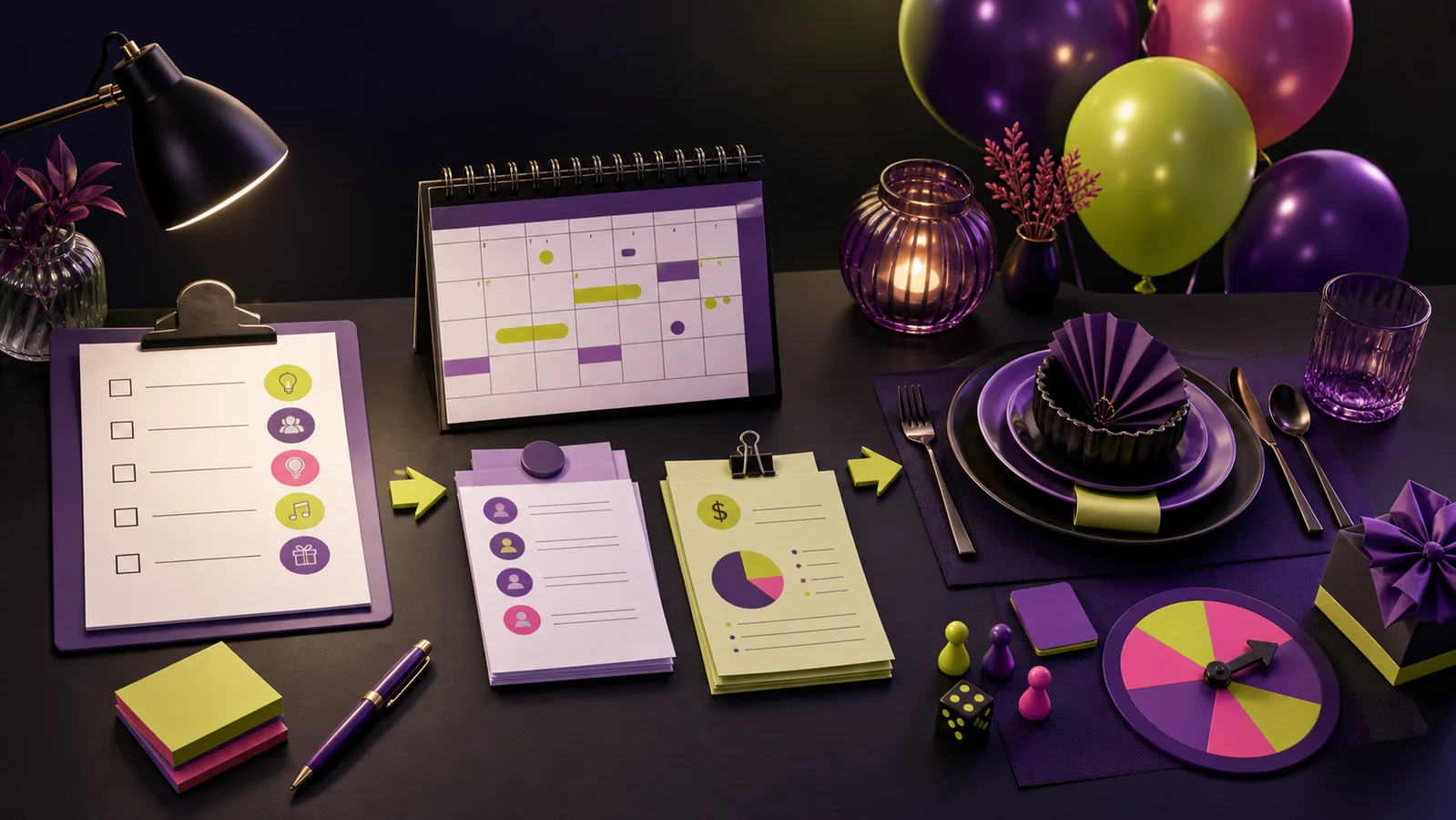
Planning a party can look easy from the outside. Choose a date, invite a few people, order food and play some music—what could go wrong? In real life, small decisions affect one another. The number of guests changes the venue and food quantity. The timing affects the menu. The age and comfort level of the group influence the games. A beautiful plan can also become stressful when the budget, responsibilities and event schedule are not clear.
The good news is that you do not need professional event-planning experience to host a thoughtful party. You need a sensible order of work. This guide takes you from the first idea to the final cleanup using practical steps that work for birthdays, family gatherings, game nights, kitty parties, farewell events and casual celebrations. Adapt the details to your home, city, culture and budget rather than following every suggestion blindly.
Start with the purpose, not the decorations
Before opening shopping apps or saving decoration ideas, write one sentence that describes the party. For example: “A relaxed birthday dinner for 20 close friends,” “A two-hour afternoon party for ten children and their parents,” or “A simple office game night where new team members can participate comfortably.” This sentence is your planning filter.
Whenever you face a choice, ask whether it supports that purpose. A loud dance setup may be perfect for a college celebration but wrong for a calm family lunch. Ten complicated games may create pressure at an event designed for conversation. Expensive decorations may add little value when the group cares most about food and time together.
Decide three things at the beginning:
- What are you celebrating or trying to achieve?
- Who is the gathering mainly for?
- How should guests feel when they leave?
Those answers give the event a direction. They also help you spend money on the experience rather than on unrelated trends.
Step 1: Set a total budget you can genuinely afford
A party budget is not a prediction of the perfect event. It is a limit that protects you from turning one enjoyable evening into weeks of financial regret. Set the total amount before requesting quotations or building the guest list. Avoid treating credit limits as available party money. If the event must fit a tight budget, reduce the scale, simplify the menu or host it at home.
Break the total into useful categories: venue, food and drinks, décor, entertainment or games, invitations, transport, photography, gifts and a small contingency. The exact percentages will vary. A home game night may spend almost nothing on a venue, while a banquet event may place a large amount there. Use our Party Budget Calculator to test different guest counts and food estimates quickly.
Create two columns called “must have” and “nice to have.” Safe seating, enough drinking water and appropriate food belong in the first column. Elaborate props, premium printed invitations or an extra decorative installation may belong in the second. When costs rise, remove nice-to-have items before compromising essentials.
Step 2: Build a realistic guest list
Guest count influences nearly every later decision, so do not treat it as a casual guess. Begin with the people who are essential to the occasion, then add others while checking the venue and budget. Consider relationships as well as numbers. A group of 25 close relatives behaves differently from 25 colleagues who have never met socially.
If the space is small, inviting fewer people usually creates a better experience than filling every available corner. Guests need room to sit, move, reach food and use washrooms without constant inconvenience. Children may require a separate safe activity area. Older guests may need comfortable chairs and easy access rather than floor seating.
Keep a simple list with these columns:
- Guest or family name
- Number of people included
- Contact method
- Invitation sent
- Response received
- Food or accessibility note
Do not request sensitive information that you do not need. Ask about dietary needs in a respectful, practical way and avoid promising that every preference can be accommodated until you have confirmed the menu.
Step 3: Choose the date, time and duration
Select two possible dates before booking anything expensive. Check the availability of key family members, the venue and important vendors. Consider school hours, office schedules, local travel time, weather and major festivals that could affect traffic or prices.
The start time should match the experience. A lunch party needs food ready earlier than a casual evening gathering. A children’s party often works better when it does not conflict with meal or sleep routines. An event involving older relatives may benefit from an earlier finish. State the expected end time when guests need to plan transport or childcare.
Longer is not automatically better. A well-paced two-and-a-half-hour event can feel more enjoyable than an unstructured gathering that loses energy. Decide how much time you need for arrivals, food, the central activity, photographs and goodbyes. Add a small buffer, but do not fill every minute with instructions.
Step 4: Select a venue that supports the plan
Compare venues using practical requirements rather than photographs alone. Ask how many guests can sit comfortably, what furniture is included, whether outside food is allowed, how parking works, when setup can begin and what happens if the event must be cancelled or rescheduled.
For a home party, walk through the event from a guest’s point of view. Where will shoes, bags and coats go? Is there a clear place for food? Can people reach the washroom without crossing a game area? Is there enough ventilation? Which rooms should remain private? Remove fragile objects from busy areas and secure loose wires or slippery rugs.
For a rented venue, request the complete price in writing. Clarify taxes, service charges, overtime, security deposits, cleaning, electricity, sound limits and damage policies. A lower headline price may become expensive after mandatory additions.
| Venue question | Why it matters | What to confirm |
|---|---|---|
| Comfortable capacity | Legal maximum and comfortable use are not the same | Seated and standing layouts |
| Food rules | Outside catering may be restricted | Kitchen access, serving and cleanup |
| Timing | Setup and overtime affect cost | Entry, event and exit times |
| Accessibility | Guests should enter and participate safely | Stairs, lifts, washrooms and seating |
| Weather backup | Outdoor plans can fail quickly | Covered area or rescheduling policy |
Step 5: Plan food around the event, not trends
Food should be easy to serve, appropriate for the timing and manageable within the venue. Start with the meal structure: snacks only, full meal, buffet, seated service or simple shared dishes. Then create a balanced menu with familiar options and a limited number of special items.
More variety is not always more generous. Too many dishes increase cost, service complexity and waste. A smaller menu prepared and served well often creates a better impression. Include enough non-alcoholic drinks and easily available water. Label important dietary categories when needed, but do not make medical claims about food unless the caterer can verify ingredients and preparation.
Estimate quantities using confirmed attendance rather than invitation count. Ask caterers how they calculate portions and what happens to safe leftovers. For home cooking, choose dishes that can be prepared partly in advance. Avoid building the entire menu around food that requires the host to remain in the kitchen during the party.
Step 6: Decide the party flow and activities
A party schedule is a guide, not a school timetable. Its purpose is to prevent long empty periods and conflicts, such as starting a game while half the guests are eating. A simple flow might include arrival and casual conversation, a welcome, one group activity, food, a second optional activity and a relaxed ending.
Choose activities based on group size, age, mobility, familiarity and available space. A game that requires personal revelations may be unsuitable for new colleagues. A running game may exclude guests with limited mobility. Loud team games can disturb neighbours in an apartment.
Useful browser tools can reduce preparation. Use the Random Name Picker to choose volunteers, the Team Generator to make groups, or Spin the Wheel for choices and turn order. If the event includes Tambola, test the Tambola Caller before guests arrive and decide the winning patterns in advance.
Always allow participation without pressure. Explain rules briefly, offer a pass and avoid using games to embarrass guests. The best host notices when the group wants another round and when it is ready to move on.
Step 7: Send clear invitations and track responses
An invitation should answer the questions a guest needs for planning: what the event is, who is invited, date, start time, expected finish if relevant, complete location, dress guidance if genuinely needed and how to respond. Mention whether children or additional guests are included instead of leaving people to guess.
Digital invitations are sufficient for most casual parties. A clear message is more useful than a beautiful image missing important details. Send a reminder a few days before the event with the location link, parking guidance and any change in timing. Avoid placing guests in a large public chat group without considering whether they want their phone numbers shared.
Set a response deadline that leaves time to confirm food and seating. Follow up once with people whose attendance affects the plan. Accept that some responses may change, and keep a modest buffer rather than repeatedly ordering extra items out of anxiety.
Step 8: Divide responsibilities before event day
Hosting becomes exhausting when one person tries to welcome guests, manage food, run music, answer calls, take photographs and solve every problem. Assign specific roles to reliable people. A role should be clear enough that the helper can act without asking for instructions every few minutes.
Possible responsibilities include:
- Receiving a delivery and checking quantities
- Greeting guests and directing bags or gifts
- Managing music at a suitable volume
- Leading games and explaining rules
- Watching the food area and water supply
- Helping children or older guests when requested
- Taking a limited set of group photographs
- Coordinating return transport
Do not turn guests into unpaid staff without asking. Keep the duties small and acknowledge the help. If the budget permits, pay vendors for work that would otherwise prevent family members from enjoying an important occasion.
Step 9: Prepare a simple event-day kit
Create one box or bag containing items that solve common small problems. Depending on the venue, include tape, scissors, markers, spare batteries, charging cables, tissues, rubbish bags, basic cleaning cloths, safety pins, serving spoons and printed vendor numbers. Store medication only when it belongs to you or has been handled according to the owner’s instructions.
Keep payment records, booking confirmations and contact numbers together. Charge the phone used for music or tools and download anything that must work if the internet becomes unreliable. Test speakers, screens and interactive tools before guests arrive. If you are using a laptop on a shared screen, close private tabs and disable distracting notifications.
Step 10: Do a final 24-hour review
The day before the party is for confirmation, not redesign. Check the guest count, vendor timing, food plan, seating, weather, transport, washroom supplies and activity materials. Walk through the venue and remove anything unsafe or unnecessary. Put drinks in an appropriate place to cool and create a clear surface for arriving food or gifts.
Use this short review:
| Area | Final check |
|---|---|
| Guests | Responses updated and important needs noted |
| Venue | Clean, ventilated, safe and easy to navigate |
| Food | Quantity, delivery time, serving tools and storage confirmed |
| Activities | Rules, materials, links and prizes ready |
| Technology | Devices charged and sound tested |
| Payments | Balances and receipts understood |
| Help | Each helper knows one clear responsibility |
Stop adding decorative tasks late at night. Rest, eat normally and leave enough time to get ready without panic. A calm host improves the atmosphere more than one additional decoration.
What to do while the party is happening
Welcome people, introduce guests who may connect naturally and point out essential areas. Do not force the entire group into an activity immediately. Allow arrivals to settle before making announcements.
Watch practical signals: an empty water station, food waiting too long at room temperature, music that blocks conversation, children entering an unsafe area or a guest who looks uncomfortable. Respond quietly instead of turning every adjustment into a public announcement.
Take a few meaningful photographs without making the event feel like a continuous photo session. Ask before posting identifiable images, especially pictures of children. A guest’s attendance does not automatically grant permission to publish their image.
When the planned end approaches, begin a natural closing activity, serve the final item or gently lower the energy. Help guests arrange transport where appropriate and check the venue before the last helper leaves.
After the party: close the loop
Store safe leftovers promptly, separate waste as local facilities allow and return rented items on time. Record any pending payment or damage issue while details are clear. Send a short thank-you message rather than a demand for public photographs or social-media engagement.
Within a day or two, write down what worked and what you would change. Did the guest count suit the space? Was the menu balanced? Which activity connected people? What created unnecessary stress? These notes become a personal planning guide for the next event.
Frequently asked questions
How early should I start planning a party?
For a small home gathering, two to four weeks may be comfortable. A large event, popular venue or date involving several vendors may need months. Start earlier when key guests must travel, but avoid making irreversible purchases before the date and budget are stable.
What should I plan first: venue or guest list?
Create an approximate essential guest list and total budget first, then compare suitable venues. Finalise the list after understanding the comfortable capacity and complete cost.
How many activities should a party include?
Many casual parties need only one or two well-chosen activities. Keep optional backups rather than forcing a long programme. Conversation, food and unstructured time are valid parts of the experience.
How can I make a low-budget party feel special?
Prioritise a comfortable setting, thoughtful food, clear music and one activity suited to the group. Personal attention and good pacing usually matter more than expensive decoration.
Is it necessary to give return gifts?
No. Return gifts are optional and depend on local custom, the occasion and your budget. Do not create financial pressure merely because another party included them.
Final takeaway
A successful party is not the one with the most decoration, food or activities. It is the one where the practical details support the people in the room. Define the purpose, protect the budget, invite a manageable group, choose an appropriate venue, plan a simple flow and ask for help before event day. Once guests arrive, focus on comfort and connection rather than trying to prove that every detail is perfect.
Use the steps in this guide as a flexible checklist. Remove anything that does not fit your event and add what your guests genuinely need. Clear decisions made early create the freedom to enjoy the celebration you worked to organise.