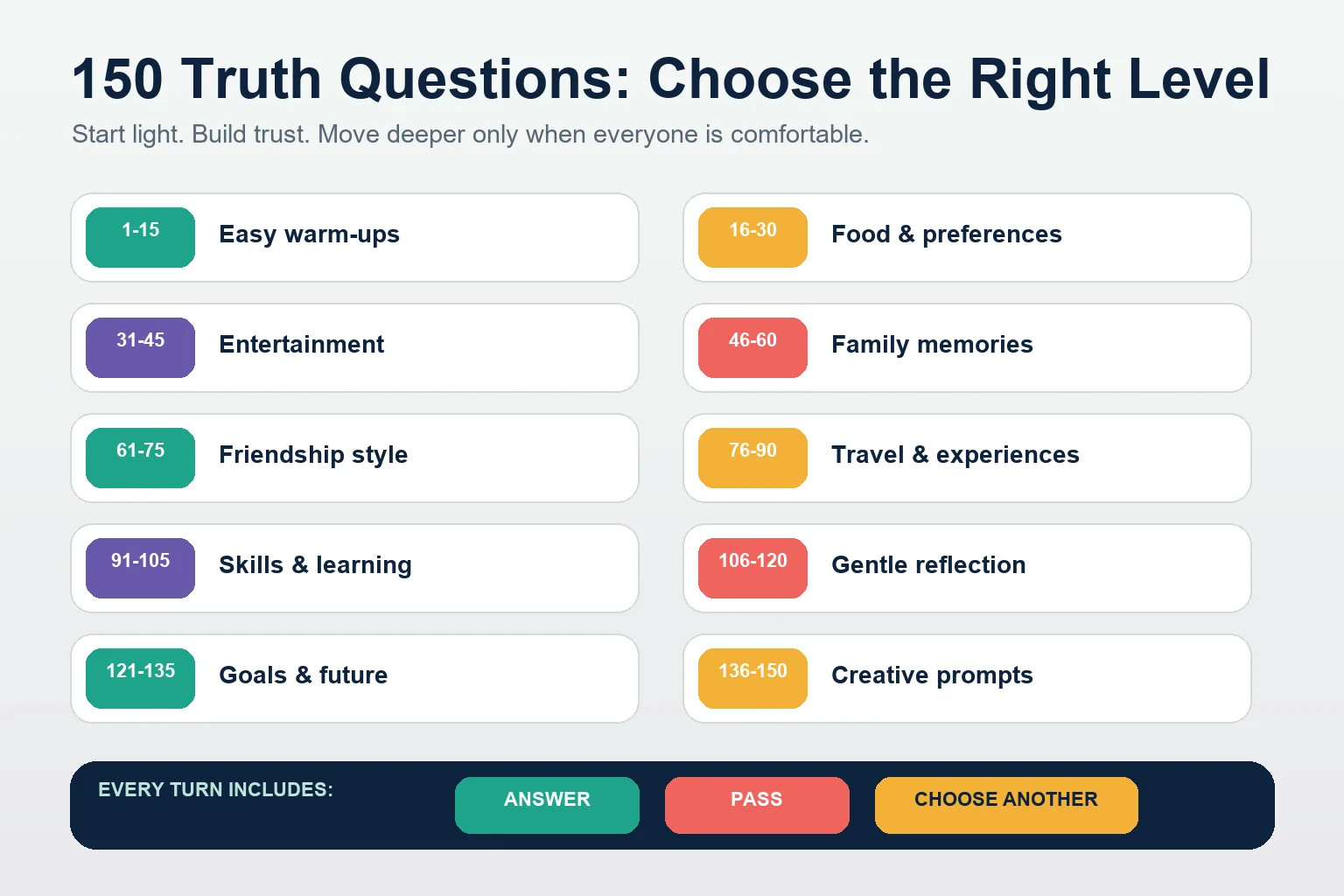
Truth questions are most enjoyable when they help people talk without turning privacy into a challenge. A useful prompt can reveal a funny habit, favourite memory or thoughtful preference. A poor prompt can pressure someone to discuss relationships, money, health or a painful event in front of people they do not fully trust.
This collection contains 150 original questions divided into ten categories. Begin with light prompts and move deeper only when the group is comfortable. Anyone may pass, change the question or leave the round without explaining why. For a complete game structure, review the Truth or Dare rules before playing.
Choose the right question level
Do not shuffle every category together. A family lunch, college group and close-friends evening need different boundaries.
| Level | Suitable categories | Best setting | Host caution |
|---|---|---|---|
| Very light | Quick choices, everyday habits | New or mixed group | Keep answers short and neutral |
| Light | Food, entertainment, travel | Family, office or casual party | Avoid judging taste or spending |
| Friendly | Memories, skills, friendship | People with some shared trust | Let players skip names and details |
| Reflective | Goals, values, lessons | Close friends or voluntary small group | Never demand an explanation |
| Creative | Imagination and hypothetical prompts | Any group after a warm-up | Keep scenarios safe and lawful |
The Truth or Dare tool can provide a random prompt, but the host should review the category and age suitability first.
1–15: Easy warm-up questions
- 1. What is the first app you usually open in the morning?
- 2. Which snack disappears fastest when it is placed near you?
- 3. What small task do you postpone even though it takes five minutes?
- 4. Which colour appears most often in your wardrobe?
- 5. What is your most-used word or expression this week?
- 6. Which household item do you misplace most frequently?
- 7. What is the last thing that made you laugh unexpectedly?
- 8. Do you usually arrive early, exactly on time or slightly late?
- 9. What simple thing can improve your mood quickly?
- 10. Which season fits your personality best?
- 11. What food combination do you enjoy that others might question?
- 12. Which everyday sound do you find especially satisfying?
- 13. What is one harmless habit you have while watching television?
- 14. Which emoji do you use more than you realise?
- 15. What is one item you almost always carry?
These questions work for arrivals and mixed groups. Keep answers optional and avoid turning an ordinary preference into a personality judgement.
16–30: Food and everyday preferences
- 16. Which meal could you happily eat twice in one week?
- 17. What dish do you enjoy cooking more than eating?
- 18. Which popular food do you personally not enjoy?
- 19. What is your ideal rainy-day drink?
- 20. Do you read a menu fully or choose a familiar option?
- 21. What food reminds you of a comfortable day at home?
- 22. Which kitchen skill would you like to learn?
- 23. What is the best snack for a long journey?
- 24. Which ingredient do you add more generously than a recipe suggests?
- 25. Would you rather host breakfast, lunch or dinner?
- 26. What is one food you began enjoying only recently?
- 27. Which homemade dish would you choose over a restaurant version?
- 28. What is your most practical cooking shortcut?
- 29. Which dessert do you prefer in a small portion?
- 30. What food would you pack for a picnic with friends?
Do not comment on how much someone eats, their body, allergies or medical diet. A player may answer with a drink or non-food preference.
31–45: Entertainment and internet habits
- 31. Which film or series have you rewatched most often?
- 32. What song can change your energy within a minute?
- 33. Which fictional character would make a reliable neighbour?
- 34. What type of video do you watch longer than planned?
- 35. Which book would you like to read again for the first time?
- 36. What is the last useful thing you learned online?
- 37. Which game do you become unexpectedly competitive about?
- 38. Do you prefer subtitles, dubbing or the original language when possible?
- 39. Which old entertainment trend would you welcome back?
- 40. What is one notification you should probably turn off?
- 41. Which playlist mood do you choose most frequently?
- 42. Have you ever pretended to know a popular film you had not seen?
- 43. Which type of story immediately holds your attention?
- 44. What is the longest break you have taken from social media?
- 45. Which online recommendation actually improved your daily life?
Do not ask players to open their phones, show histories, reveal private accounts or prove an answer.
46–60: Family-friendly memories
- 46. What game did you enjoy most as a child?
- 47. Which school-day lunch do you remember clearly?
- 48. What was a small responsibility that made you feel grown-up?
- 49. Which family or community celebration memory makes you smile?
- 50. What was your favourite place to sit at home as a child?
- 51. Which childhood hobby would you enjoy trying again?
- 52. What is the earliest journey you remember?
- 53. Which teacher’s practical lesson stayed with you?
- 54. What harmless rule did you misunderstand when you were young?
- 55. Which object from your childhood would you like to see again?
- 56. What was your favourite way to spend a free afternoon?
- 57. Which old photograph would you like to know more about?
- 58. What skill did an older relative or neighbour teach you?
- 59. Which childhood trend now seems funny?
- 60. What is one tradition you enjoy continuing in your own way?
Players can speak generally without naming relatives. Avoid grief, conflict, punishment and family secrets unless a person chooses the subject independently.
61–75: Friendship and social style
- 61. What quality helps you trust a new friend?
- 62. Are you more likely to organise a plan or join one?
- 63. What kind of message are you happiest to receive unexpectedly?
- 64. What small action makes you feel welcomed in a group?
- 65. When do you find it easiest to meet new people?
- 66. What is one thing a good host does quietly?
- 67. Which shared activity helps you know someone better?
- 68. Do you prefer a large gathering or a small conversation?
- 69. What is a thoughtful favour someone once did for you?
- 70. What social plan do you enjoy more after you arrive than before?
- 71. How do you usually show appreciation to a friend?
- 72. What makes a group chat useful rather than tiring?
- 73. Which kind of invitation is easiest for you to accept?
- 74. What friendly boundary have you learned to communicate?
- 75. What does a comfortable silence with someone feel like to you?
Do not use these questions to identify a “best” or “worst” person in the room. Answers may describe behaviours without naming anyone.
76–90: Travel and new experiences
- 76. What place would you revisit mainly for its atmosphere?
- 77. Which travel item have you learned not to forget?
- 78. Do you plan every day of a trip or leave open time?
- 79. What is the most useful local tip you have received while travelling?
- 80. Which kind of journey—road, rail, air or walking—do you enjoy most?
- 81. What nearby place have you postponed exploring?
- 82. Which travel mistake taught you a practical lesson?
- 83. What makes accommodation feel comfortable to you?
- 84. What food do you like trying in a new place?
- 85. Which trip photograph means more to you than it looks?
- 86. Would you choose an active holiday or a restful one today?
- 87. What is the earliest you have packed before a journey?
- 88. Which weather do you prefer for exploring a city?
- 89. What is one respectful travel habit everyone should practise?
- 90. Which fictional place would you safely visit for one day?
Keep travel questions free from assumptions about passports, money or previous opportunities. A nearby park or imagined journey is a complete answer.
91–105: Skills, work and learning
- 91. Which skill looked easy until you tried it?
- 92. What is something you learned mainly through practice?
- 93. Which piece of everyday technology would you like to understand better?
- 94. What type of explanation helps you learn fastest?
- 95. Which useful task can you now do much quicker than before?
- 96. What subject would you study for fun with no exam?
- 97. What is one mistake that improved your method?
- 98. Which skill would you happily teach a beginner?
- 99. Do you prefer learning alone, with a teacher or in a group?
- 100. What small achievement are you quietly proud of?
- 101. Which tool or system keeps you organised?
- 102. What advice would you give yourself before starting a difficult project?
- 103. Which task requires more creativity than people assume?
- 104. What is one question you have become better at asking?
- 105. Which learning habit would you like to restart?
In workplace groups, keep answers separate from performance evaluation, salary, job security and confidential projects. Managers should not pressure employees to participate.
106–120: Gentle self-reflection
- 106. What helps you recover after an unusually busy day?
- 107. Which small decision has made your routine easier?
- 108. What do you appreciate more now than five years ago?
- 109. When are you most likely to ask for help?
- 110. What is one opinion you changed after learning more?
- 111. Which personal rule protects your time or energy?
- 112. What kind of compliment do you remember longest?
- 113. What is something you no longer need to do perfectly?
- 114. Which ordinary moment makes you feel present?
- 115. What does a genuinely restful day include?
- 116. Which habit would you prefer to make simpler rather than bigger?
- 117. What is one useful lesson you learned slowly?
- 118. Which responsibility do you handle better with a written plan?
- 119. What helps you make a difficult choice calmly?
- 120. What would you like to notice more often in daily life?
These questions can feel personal. Use them only after the group has established trust, and do not request reasons or examples after a short answer.
121–135: Goals and the future
- 121. What skill would you like to practise for ten minutes a week?
- 122. Which place would you like to know more deeply rather than visit quickly?
- 123. What would make your next month feel well balanced?
- 124. Which household system would you like to improve?
- 125. What kind of creative project would you start with unlimited time?
- 126. Which friendship habit would you like to protect?
- 127. What would you like to become more confident asking?
- 128. Which future celebration would you enjoy planning?
- 129. What is one realistic experience you hope to try?
- 130. Which item would you like to repair instead of replace?
- 131. What topic would you like to understand by next year?
- 132. Which daily inconvenience would you invent a solution for?
- 133. What would your ideal community space include?
- 134. Which positive routine would you share with a friend?
- 135. What would make future-you grateful for something you did this week?
Goals are not promises. Do not track answers, demand progress reports or compare ambition between players.
136–150: Creative and hypothetical truths
- 136. If your week had a title, what would it be?
- 137. Which ordinary object best represents your current mood?
- 138. If you designed a new holiday, what would people do?
- 139. Which three sounds would appear in a soundtrack of your day?
- 140. If your home had one secret, practical room, what would it contain?
- 141. Which fictional job would you try for one week?
- 142. If you could rename one everyday task, what would you call it?
- 143. Which animal would be the best organiser of a party?
- 144. If your favourite meal were a weather forecast, what would it predict?
- 145. Which harmless superpower would make your mornings easier?
- 146. If you opened a tiny museum, what would it display?
- 147. Which object would narrate the funniest story about your home?
- 148. If your group invented a board game, what would the goal be?
- 149. Which imaginary award would you genuinely have a chance to win?
- 150. If tonight became a postcard, what short message would it carry?
Creative prompts are useful when the group wants conversation without personal disclosure. Accept one-word or purely fictional answers.
How to run the question round
Choose one category that fits the group and copy only ten to fifteen questions into the game deck. Put “Pass” and “Choose Another” cards into the same deck. Draw with the Random Name Picker only among people who have opted in, or let turns move around the table.
| Group size | Recommended format | Question count |
|---|---|---|
| 3 to 6 | One question per person, open follow-up by permission | 6 to 12 |
| 7 to 15 | Small circles of 3 to 5 | 10 to 20 per circle |
| 16 to 40 | Table decks with one facilitator | 10 to 15 per table |
| More than 40 | Anonymous voting or selected volunteers | 5 to 8 shared prompts |
Do not make every answer public in a large room. Small circles produce more genuine and safer conversation.
Questions to exclude
Remove prompts about passwords, private messages, exact income, debt, medical history, trauma, sexual experiences, illegal acts, family conflict, workplace secrets or another person’s private information. Do not ask a player to identify the “most annoying,” “least attractive” or “worst” person present.
For younger players, an adult should review every prompt and use only light categories. A child’s pass must be accepted immediately.
Use a clear consent script
The host can say: “You may answer, pass or draw a different question. No explanation is needed, and nobody may pressure you for details. Please do not name another person in a sensitive story.” Repeat the rule when new guests join.
If an answer changes the mood or reveals distress, pause the game and move to a neutral activity. Use the complete host checklist for broader preparation, and repeat the boundary rules whenever new players join.
Final takeaway
Good truth questions create curiosity without making privacy the price of participation. Start with warm-ups, choose a category that matches the group and offer Pass and Choose Another every time. Never ask players to prove an answer or expose somebody else.
This list contains exactly 150 original prompts, but a successful round may use only ten. The right question is not the most shocking one; it is the one the group can answer comfortably and enjoy discussing.