Tambola becomes confusing when a host announces a prize name but does not define its exact rule. “Corners” may mean four printed corner numbers in one game and the first and last number of each row in another. “Early Five” may stop after one claim or remain open for several winners. A fair game begins with written pattern definitions before the first number is called.
This guide explains common Tambola winning patterns and practical validation. It assumes a standard 90-number ticket with three rows, nine columns and fifteen printed numbers. House rules differ, so the host’s pre-announced definition controls the game. Tambola should remain low-stakes entertainment and must follow applicable local rules.
Understand the ticket layout
A standard ticket has three horizontal rows. Each row contains five numbers and four blank spaces. The left columns generally contain lower number ranges and the right columns higher ranges. Players mark a printed number only after the caller announces it.
| Ticket feature | Standard description | Why it matters |
|---|---|---|
| Rows | Three | Top, middle and bottom line use separate rows |
| Columns | Nine | Some custom patterns refer to columns |
| Printed numbers | Fifteen total | Full House requires all fifteen |
| Numbers per row | Five | A line claim needs all five in that row |
| Blank spaces | Twelve | Blanks never need marking |
| Caller pool | 1 to 90 | Each number should be called once |
Read the complete Tambola rules guide before introducing extra patterns.
A sample ticket for examples
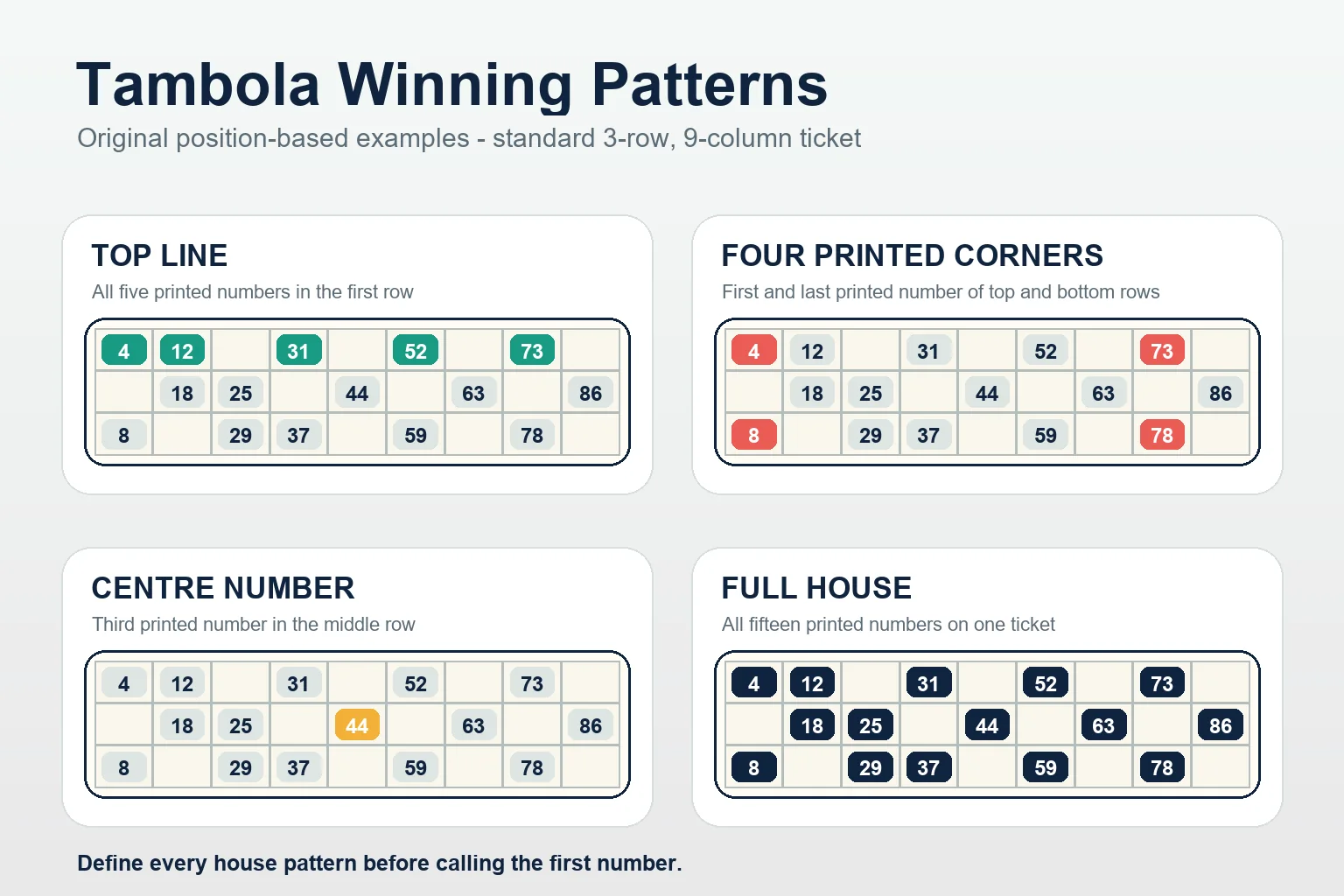
The simplified ticket below is original and used only to explain pattern positions. A dash represents a blank space.
| Row | C1 | C2 | C3 | C4 | C5 | C6 | C7 | C8 | C9 |
|---|---|---|---|---|---|---|---|---|---|
| Top | 4 | 12 | — | 31 | — | 52 | — | 73 | — |
| Middle | — | 18 | 25 | — | 44 | — | 63 | — | 86 |
| Bottom | 8 | — | 29 | 37 | — | 59 | — | 78 | — |
For this ticket, the top line consists of 4, 12, 31, 52 and 73. Blank positions do not count. When a pattern refers to ticket corners, the host must say which printed positions qualify.
Early Five
Early Five is completed when any five printed numbers on a ticket have been called. They may appear in any rows or columns. The player does not need a line.
Example: if 4, 18, 31, 63 and 78 have been called on the sample ticket, the ticket has five valid marks and may claim Early Five. A sixth called number does not invalidate the pattern if the host allows claims until another number is announced; the claim-timing rule must be clear.
Early Seven
Early Seven follows the same logic but requires any seven called numbers on one ticket. It makes the early prize last longer in a larger group.
Hosts usually choose Early Five or Early Seven, not both, unless the prize list and timing can support two separate milestones.
Top Line
Top Line requires all five printed numbers in the first row. On the sample ticket those are 4, 12, 31, 52 and 73. Numbers in the middle and bottom rows do not affect this claim.
The validator should check each of the five top-row numbers against the called-number log.
Middle Line
Middle Line requires all five printed numbers in the second row: 18, 25, 44, 63 and 86 on the sample ticket. Blank spaces are ignored.
Do not accept four numbers simply because the fifth position looks blank; every standard row has five printed numbers.
Bottom Line
Bottom Line requires all five printed numbers in the third row: 8, 29, 37, 59 and 78 in the example.
For all line prizes, announce whether multiple players may share the prize when valid claims occur on the same called number.
Any Line
Any Line is won when a player completes one of the three rows. If the game also offers separate Top, Middle and Bottom Line prizes, do not add Any Line unless the host explains how overlaps work.
For example, a Top Line claim might also technically satisfy Any Line. The rules should state whether one ticket can win both prizes on the same pattern.
Four Corners: printed-corner method
One common definition uses the leftmost and rightmost printed number in the top row plus the leftmost and rightmost printed number in the bottom row. On the sample ticket, these are 4, 73, 8 and 78.
This method follows printed positions, not fixed grid cells. It works even when the first or ninth column in a row is blank.
Four Corners: grid-corner method
Some hosts define corners as the four literal grid cells at top-left, top-right, bottom-left and bottom-right. This creates problems because one or more corner cells may be blank on a valid ticket.
If using grid corners, explain how blanks are treated. The printed-corner method is usually clearer and gives every ticket four actual numbers.
Full House
Full House requires all fifteen printed numbers on the ticket. It is usually the main prize. The validator must check every number against the call log.
Large games often offer First Full House, Second Full House and Third Full House. These are separate valid tickets completed in chronological order, not the first, second and third rows of one ticket.
Second Full House
Second Full House opens only after the first valid Full House has been accepted. Continue calling until another ticket completes all fifteen numbers.
State whether the first winning ticket is removed from later Full House prizes. The clearest default is one Full House prize per ticket.
Breakfast, Lunch and Dinner
This custom pattern divides the ticket by rows: top as Breakfast, middle as Lunch and bottom as Dinner. In many games, completing the named row wins the corresponding prize, making it another name for the line prizes.
Other groups use different definitions. Write the five required positions or say explicitly that the named row must be complete.
Temperature: Highest and Lowest
“Highest” may mean the ticket’s largest printed number, while “Lowest” means its smallest. The ticket wins when that specific number is called. On the sample ticket, Lowest is 4 and Highest is 86.
This pattern can produce many simultaneous winners because every ticket’s extreme number may be called at different times. Decide whether the first valid claim closes the prize.
King’s Corner and Queen’s Corner
These names do not have one universal definition. A host might use the top two printed corners for King’s Corner and bottom two for Queen’s Corner, or assign different ticket positions.
Never announce only the name. Show a diagram or list the required positions. Use neutral alternative names such as Top Pair and Bottom Pair if that is clearer for the group.
Star Pattern
A Star is usually a custom five-number shape chosen from ticket positions: often four printed corners plus the centre printed number of the middle row. Standard tickets do not always place a number in the literal centre grid cell, so the host must define “centre.”
A fair definition can use the middle row’s third printed number, regardless of column. On the sample ticket, that would be 44, combined with 4, 73, 8 and 78.
Centre Number
The Centre Number prize requires one pre-defined position, commonly the third printed number in the middle row. On the sample ticket, the middle-row printed sequence is 18, 25, 44, 63, 86, so the centre is 44.
This printed-order method works on every valid ticket and is clearer than using grid cell row two, column five.
Full Column
A Full Column requires every printed number in one specified ticket column to be called. Some columns contain one, two or three printed numbers, which makes difficulty uneven.
For fairness, announce a particular column and use tickets known to have the same number of printed entries there, or require a column containing all three numbers.
Three Verticals
This custom prize may require three completed columns, but definitions vary. Because columns contain different numbers of printed cells, display the exact qualifying rule and a sample ticket.
Avoid a vague “three lines down” instruction. Tambola tickets are not identical five-by-five bingo cards.
Pyramid Pattern
A Pyramid can use one printed number from the top row, three from the middle and five from the bottom, selected by printed order rather than grid cells. The reverse version uses five, three and one.
List every required printed position: for example, top third; middle second through fourth; all bottom-row numbers. Confirm that the pattern works on every ticket format being sold or distributed.
Letter H
An H pattern may use all five numbers in the top row, all five in the bottom row and the middle-row centre number. That is eleven required numbers when printed-order positions are used.
Because the visual shape on a nine-column ticket may not resemble a perfect H, show the pattern diagram and required count.
Letter L
A common L uses the leftmost printed number in each row plus all five numbers of the bottom row. Since the bottom-left number belongs to both parts, the pattern normally contains seven unique numbers.
Confirm that “leftmost” means the first printed number in each row, not the first grid column.
Letter T
A T can use all five top-row numbers plus the middle printed number of both the middle and bottom rows. That produces seven unique positions.
Like other letter shapes, it is a house rule. Draw it on an original sample ticket instead of relying on the prize name.
Railway Lines
Some games use the first and last column numbers, while others use the top and bottom rows. The name is not standard enough for validation.
Rename the prize according to its actual rule—Outer Pairs, Top-and-Bottom or Edge Numbers—or publish a diagram before play.
Couple or Pair Pattern
A Pair may require two adjacent printed numbers in one row, a specific first-and-last pair or two tickets held by partners. These are different games.
If the prize is for two people, state whether both tickets must complete the same pattern and whether one person may hold both tickets.
Number Range Pattern
The host chooses a range such as 1–30, and the ticket wins when all its printed numbers within that range are called. Tickets may contain different quantities in the range, so difficulty is not equal.
For casual fun this may be acceptable, but disclose the variation. A fixed-position pattern is fairer for meaningful prizes.
Odd or Even Pattern
A ticket completes the pattern when all its printed odd numbers or all its printed even numbers have been called. The number of required marks varies by ticket.
Count qualifying numbers on every ticket before the game if prizes are significant. Otherwise use it only as a light house pattern.
Pattern difficulty comparison
| Pattern | Typical required marks | Difficulty | Validation risk |
|---|---|---|---|
| Highest or Lowest | 1 | Very early | Many simultaneous claims |
| Early Five | 5 anywhere | Early | Count marks carefully |
| Four Printed Corners | 4 fixed positions | Early to middle | Define printed corners |
| Centre Number | 1 fixed position | Early | Define centre by printed order |
| One Line | 5 in one row | Middle | Easy to validate |
| Letter L | Usually 7 unique positions | Middle | Needs a diagram |
| Letter H | Usually 11 positions | Late | Needs exact position list |
| Full House | 15 | Late | Check entire call log |
Choose patterns that finish at different stages. Offering several one-number prizes can close too quickly, while several large shapes may remain open after the Full House.
Build a balanced prize list
A simple home game might use Early Five, Top Line, Middle Line, Bottom Line and Full House. A longer club game can add Four Printed Corners and Second Full House. Add only patterns the caller can explain and validate.
Set the prize limit before shopping with the party budget calculator so the value of later prizes does not depend on how much money remains.
| Game length | Suggested prizes |
|---|---|
| 15 to 25 minutes | Early Five, Any Line, Full House |
| 30 to 45 minutes | Early Five, Three Lines, Four Corners, Full House |
| 45 to 60 minutes | Early Seven, Three Lines, Four Corners, Letter L, First and Second Full House |
| Beginner game | Early Five, Top Line, Bottom Line, Full House |
| Children’s supervised game | Picture labels for Early Five, One Line and Full House; non-cash prizes |
Use the Tambola Caller for a visible casual number sequence, but keep a separate written claim log when prizes matter.
Announce every rule before the first call
For each prize, state its name, required positions, number of winners, claim deadline, tie rule and whether one ticket can win more than once. Show a sample ticket on paper or screen.
A useful announcement is: “Four Corners means the first and last printed number in the top row and the first and last printed number in the bottom row. The first valid claim closes the prize. Claims must be made before the next number is called.”
Validate a claim step by step
Pause calling when a claim is heard. Ask for the ticket identifier and pattern. Read the required numbers, then compare each with the called-number log. Confirm that the ticket was eligible and the prize was still open.
| Validation step | Check |
|---|---|
| 1 | Claim was made within the announced time |
| 2 | Ticket identifier is valid for this game |
| 3 | Claimed pattern uses the correct positions |
| 4 | Every required number appears in the call log |
| 5 | No uncalled number was marked as required |
| 6 | Prize is still open under the winner limit |
| 7 | Result and call number are recorded |
Announce “valid” or “invalid” calmly and explain the specific reason. Do not continue calling during validation.
Handle simultaneous claims
Two players may complete a pattern on the same called number. Decide whether the prize is shared, duplicated or decided by a pre-announced random tie-break. Sharing is often the simplest social rule.
For a casual low-value tie, the Random Name Picker can display the eligible claimants before one name is drawn. Confirm the list openly and do not use an improvised draw for regulated or high-value contests.
Never change the tie method after seeing who claimed. For higher-value prizes, use written terms and appropriate legal guidance.
False and late claims
A false claim usually means one required number was not called. In a family game, reject the claim without humiliation and continue. A late claim occurs after the stated deadline, often after the next number has been called.
Explain claim timing before play. Avoid penalties unless they were written in advance; losing the invalid claim is usually enough.
Digital and online Tambola
For remote games, show the called-number history and pause audio during validation. Players can send a ticket ID or clear image through the agreed private channel. Do not expose phone numbers or personal profiles to the group.
Test screen sharing and delay before the game. The caller’s server-side or agreed official call log should control disputes, not a participant’s delayed stream.
Review equipment, cables, seating and contact arrangements with the complete party host checklist before an in-person session.
Common pattern mistakes
The most common error is assuming a prize name has one universal definition. Other mistakes include treating blanks as required, validating from memory, accepting a repeated ticket image, keeping the winner limit secret and continuing to call while checking a claim.
Use written definitions and a claim sheet. A simple game with five clear prizes is better than twenty confusing ones.
Final takeaway
Tambola winning patterns are fair only when their required positions are defined before play. Early Five, the three Lines, printed Four Corners and Full House are easy for beginners. Letter shapes and range patterns need diagrams because ticket layouts differ.
Announce the winner limit and claim timing, pause the caller during checks and validate every required number against the same call log. Clear rules protect the fun far better than an impressive list of prize names.